

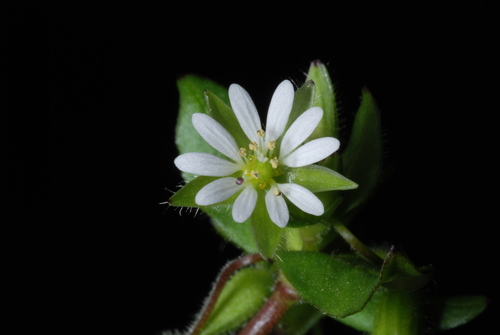
Common Chickweed
Stellaria media
Found in disturbed areas, gardens, fields, bottomlands, moist forests. Weakley, Flora of the Southeastern United States (2025), Northern Tier edition What its natural habitat tells you
Not native to West Virginia. How scores work Is it native here?
Profile 82%
- Height
- 4–20 inches
- Spread
- 4–12 inches
- Light
- Full sun, Partial shade
- Soil moisture
- Usually moist
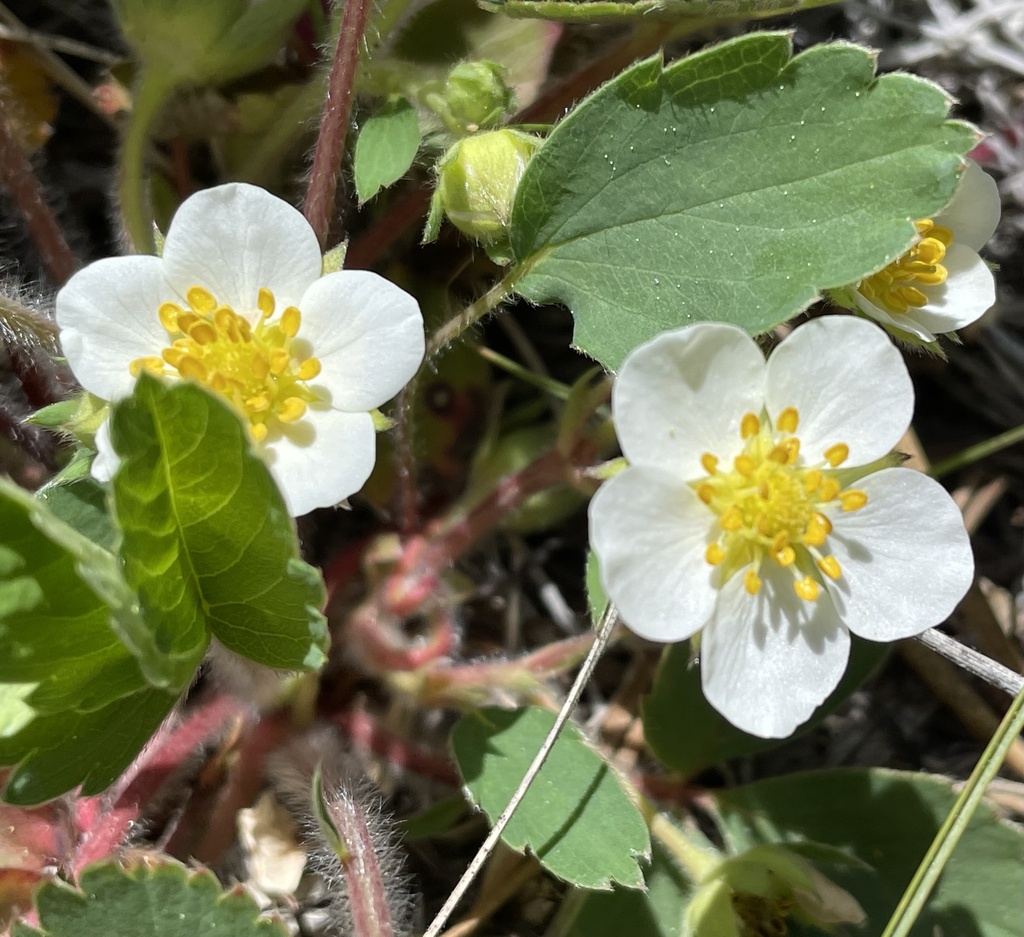
Plant this instead
Choose your county to list local plants first.

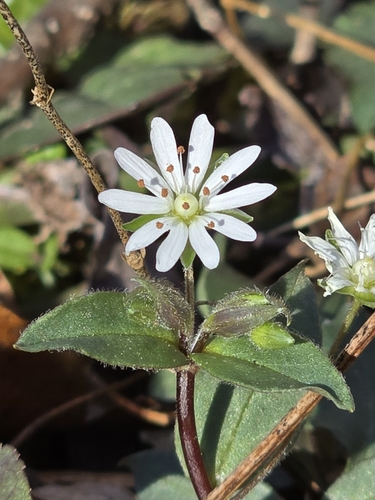
No recorded swaps for this county. Try the garden finder.
At a glance
- Life cycle
- Annual
- Leaves
- Deciduous or semi-evergreen
- Bloom
- January to December
Recorded in 18 West Virginia counties.
Natural habitats
Places it grows wild. Not a planting requirement. Each habitat page lists the plants and wildlife also found there.
Roadsides, fields and disturbed ground
Ground opened by people: roadsides, old fields, pastures, fencerows and lots.
Floodplain and bottomland forests
Forests on low ground beside rivers and streams that flood from time to time.
Forests on moist but not wet ground, such as rich slopes and ravines.
Also found with this plant
Wildlife whose habitat models include habitats this plant grows in, in West Virginia. Shared habitat, not food. 146 animals.
- Belted KingfisherMegaceryle alcyon
- Chimney SwiftChaetura pelagica
- Common NighthawkChordeiles minor
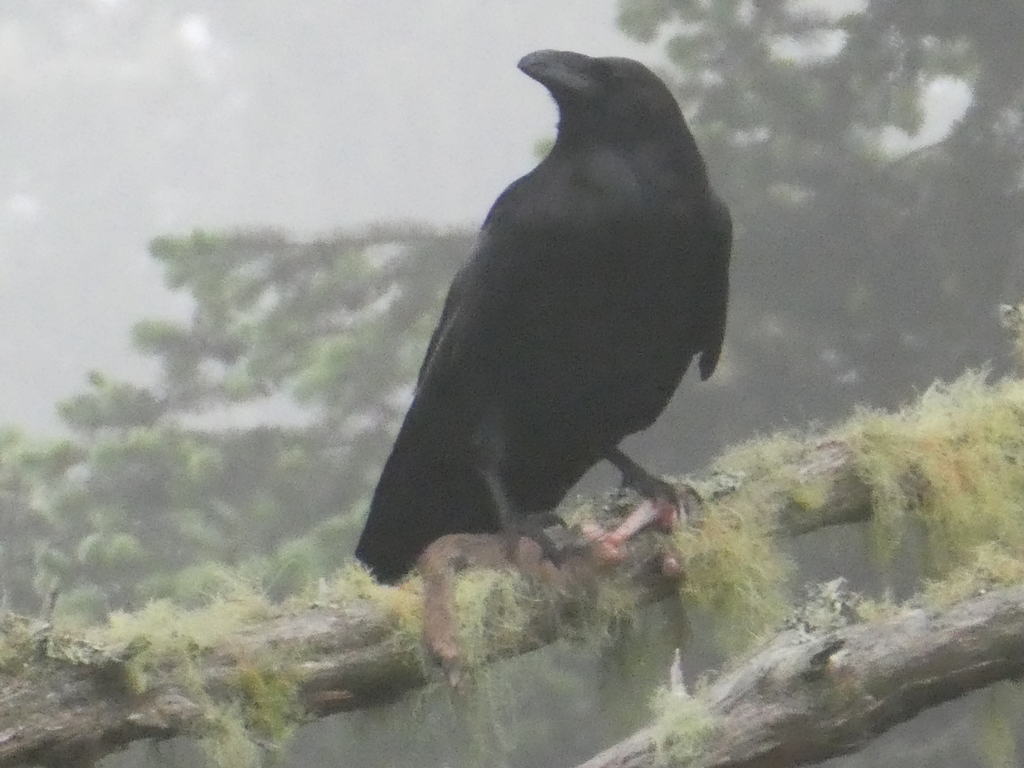
- Common RavenCorvus corax
- Eastern KingbirdTyrannus tyrannus
- European StarlingSturnus vulgaris
- Great Horned OwlBubo virginianus
- Mourning DoveZenaida macroura
- Red-tailed HawkButeo jamaicensis
- Sharp-shinned HawkAccipiter striatus
- Turkey VultureCathartes aura
- Acadian FlycatcherEmpidonax virescens
- Alder FlycatcherEmpidonax alnorum
- American CrowCorvus brachyrhynchos
- American GoldfinchCarduelis tristis
- American KestrelFalco sparverius
- American RedstartSetophaga ruticilla
- American RobinTurdus migratorius
- Bald EagleHaliaeetus leucocephalus
- Black-and-White WarblerMniotilta varia
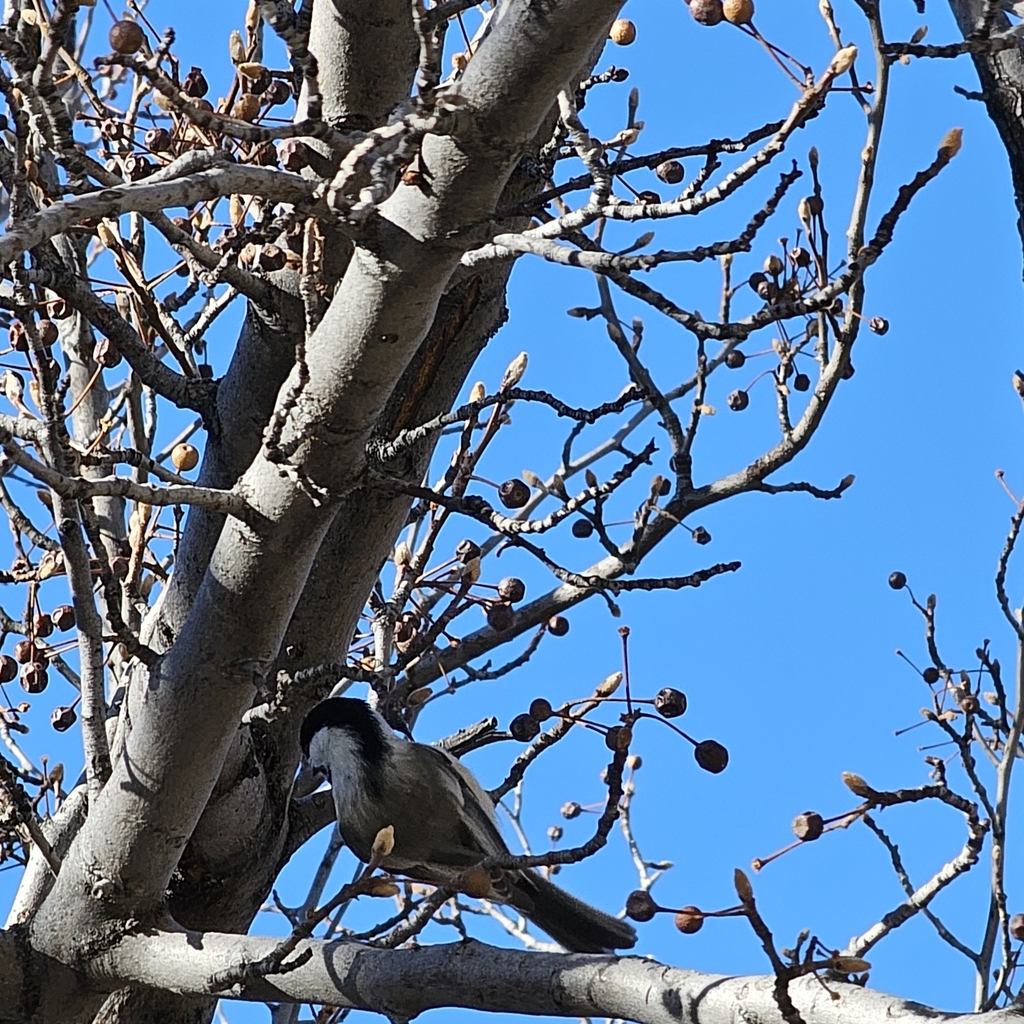
- Black-capped ChickadeePoecile atricapillus
- Blue GrosbeakPasserina caerulea
- Blue JayCyanocitta cristata
- Blue-gray GnatcatcherPolioptila caerulea






















Who uses this plant?
 14CaterpillarsGenus host records with ranges including WV
Genus host records with ranges including WV · Stellaria
- Agnorisma badinodisPale-Banded Dart
- Agrotis venerabilisVenerable Dart, Dusky Cut-Worm
- Elaphria grataGrateful Midget
- Euphyia intermediataSharp-Angled Carpet Moth, The Intermediate
- Feltia jaculiferaDingy Cutworm
- Haematopis gratariaChickweed Geometer
- Hyles lineataWhite-Lined Sphinx
- Lacinipolia renigeraBristly Ground Cat, Bristly Cutworm Moth, Kidney Spotted "Mamestra"
- Lobocleta ossulariaDrab Brown Wave
- Xanthorhoe ferrugataRed Twin-Spot, Twin-Spot Carpet
Show all 14
- Xestia c-nigrumSpotted Cut-Worm, Setaceous Hebrew Character, Lesser Black-letter Dart
- Xestia dolosaGreater Black-Letter Dart, Greater Spotted Cutworm
- Xestia smithiiSmith's Dart
- Caryocolum cassella
 —BeesSoutheastern regional records
 —Specialist beesPollen specialists
 18BirdsRecorded genus food-resource interactions; not a state feeding claim
Recorded genus food-resource interactions; not a state feeding claim · Stellaria
- Agelaius tricolorTricolored Blackbird
- Anser rossiiRoss's Goose
- Anthus rubescensAmerican Pipit
- Callipepla californicaCalifornia Quail
- Haemorhous mexicanusHouse Finch
- Junco hyemalisDark-eyed Junco
- Lagopus leucuraWhite-tailed Ptarmigan
- Melospiza melodiaSong Sparrow
- Melozone crissalisCalifornia Towhee
- Oreortyx pictusMountain Quail
Show all 18
- Passer domesticusHouse Sparrow
- Pheucticus melanocephalusBlack-headed Grosbeak
- Pipilo maculatusSpotted Towhee
- Spinus psaltriaLesser Goldfinch
- Spizella passerinaChipping Sparrow
- Turdus migratoriusAmerican Robin
- Zonotrichia atricapillaGolden-crowned Sparrow
- Zonotrichia leucophrysWhite-crowned Sparrow
Direct food only: birds recorded eating this genus across North America. Caterpillars on host plants also feed nesting birds. NC Native Plant Society: butterfly gardening
Plant details
- Family
- Caryophyllaceae
- Hardiness
- Zones 4a–11b
- Soil pH
- Acidic to neutral
- Flower color
- White
Safety has not been reviewed for this plant; check toxicity and thorns before planting.
Growing sources and scope
- Bloom · “January to December” · Weakley, Flora of the Southeastern United States (2025), Carolinas & Georgia edition · Carolinas and Georgia
- Flower color · “White” · NC Extension Plant Toolbox
- Hardiness · “Zones 4a–11b” · NC Extension Plant Toolbox
- Height · “4–20 inches” · NC Extension Plant Toolbox (ranked first; Minnesota Wildflowers differs)
- Leaves · “Deciduous or semi-evergreen” · NC Extension Plant Toolbox
- Life cycle · “Annual” · NC Extension Plant Toolbox (ranked first; Minnesota Wildflowers differs)
- Light · “Full sun (6 or more hours of direct sunlight a day); Partial shade (direct sunlight only part of the day, 2-6 hours)” · NC Extension Plant Toolbox
- primary_flower_color · “white” · NC Extension Plant Toolbox
- Soil · “Occasionally wet” · NC Extension Plant Toolbox
- Soil pH · “Acidic to neutral” · NC Extension Plant Toolbox
- Spread · “4–12 inches” · NC Extension Plant Toolbox
Conservation status
| West Virginia rank | SNA |
|---|---|
| Global rank | GNR |
| WV status | Not verified |
| Federal status | Not verified |
Sources
- NatureServe Explorer
- USDA PLANTS
- Weakley, Flora of the Southeastern United States (2025), Carolinas & Georgia edition
- West Virginia occurrence source
- Shropshire & Tallamy 2025, Lepidoptera of North America north of Mexico, ZooKeys 1261 (ODbL)
- Noori, Seltmann & Orr 2026, A curated and integrated dataset for exploring global bee-plant interactions (GloBI), Zenodo, CC BY 4.0
- Smith, Bachelder, Russell, Morales, Mosher & Seltmann 2024, Bee-Specialization-Modeling v0.6.1 (specialist host table compiled from J. Fowler's pollen specialist bee lists), Zenodo, CC BY 4.0
- Hurlbert, Olsen, Sawyer & Winner 2021, Avian Diet Database, Scientific Data 8: 260 (CC0)
- Narango, Tallamy & Shropshire 2020, Few keystone plant genera support the majority of Lepidoptera species, Nature Communications