

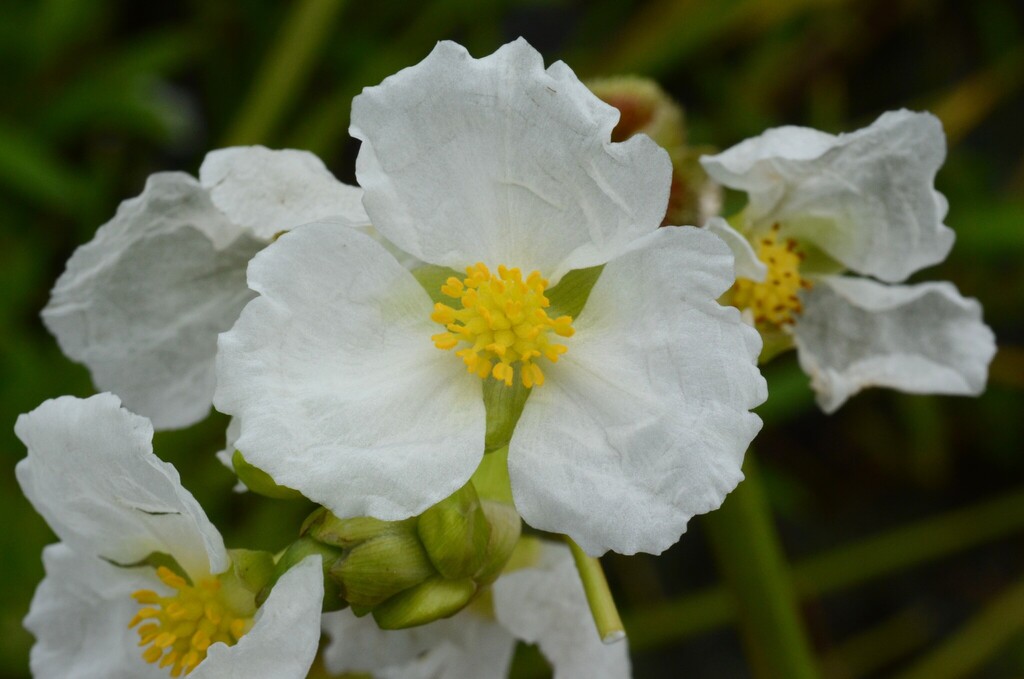
Sessile Fruit Arrowhead
Sagittaria rigida
Found in natural mountain ponds, wet meadows. Weakley, Flora of the Southeastern United States (2025), Northern Tier edition What its natural habitat tells you
Native status: sources disagree, under review. How scores work Is it native here?
Profile 65%
- Height
- 6 inches–2.5 feet
- Light
- 4 or more hours of direct sun
- Soil moisture
- Moist to wet
At a glance
- Life cycle
- Perennial
Not yet recorded · Spread · Leaves · Bloom
This plant is missing most of its facts, so Quercus is looking them up in old botany books.
Recorded in 1 West Virginia county.
Natural habitats
Places it grows wild. Not a planting requirement. Each habitat page lists the plants and wildlife also found there.
Still water and its edges: ponds, lakes, millponds and reservoirs.
Open, wet, grassy or sedgy ground that is not a bog.
Who uses this plant?
 6CaterpillarsGenus host records with ranges including WV
Genus host records with ranges including WV · Sagittaria
- Acronicta oblinitaSmeared Dagger
- Argyrogramma verrucaGolden Looper
- Bellura obliquaCattail Border Moth, Cattail Diver
- Elophila icciusalisPondside Pyralid, Pondside Crambid
- Elophila obliteralisWaterlily Leafcutter Moth
- Parapoynx obscuralisObscure Pondweed Moth
 —BeesSoutheastern regional records
 —Specialist beesPollen specialists
 11BirdsRecorded genus food-resource interactions; not a state feeding claim
Recorded genus food-resource interactions; not a state feeding claim · Sagittaria
- Aix sponsaWood Duck
- Anas platyrhynchosMallard
- Anser caerulescensSnow Goose
- Antigone canadensisSandhill Crane
- Aythya affinisLesser Scaup
- Aythya collarisRing-necked Duck
- Aythya valisineriaCanvasback
- Bucephala clangulaCommon Goldeneye
- Fulica americanaAmerican Coot
- Gallinula galeataCommon Gallinule
Show all 11
- Mareca americanaAmerican Wigeon
Direct food only: birds recorded eating this genus across North America. Caterpillars on host plants also feed nesting birds. NC Native Plant Society: butterfly gardening
Plant details
- Family
- Alismataceae
- Flower color
- White
Safety has not been reviewed for this plant; check toxicity and thorns before planting.
Growing sources and scope
- Flower color · “White” · Lady Bird Johnson Wildflower Center
- Height · “6 inches–2.5 feet” · Minnesota Wildflowers
- Life cycle · “Perennial” · Minnesota Wildflowers
- primary_flower_color · “white” · Lady Bird Johnson Wildflower Center
Conservation status
| West Virginia rank | SNA |
|---|---|
| Global rank | Not available |
| WV status | Not verified |
| Federal status | Not verified |
Will it fit your yard?
Check this plant against your county, sun and soil moisture. Conditions are checked in your browser.
Sources
- NatureServe Explorer
- Weakley, Flora of the Southeastern United States (2025), Northern Tier edition
- West Virginia occurrence source
- Shropshire & Tallamy 2025, Lepidoptera of North America north of Mexico, ZooKeys 1261 (ODbL)
- Noori, Seltmann & Orr 2026, A curated and integrated dataset for exploring global bee-plant interactions (GloBI), Zenodo, CC BY 4.0
- Smith, Bachelder, Russell, Morales, Mosher & Seltmann 2024, Bee-Specialization-Modeling v0.6.1 (specialist host table compiled from J. Fowler's pollen specialist bee lists), Zenodo, CC BY 4.0
- Hurlbert, Olsen, Sawyer & Winner 2021, Avian Diet Database, Scientific Data 8: 260 (CC0)
- Narango, Tallamy & Shropshire 2020, Few keystone plant genera support the majority of Lepidoptera species, Nature Communications