

Coral Honeysuckle
Lonicera sempervirens
A climbing native honeysuckle with red-orange trumpets visited by hummingbirds. Found in dry forests and woodlands, maritime forests. Weakley, Flora of the Southeastern United States (2025), Northern Tier edition What its natural habitat tells you
Native status: sources disagree, under review. How scores work Is it native here?
Profile 82%
- Height
- 10–20 feet with support
- Spread
- 3–6 feet
- Light
- Full sun, Partial shade
- Soil moisture
- Usually moist
Space about 4.5 ft apart from its recorded spread, about 5 per 100 sq ft. Enter your bed size for a count
Will it fit your yard?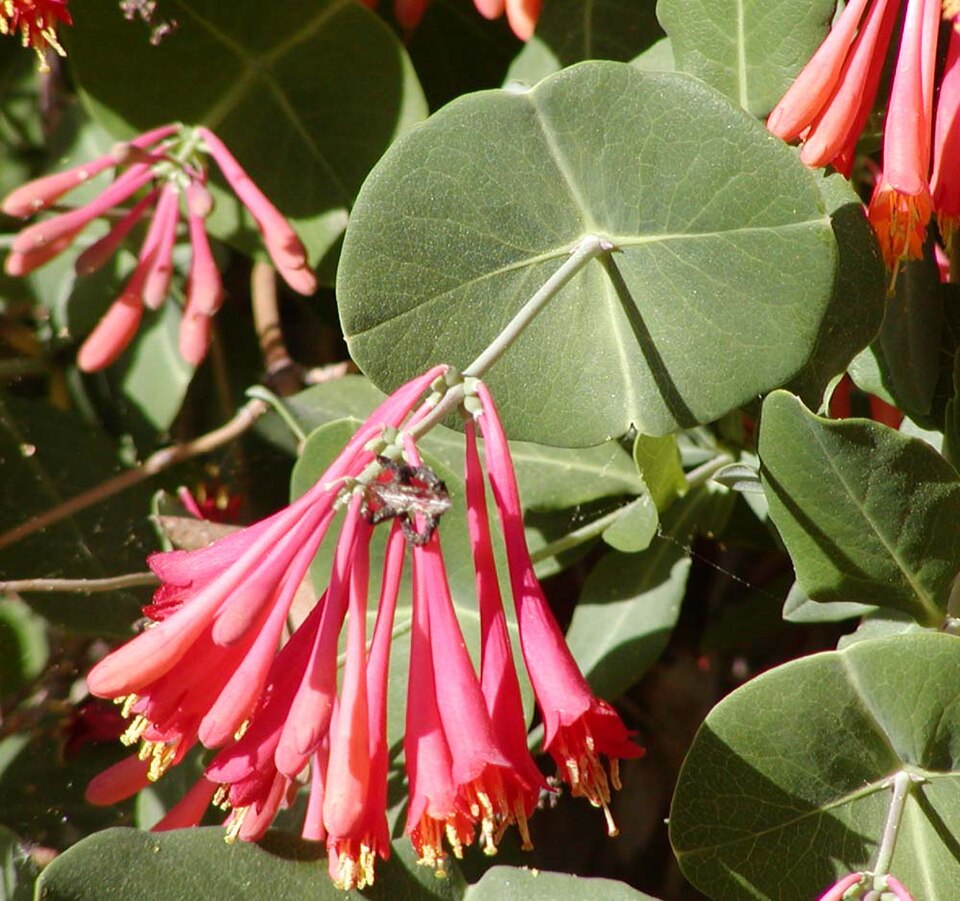

At a glance
- Life cycle
- Perennial twining vine
- Leaves
- Deciduous or evergreen
- Bloom
- March to July
- Fruiting season
- July to September
Recorded in 1 West Virginia county.
Natural habitats
Places it grows wild. Not a planting requirement. Each habitat page lists the plants and wildlife also found there.
Forests and open woodlands on dry ridges and slopes, often oak or pine.
Forest or woodland where the source does not say how moist or dry.
Who uses this plant?
 36CaterpillarsGenus host records with ranges including WV
Genus host records with ranges including WV · Lonicera
- Hemaris diffinisSnowberry Clearwing
- Hemaris thysbeHummingbird Clearwing
- Acronicta oblinitaSmeared Dagger
- Aethalura intertextaFour-Barred Gray
- Amorbia humerosanaWhite-Lined Leafroller Moth
- Argyrotaenia velutinanaRed-Banded Leafroller Moth, Jack Pine Tube Moth
- Callizzia amorataGray Scoopwing
- Celastrina luciaLucia Azure
- Choristoneura rosaceanaOblique-Banded Leafroller Moth, Rosaceous Leaf Roller
- Dysstroma truncataMarbled Carpet
Show all 36
- Ectropis crepusculariaThe Small Engrailed, Saddleback Looper
- Egira alternansAlternate Woodling
- Euphydryas phaetonThe Baltimore, The Black Checker
- Harrisimemna trisignataHarris's Three-Spot
- Helicoverpa zeaCorn Earworm Moth
- Herpetogramma thestealisZigzag Herpetogramma, Subtle-Feathered Grass Moth
- Hyalophora cecropiaCecropia Silkmoth, Cecropia Moth
- Hyles lineataWhite-Lined Sphinx
- Hypercompe scriboniaGiant Leopard Moth, Great Leopard Moth
- Hyphantria cuneaFall Webworm
- Hyppa xylinoidesCommon Hyppa
- Leucania ursulaUrsula Wainscot
- Megalopyge opercularisSouthern Flannel Moth, Puss Caterpillar
- Melanchra adjunctaHitched Arches
- Melanchra pictaPainted Arches, Zebra Caterpillar Moth
- Orgyia leucostigmaWhite-Marked Tussock Moth
- Orthosia hibisciSpeckled Green Fruitworm Moth, Speckled Green Quaker
- Orthotaenia undulanaDusky Leafroller
- Palthis angulalisDark-Spotted Palthis
- Polia purpurissataPurple Arches
- Spilosoma virginicaVirginian Tiger Moth, Yellow Woolybear Moth, Yellow Bear
- Sympistis badistrigaBrown-Lined Sallow
- Uresiphita reversalisGenista Caterpillar, Genista Cbroom Moth
- Zanclognatha dentataToothed Zanclognatha, Toothed Fan-Foot
- Alucita adriendenisi
- Herpetogramma aquilonalis
 —BeesSoutheastern regional records
 —Specialist beesPollen specialists
 10BirdsRecorded genus food-resource interactions; not a state feeding claim
Recorded genus food-resource interactions; not a state feeding claim · Lonicera
- Bonasa umbellusRuffed Grouse
- Catharus guttatusHermit Thrush
- Catharus ustulatusSwainson's Thrush
- Ixoreus naeviusVaried Thrush
- Mimus polyglottosNorthern Mockingbird
- Myadestes townsendiTownsend's Solitaire
- Pinicola enucleatorPine Grosbeak
- Pipilo maculatusSpotted Towhee
- Turdus migratoriusAmerican Robin
- Vireo olivaceusRed-eyed Vireo
Direct food only: birds recorded eating this genus across North America. Caterpillars on host plants also feed nesting birds. NC Native Plant Society: butterfly gardening
Ruby-throated hummingbird — Drinks flower nectar
Songbirds — Eat the red berries
No records yet · Ants · Beetles · Flies · Adult butterflies / moths · Other wasps · Other insects
Plant details
- Family
- Caprifoliaceae
- Hardiness
- Zones 4a–9b
- Soil pH
- Acidic to neutral
- Flower color
- Yellow, orange or red
- Growth rate
- Rapid
- Growth habit
- Several stems
- Foliage color
- Green
- Fruit begins
- July
- Fruit ends
- September
Safety has not been reviewed for this plant; check toxicity and thorns before planting.
Provide a trellis or fence. Prune after flowering and avoid excessive nitrogen fertilizer. NC State Extension
Growing sources and scope
- Bloom · “Late summer” · USDA PLANTS · Nationwide species characteristics; local growing conditions may vary
- Flower color · “Yellow, orange or red” · NC Extension Plant Toolbox (ranked first; USDA PLANTS differs)
- Foliage color · “Green” · USDA PLANTS · Nationwide species characteristics; local growing conditions may vary
- Fruit begins · “July” · Weakley, Flora of the Southeastern United States (2025), Carolinas & Georgia edition (ranked first; USDA PLANTS differs) · Carolinas and Georgia
- Fruit ends · “September” · Weakley, Flora of the Southeastern United States (2025), Carolinas & Georgia edition (ranked first; USDA PLANTS differs) · Carolinas and Georgia
- Growth habit · “Several stems” · USDA PLANTS · Nationwide species characteristics; local growing conditions may vary
- Growth rate · “Rapid” · USDA PLANTS · Nationwide species characteristics; local growing conditions may vary
- Hardiness · “Zones 4a–9b” · NC Extension Plant Toolbox
- Height · “10–20 feet” · NC Extension Plant Toolbox (ranked first; USDA PLANTS differs)
- Leaves · “Deciduous or evergreen” · NC Extension Plant Toolbox
- Life cycle · “Woody perennial” · NC Extension Plant Toolbox
- Light · “Full sun (6 or more hours of direct sunlight a day); Partial shade (direct sunlight only part of the day, 2-6 hours)” · NC Extension Plant Toolbox (ranked first; Tennessee Smart Yards, Virginia DCR Piedmont, Virginia DCR Coastal Plain differ)
- Soil · “Moist” · NC Extension Plant Toolbox (ranked first; Tennessee Smart Yards, Virginia DCR Piedmont, Virginia DCR Coastal Plain differ)
- Soil pH · “Acidic to neutral” · NC Extension Plant Toolbox
- Spread · “3–6 feet” · NC Extension Plant Toolbox
Recognizing it
Opposite upper leaves join around the stem below clusters of narrow, non-fragrant flowers. Identification source
Also known as
Trumpet Honeysuckle
Conservation status
| West Virginia rank | SNA |
|---|---|
| Global rank | G5 |
| WV status | Not verified |
| Federal status | Not verified |
Will it fit your yard?
Check this plant against your county, sun and soil moisture. Conditions are checked in your browser.
Sources
- NatureServe Explorer
- USDA PLANTS
- Vascular Plants of North Carolina (NC Natural Heritage Program)
- Weakley, Flora of the Southeastern United States (2025)
- West Virginia occurrence source
- Shropshire & Tallamy 2025, Lepidoptera of North America north of Mexico, ZooKeys 1261 (ODbL)
- Noori, Seltmann & Orr 2026, A curated and integrated dataset for exploring global bee-plant interactions (GloBI), Zenodo, CC BY 4.0
- Smith, Bachelder, Russell, Morales, Mosher & Seltmann 2024, Bee-Specialization-Modeling v0.6.1 (specialist host table compiled from J. Fowler's pollen specialist bee lists), Zenodo, CC BY 4.0
- Hurlbert, Olsen, Sawyer & Winner 2021, Avian Diet Database, Scientific Data 8: 260 (CC0)
- Narango, Tallamy & Shropshire 2020, Few keystone plant genera support the majority of Lepidoptera species, Nature Communications
- NC State Extension