

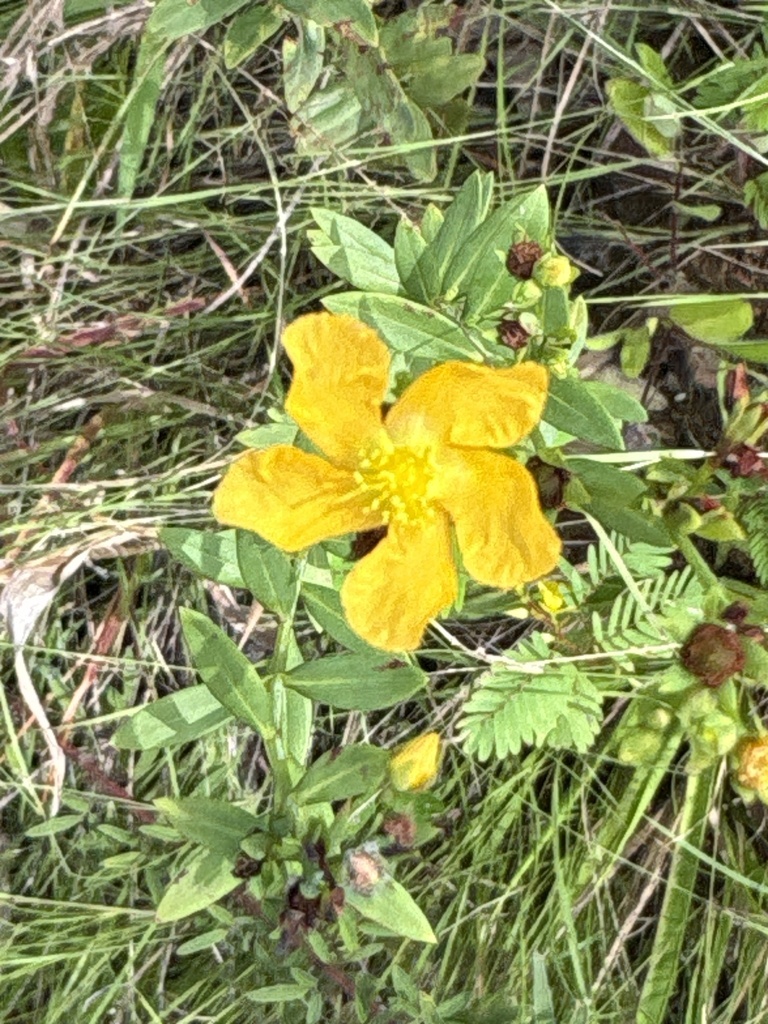
Sharpleaf St. John's-wort
Hypericum virgatum
Found in hardpan woodlands, rock outcrops, woodland borders, glades and barrens (especially over mafic or ultramafic rocks). Weakley, Flora of the Southeastern United States (2025), Northern Tier edition What its natural habitat tells you
Native to West Virginia. How scores work Is it native here?
Profile 94%
- Height
- Up to about 3 feet
- Light
- Partial shade, Full sun
- Soil moisture
- Dry to wet
Rare or protected plant. Specialist conservation planting; excluded from routine garden suggestions. Plant caution source
Hidden from default planting suggestions. Wildlife value and native status remain unchanged.
At a glance
- Life cycle
- Perennial
- Bloom
- June to September
Not yet recorded · Spread · Leaves
County records are not available.
Natural habitats
Places it grows wild. Not a planting requirement. Each habitat page lists the plants and wildlife also found there.
Forest or woodland where the source does not say how moist or dry.
Cliffs, ledges and rocky summits
Cliffs, ledges, rock outcrops, talus and rocky summits where the source does not name the rock. A named rock files the place under its own glade or outcrop type instead.
Borders of forests, clearings and shrubby thickets.
Glades, barrens and outcrops on mafic or serpentine rock
Open, thin-soil openings, outcrops and cliffs on dark, magnesium- or iron-rich rock such as serpentine, diabase or gabbro.
Who uses this plant?
 22CaterpillarsGenus host records with ranges including WV
Genus host records with ranges including WV · Hypericum
- Acleris maculidorsanaStained-Back Leafroller Moth
- Choristoneura rosaceanaOblique-Banded Leafroller Moth, Rosaceous Leaf Roller
- Dejongia lobidactylusLobed Plume Moth
- Eupithecia miserulataCommon Eupithacia, Common Pug
- Hyppa xylinoidesCommon Hyppa
- Iodopepla u-albumBurgundy St. Johnswort Moth, White-Eyed Borer
- Iridopsis ephyrariaPale-Winged Gray
- Melanchra assimilisBlack Arches
- Mocis latipesSmall Mocis, Striped Grass Looper
- Nedra ramosulaGray Half-Spot
Show all 22
- Nemoria bistriariaTwo-Striped Emerald, Red-Fringed Emerald
- Nemoria tuscaroraAppalachian Emerald
- Phlogophora irisOlive Angle Shades
- Platynota flavedanaBlack-Shaded Platynota
- Probole amicariaFriendly Probole
- Sparganothis sulfureanaSparganothis Fruitworm Moth, Sulfur Leafroller, False Yellow-Head
- Synchlora aerataWavy-Lined Emerald, Camouflaged Looper
- Xestia c-nigrumSpotted Cut-Worm, Setaceous Hebrew Character, Lesser Black-letter Dart
- Zale lunataLunate Zale
- Agonopterix lythrella
- Caloptilia hypericella
- Xenotemna pallorana
 43BeesSoutheastern regional records
Southeastern regional records · Hypericum
Individual names are not available yet.
Noori, Seltmann & Orr 2026, A curated and integrated dataset for exploring global bee-plant interactions (GloBI), Zenodo, CC BY 4.0 0Specialist beesPollen specialists
 1BirdsRecorded genus food-resource interactions; not a state feeding claim
Recorded genus food-resource interactions; not a state feeding claim · Hypericum
- Aythya collarisRing-necked Duck
Direct food only: birds recorded eating this genus across North America. Caterpillars on host plants also feed nesting birds. NC Native Plant Society: butterfly gardening
No records yet · Ants · Beetles · Flies · Adult butterflies / moths · Other wasps · Other insects
Plant details
- Family
- Hypericaceae
- Flower color
- Orange or yellow
Growing sources and scope
- Bloom · “Late June to September” · Weakley, Flora of the Southeastern United States (2025), Carolinas & Georgia edition · Carolinas and Georgia
- Flower color · “Orange or yellow” · Lady Bird Johnson Wildflower Center
- Height · “Up to about 3 feet” · Lady Bird Johnson Wildflower Center
- Life cycle · “Perennial” · Lady Bird Johnson Wildflower Center
- Light · “Partial shade; Full sun (documented habitat)” · Weakley, Flora of the Southeastern United States (2025), Carolinas & Georgia edition · Carolinas and Georgia
- Soil · “Dry; Moist; Wet (documented habitat)” · Weakley, Flora of the Southeastern United States (2025), Carolinas & Georgia edition · Carolinas and Georgia
Also known as
Sharp Leaf St. Johnswort; Sharpleaf St. John's wort; Strict St. Johnswort
Conservation status
| West Virginia rank | S1 |
|---|---|
| Global rank | G4? |
| WV status | Not verified |
| Federal status | Not verified |
Will it fit your yard?
Check this plant against your county, sun and soil moisture. Conditions are checked in your browser.
Sources
- NatureServe Explorer
- USDA PLANTS
- Vascular Plants of North Carolina (NC Natural Heritage Program)
- Weakley, Flora of the Southeastern United States (2025), Carolinas & Georgia edition
- West Virginia occurrence source
- Shropshire & Tallamy 2025, Lepidoptera of North America north of Mexico, ZooKeys 1261 (ODbL)
- Noori, Seltmann & Orr 2026, A curated and integrated dataset for exploring global bee-plant interactions (GloBI), Zenodo, CC BY 4.0
- Smith, Bachelder, Russell, Morales, Mosher & Seltmann 2024, Bee-Specialization-Modeling v0.6.1 (specialist host table compiled from J. Fowler's pollen specialist bee lists), Zenodo, CC BY 4.0
- Hurlbert, Olsen, Sawyer & Winner 2021, Avian Diet Database, Scientific Data 8: 260 (CC0)
- Narango, Tallamy & Shropshire 2020, Few keystone plant genera support the majority of Lepidoptera species, Nature Communications