

Steeplebush
Spiraea tomentosa
In the Carolinas and Georgia, found in bogs, wet meadows. Weakley, Flora of the Southeastern United States (2025), Carolinas & Georgia edition What its natural habitat tells you
Native to Arkansas. How scores work Is it native here?
Profile 100%
- Height
- 2–4 feet
- Spread
- 3–5 feet
- Light
- Full sun
- Soil moisture
- Usually moist
Space about 4 ft apart from its recorded spread, about 6 per 100 sq ft. Enter your bed size for a count
Will it fit your yard?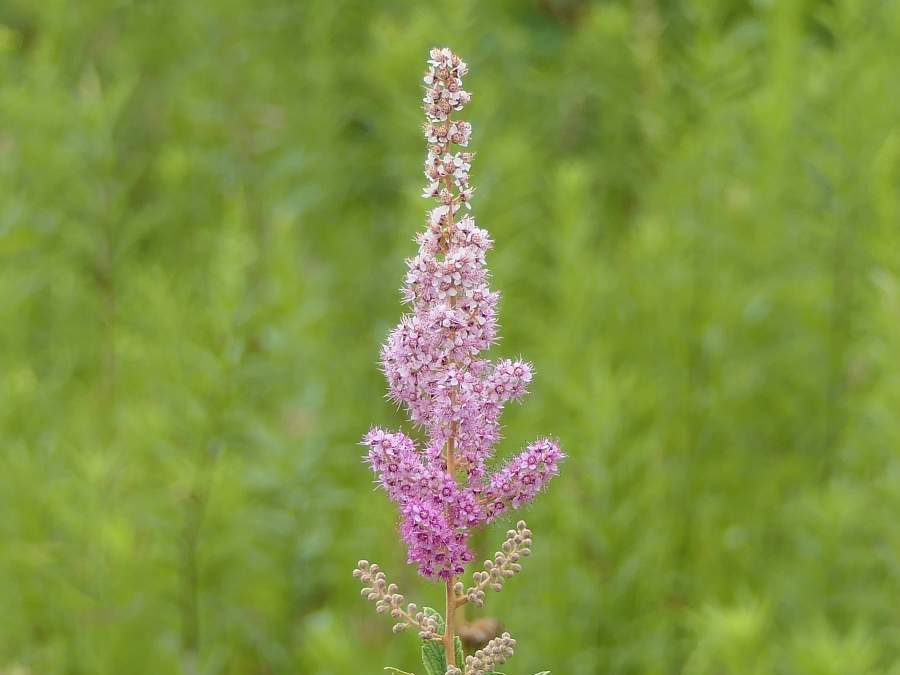
Rare or protected plant. Specialist conservation planting; excluded from routine garden suggestions. Plant caution source
Hidden from default planting suggestions. Wildlife value and native status remain unchanged.
At a glance
- Life cycle
- Perennial
- Leaves
- Deciduous
- Bloom
- Summer
- Fruiting season
- September to October
Recorded in 3 Arkansas counties.
Natural habitats
Places it grows wild. Not a planting requirement. Each habitat page lists the plants and wildlife also found there.
Open, wet, grassy or sedgy ground that is not a bog.
Also found with this plant
Wildlife whose habitat models include habitats this plant grows in, in Arkansas. Shared habitat, not food. 44 animals.
Widespread birds also seen here (75)
Found in many habitats here, so not listed above.
- Alder Flycatcher
- American Goldfinch
- American Kestrel
- American Redstart
- American Robin
- Baltimore Oriole
- Bank Swallow
- Belted Kingfisher
- Bewick's Wren
- Black-and-White Warbler
- Black-crowned Night-heron
- Blue Grosbeak
- Blue Jay
- Blue-gray Gnatcatcher
- Brown Creeper
- Brown Thrasher
- Canada Goose
- Carolina Chickadee
- Cedar Waxwing
- Chimney Swift
- Chipping Sparrow
- Cliff Swallow
- Common Nighthawk
- Common Yellowthroat
- Cooper's Hawk
- Double-crested Cormorant
- Downy Woodpecker
- Eastern Kingbird
- Eastern Screech-owl
- Eastern Wood-pewee
- Eurasian Collared-dove
- European Starling
- Golden-crowned Kinglet
- Gray Catbird
- Great Horned Owl
- Hairy Woodpecker
- Harris's Sparrow
- Hermit Thrush
- Hooded Merganser
- Indigo Bunting
- Lincoln's Sparrow
- Mallard
- Mississippi Kite
- Mourning Dove
- Northern Cardinal
- Northern Flicker
- Northern Mockingbird
- Orange-crowned Warbler
- Orchard Oriole
- Osprey
- Pileated Woodpecker
- Pine Siskin
- Purple Finch
- Red-bellied Woodpecker
- Red-headed Woodpecker
- Red-tailed Hawk
- Red-winged Blackbird
- Ruby-crowned Kinglet
- Ruby-throated Hummingbird
- Rusty Blackbird
- Sharp-shinned Hawk
- Song Sparrow
- Spotted Sandpiper
- Tree Swallow
- Tufted Titmouse
- Turkey Vulture
- White-breasted Nuthatch
- White-throated Sparrow
- Wild Turkey
- Wood Thrush
- Yellow-bellied Sapsucker
- Yellow-billed Cuckoo
- Yellow-breasted Chat
- Yellow-crowned Night-heron
- Yellow-rumped Warbler
Care
- Keep the soil moist.
- Optional bloom tip: Removing faded flower clusters can encourage more blooms.
Who uses this plant?
 46CaterpillarsGenus host records with ranges including AR
Genus host records with ranges including AR · Spiraea
- Acronicta impressaImpressive Dagger, Printed Dagger
- Acronicta noctivagaNight-Wandering Dagger, Burglar Dagger
- Acronicta oblinitaSmeared Dagger
- Anavitrinella pampinariaCommon Gray, Cranberry Spanworm
- Archips argyrospilaFruit-Tree Leafroller Moth
- Archips purpuranaOmnivorous Leafroller Moth
- Automeris ioIo Moth
- Biston betulariaSalt-and-Pepper Geometer, Cleft-Headed Looper
- Cecrita guttivittaMaple Prominent, Saddled Prominent
- Cenopis reticulatanaReticulated Fruitworm Moth
Show all 46
- Choristoneura rosaceanaOblique-Banded Leafroller Moth, Rosaceous Leaf Roller
- Clepsis melaleucanusBlack-Patched Clepsis, Trillium Tortrix
- Crocigrapha normaniNorman's Quaker
- Euchlaena irrariaLeast-Marked Euchlaena
- Euchlaena johnsonariaJohnson's Euchlaena
- Euchlaena marginariaOchre Euchlaena
- Euchlaena serrataThe Saw-Wing
- Eupithecia miserulataCommon Eupithacia, Common Pug
- Glena cognatariaBlueberry Gray
- Harrisimemna trisignataHarris's Three-Spot
- Hyalophora cecropiaCecropia Silkmoth, Cecropia Moth
- Hyphantria cuneaFall Webworm
- Lacinipolia loreaBridled Arches, Bridle Groundcat
- Melanolophia canadariaCanadian Melanolphia, Variable Redmarked Looper
- Metarranthis duariaRuddy Metarranthis
- Metarranthis hypochrariaCommon Metarranthis
- Metarranthis obfirmariaYellow-Washed Metarranthis
- Olethreutes permundanaRaspberry Leafroller
- Orgyia leucostigmaWhite-Marked Tussock Moth
- Orthosia revictaSubdued Quaker
- Palthis angulalisDark-Spotted Palthis
- Paonias excaecataBlinded Sphinx, Blind Eyed Sphinx
- Papaipema nebrisStalk Borer
- Pero morrisonariaMorrison's Pero
- Phlogophora periculosaBrown Angle Shades
- Probole amicariaFriendly Probole
- Prochoerodes lineolaLarge Maple Spanworm Moth
- Pyrrharctia isabellaIsabella Tiger Moth, Banded Woolybear
- Rheumaptera prunivorataFerguson's Scallop Shell, Cherry Scallop Shell
- Schizura ipomaeaeMorning-Glory Prominent, Checkered-Fringe Prominent
- Smerinthus jamaicensisTwin-Spotted Sphinx
- Spilosoma virginicaVirginian Tiger Moth, Yellow Woolybear Moth, Yellow Bear
- Xanthotype urticariaFalse Crocus Geometer
- Xestia c-nigrumSpotted Cut-Worm, Setaceous Hebrew Character, Lesser Black-letter Dart
- Xestia dolosaGreater Black-Letter Dart, Greater Spotted Cutworm
- Ancylis spiraeifoliana
 6BeesSoutheastern regional records
Southeastern regional records · Spiraea
Individual names are not available yet.
Noori, Seltmann & Orr 2026, A curated and integrated dataset for exploring global bee-plant interactions (GloBI), Zenodo, CC BY 4.0 0Specialist beesPollen specialists
 1BirdsRecorded genus food-resource interactions; not a state feeding claim
Recorded genus food-resource interactions; not a state feeding claim · Spiraea
- Falcipennis canadensisSpruce Grouse
Direct food only: birds recorded eating this genus across North America. Caterpillars on host plants also feed nesting birds. NC Native Plant Society: butterfly gardening
No records yet · Ants · Beetles · Flies · Adult butterflies / moths · Other wasps · Other insects
Plant details
- Family
- Rosaceae
- Hardiness
- Zones 3a–8b
- Soil pH
- Acidic
- Flower color
- Pink or purple
- Growth rate
- Moderate
- Growth habit
- Spreads by rhizomes
- Foliage color
- Green
- Fruit begins
- September
- Fruit ends
- October
Growing sources and scope
- Bloom · “Summer” · USDA PLANTS (ranked first; Prairie Moon 2026 Cultural Guide differs) · Nationwide species characteristics; local growing conditions may vary
- Flower color · “Pink or purple” · NC Extension Plant Toolbox (ranked first; USDA PLANTS, Prairie Moon 2026 Cultural Guide differ)
- Foliage color · “Green” · USDA PLANTS · Nationwide species characteristics; local growing conditions may vary
- Fruit begins · “September” · Weakley, Flora of the Southeastern United States (2025), Carolinas & Georgia edition (ranked first; NC Extension Plant Toolbox, USDA PLANTS differ) · Carolinas and Georgia
- Fruit ends · “October” · Weakley, Flora of the Southeastern United States (2025), Carolinas & Georgia edition (ranked first; NC Extension Plant Toolbox, USDA PLANTS differ) · Carolinas and Georgia
- Growth habit · “Spreads by rhizomes” · USDA PLANTS · Nationwide species characteristics; local growing conditions may vary
- Growth rate · “Moderate” · USDA PLANTS · Nationwide species characteristics; local growing conditions may vary
- Hardiness · “Zones 3a–8b” · NC Extension Plant Toolbox
- Height · “2–4 feet” · NC Extension Plant Toolbox (ranked first; USDA PLANTS, Prairie Moon 2026 Cultural Guide differ)
- Leaves · “Deciduous” · NC Extension Plant Toolbox
- Life cycle · “Perennial” · NC Extension Plant Toolbox
- Light · “Full sun (6 or more hours of direct sunlight a day)” · NC Extension Plant Toolbox (ranked first; Prairie Moon 2026 Cultural Guide differs)
- Soil · “Moist; Occasionally wet” · NC Extension Plant Toolbox (ranked first; Prairie Moon 2026 Cultural Guide differs)
- Soil pH · “Acidic” · NC Extension Plant Toolbox
- Spread · “3–5 feet” · NC Extension Plant Toolbox
Also known as
Hardhack
Conservation status
| Arkansas rank | S2 |
|---|---|
| Global rank | G5 |
| AR status | Not verified |
| Federal status | Not verified |
Will it fit your yard?
Check this plant against your county, sun and soil moisture. Conditions are checked in your browser.
Growing cautions
- Suckers and forms colonies. Spreads by suckers to form colonies. NC State Extension Plant Toolbox
For planning only; these do not change the score or Fit.
Sources
- Atlas of the Vascular Plants of Arkansas (2013)
- USDA PLANTS
- Vascular Plants of North Carolina (NC Natural Heritage Program)
- Weakley, Flora of the Southeastern United States (2025), Carolinas & Georgia edition
- NatureServe Explorer
- Arkansas occurrence source
- Shropshire & Tallamy 2025, Lepidoptera of North America north of Mexico, ZooKeys 1261 (ODbL)
- Noori, Seltmann & Orr 2026, A curated and integrated dataset for exploring global bee-plant interactions (GloBI), Zenodo, CC BY 4.0
- Smith, Bachelder, Russell, Morales, Mosher & Seltmann 2024, Bee-Specialization-Modeling v0.6.1 (specialist host table compiled from J. Fowler's pollen specialist bee lists), Zenodo, CC BY 4.0
- Hurlbert, Olsen, Sawyer & Winner 2021, Avian Diet Database, Scientific Data 8: 260 (CC0)
- Narango, Tallamy & Shropshire 2020, Few keystone plant genera support the majority of Lepidoptera species, Nature Communications