

Wrinkle-leaf Goldenrod
Solidago rugosa
Arching sprays of yellow flowers bring late-season color above rough, wrinkled leaves.
Native to Arkansas. How scores work Is it native here?
Profile 100%
- Height
- 2–5 feet
- Spread
- 1.5–2.5 feet
- Light
- Full sun, Partial shade
- Soil moisture
- Somewhat dry to moist
Space about 2 ft apart from its recorded spread, about 25 per 100 sq ft. Enter your bed size for a count
Will it fit your yard?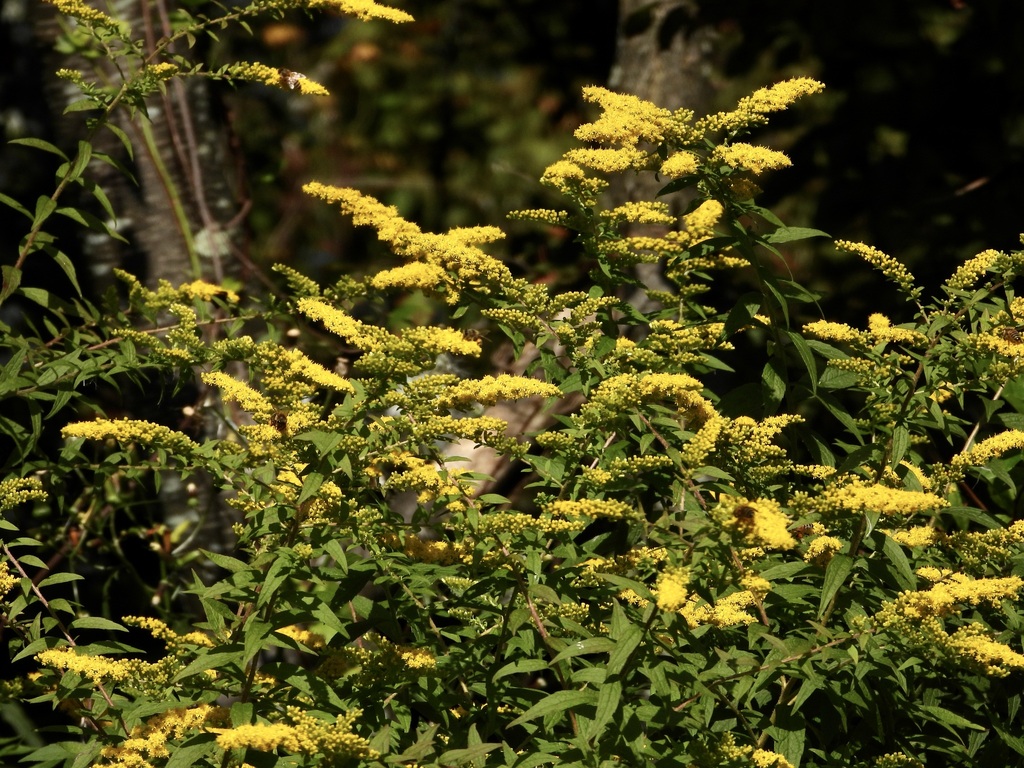
At a glance
- Life cycle
- Herbaceous perennial
- Leaves
- Deciduous
- Bloom
- August to October
- Fruiting season
- Fall
Recorded in 41 Arkansas counties.
Also found with this plant
Wildlife whose habitat models include habitats this plant grows in, in Arkansas. Shared habitat, not food. 51 animals.
Widespread birds also seen here (76)
Found in many habitats here, so not listed above.
- Alder Flycatcher
- American Goldfinch
- American Kestrel
- American Redstart
- American Robin
- Bald Eagle
- Baltimore Oriole
- Bank Swallow
- Belted Kingfisher
- Bewick's Wren
- Black-and-White Warbler
- Black-crowned Night-heron
- Blue Grosbeak
- Blue Jay
- Blue-gray Gnatcatcher
- Brown Creeper
- Brown Thrasher
- Canada Goose
- Carolina Chickadee
- Cedar Waxwing
- Chimney Swift
- Chipping Sparrow
- Cliff Swallow
- Common Nighthawk
- Common Yellowthroat
- Cooper's Hawk
- Double-crested Cormorant
- Downy Woodpecker
- Eastern Kingbird
- Eastern Screech-owl
- Eastern Wood-pewee
- Eurasian Collared-dove
- European Starling
- Golden-crowned Kinglet
- Gray Catbird
- Great Horned Owl
- Hairy Woodpecker
- Harris's Sparrow
- Hermit Thrush
- Hooded Merganser
- Indigo Bunting
- Lincoln's Sparrow
- Mallard
- Mississippi Kite
- Mourning Dove
- Northern Cardinal
- Northern Flicker
- Northern Mockingbird
- Orange-crowned Warbler
- Orchard Oriole
- Osprey
- Pileated Woodpecker
- Pine Siskin
- Purple Finch
- Red-bellied Woodpecker
- Red-headed Woodpecker
- Red-tailed Hawk
- Red-winged Blackbird
- Ruby-crowned Kinglet
- Ruby-throated Hummingbird
- Rusty Blackbird
- Sharp-shinned Hawk
- Song Sparrow
- Spotted Sandpiper
- Tree Swallow
- Tufted Titmouse
- Turkey Vulture
- White-breasted Nuthatch
- White-throated Sparrow
- Wild Turkey
- Wood Thrush
- Yellow-bellied Sapsucker
- Yellow-billed Cuckoo
- Yellow-breasted Chat
- Yellow-crowned Night-heron
- Yellow-rumped Warbler
Care
- Grows best in moist soil; tolerates occasional dry spells.
Who uses this plant?
 95CaterpillarsGenus host records with ranges including AR
Genus host records with ranges including AR · Solidago
- Agnorisma badinodisPale-Banded Dart
- Agrotis gladiariaSwordsman Dart, Clay-Backed Cut-Worm
- Agrotis vetustaOld Man Dart
- Alsophila pometariaFall Cankerworm Moth
- Amorbia humerosanaWhite-Lined Leafroller Moth
- Anavitrinella pampinariaCommon Gray, Cranberry Spanworm
- Ancylis floridanaStrawberry Leafroller
- Archips purpuranaOmnivorous Leafroller Moth
- Argyrotaenia velutinanaRed-Banded Leafroller Moth, Jack Pine Tube Moth
- Bucculatrix angustataNarrow Bucculatrix
Show all 95
- Catabena lineolataFine-Lined Sallow
- Chlorochlamys chloroleucariaBlackberry Looper Moth
- Chlosyne nycteisSilvery Checkerspot
- Choristoneura rosaceanaOblique-Banded Leafroller Moth, Rosaceous Leaf Roller
- Chrysodeixis includensSoybean Looper Moth
- Cisseps fulvicollisYellow-Collared Scape Moth
- Condica sutorThe Cobbler, Cobbler Groundling
- Condica vidensWhite-Dotted Groundling
- Cremastobombycia solidaginisGoldenrod Leafminer
- Ctenoplusia oxygrammaSharp-Stigma Looper Moth
- Cucullia asteroidesThe Asteroid, Asteroid Paint, Goldenrod Hooded Owlet
- Cucullia speyeriSpeyer's Cucullia, Speyer's Paint
- Dichomeris bilobellaBilobed Dichomeris Moth
- Dichomeris flavocostellaCream-Edged Dichomeris
- Dichomeris inserrataIndented Dichomeris
- Dichomeris juncidellaOrange-Dotted Dichomeris
- Dichomeris nonstrigellaLittle Devil, The Little Devil
- Dichomeris ochripalpellaShining Dichomeris Moth
- Dichomeris setosellaHairy Dichomeris
- Endothenia hebesanaVerbena Bud Moth
- Epiblema otiosanaBidens Borer Moth
- Epiblema scudderianaScudder's Epiblema, Goldenrod Gall Moth
- Epiblema tripartitanaThree-Parted Epiblema
- Episimus argutanaSumac Leaftier
- Eucosma ochroterminanaBuff-Tipped Phaneta
- Eucosma raracanaReddish Eucosma, Reddish Phaneta
- Eucosma umbrastrianaShaded Phaneta
- Euphydryas phaetonThe Baltimore, The Black Checker
- Eupithecia absinthiataWormwood Pug, Composite Pug
- Eupithecia miserulataCommon Eupithacia, Common Pug
- Eusarca confusariaConfused Eusarca
- Feltia jaculiferaDingy Cutworm
- Gnorimoschema gallaesolidaginisGoldenrod Gall Moth
- Helicoverpa zeaCorn Earworm Moth
- Hellinsia kellicottiiGoldenrod Borer Plume Moth
- Herpetogramma aeglealisSerpentine Webworm
- Herpetogramma pertextalisBold-Feathered Grass Moth
- Herpetogramma thestealisZigzag Herpetogramma, Subtle-Feathered Grass Moth
- Iridopsis humariaSmall Purplish Gray
- Iridopsis larvariaBent-Line Gray
- Lacinipolia meditataThe Thinker
- Leuconycta diphteroidesGreen Leuconycta
- Nephelodes miniansBronzed Cutworm
- Orthodes cynicaCynical Quaker, Cynical Groundcat
- Orthodes majusculaRustic Quaker, Rustic Groundcat
- Ostrinia obumbratalisSmartweed Borer
- Palthis angulalisDark-Spotted Palthis
- Pelochrista cataclystianaSolidaga Eucosma, Solidaga Pelochrista
- Pelochrista derelictaDerelict Eucosma
- Pelochrista dorsisignatanaTriangle-Backed Eucosma
- Pelochrista robinsonanaRobinson's Pelochrista, Robinson's Eucosma
- Pelochrista similianaSimilar Eucosma
- Platynota idaeusalisTufted Apple-Bud Moth
- Platynota stultanaOmnivorous Leafroller
- Pleuroprucha insulsariaCommon Tan Wave
- Pseudeustrotia carneolaPink-Barred Lithacodia, Pink-Barred Pseudeustrotia
- Schinia nundinaGoldenrod Flower Moth
- Sonia canadanaCanadian Sonia Moth
- Sonia constrictanaConstricted Sonia
- Sparganothis distinctaDistinct Sparganothis
- Sparganothis sulfureanaSparganothis Fruitworm Moth, Sulfur Leafroller, False Yellow-Head
- Spodoptera ornithogalliYellow-Striped Armyworm Moth, Cotton Cutworm
- Synchlora aerataWavy-Lined Emerald, Camouflaged Looper
- Synchlora frondariaSouthern Emerald
- Tricholita signataSignate Quaker, Signate Groundcat
- Trichordestra legitimaStriped Garden Caterpillar Moth
- Udea rubigalisCelery Leaftier
- Utetheisa ornatrixOrnate Moth, Pink Underwing, Rattlebox Moth, Bella Moth
- Xanthotype urticariaFalse Crocus Geometer
- Xestia c-nigrumSpotted Cut-Worm, Setaceous Hebrew Character, Lesser Black-letter Dart
- Xestia dolosaGreater Black-Letter Dart, Greater Spotted Cutworm
- Xestia smithiiSmith's Dart
- Zale lunataLunate Zale
- Anania mysippusalis
- Astrotischeria solidagonifoliella
- Bucculatrix magnella
- Dichomeris agonia
- Epiblema desertana
- Epiblema obfuscana
- Hahncappsia marculenta
- Hellinsia lacteodactylus
- Helvibotys helvialis
- Isophrictis similiella
- Pelochrista vagana
- Xenotemna pallorana
 82BeesSoutheastern regional records
Southeastern regional records · Solidago
Individual names are not available yet.
Noori, Seltmann & Orr 2026, A curated and integrated dataset for exploring global bee-plant interactions (GloBI), Zenodo, CC BY 4.0 36Specialist beesPollen specialists
Pollen specialists · Solidago
- Andrena asteris
- Andrena braccata
- Andrena canadensis
- Andrena chromotricha
- Andrena fulvipennis
- Andrena hirticincta
- Andrena nubecula
- Andrena placata
- Andrena simplex
- Calliopsis coloradensis
Show all 36
- Colletes americanus
- Colletes compactus
- Colletes rufocinctus
- Colletes simulans
- Colletes solidaginis
- Colletes speculiferus
- Colletes thysanellae
- Dianthidium simile
- Megachile inimica
- Megachile xylocopoides
- Melissodes coreopsis
- Melissodes dentiventris
- Melissodes druriellus
- Melissodes fumosus
- Melissodes illatus
- Melissodes niveus
- Melissodes trinodis
- Perdita boltoniae
- Perdita bruneri
- Perdita laticincta
- Perdita octomaculata
- Perdita swenki
- Protandrena aestivalis
- Protandrena andrenoides
- Protandrena citripes
- Protandrena compositarum
 1BirdsRecorded eating Solidago in Arkansas
Diet records by plant genus, from studies across North America. Not a record from this state. Birds whose range includes Arkansas, most records first.
- Wild Turkey2 diet records
Direct food only. Caterpillars on host plants also feed nesting birds. NC Native Plant Society: butterfly gardening
Songbirds — Eat the seeds
No records yet · Ants · Beetles · Flies · Adult butterflies / moths · Other wasps · Other insects
Birds that eat Solidago 1
Diet records by plant genus, from studies across North America. Not a record from this state. Avian Diet Database (Hurlbert Lab), CC0 1.0.
- Wild TurkeyMeleagris gallopavo

Plant details
- Family
- Asteraceae
- Hardiness
- Zones 4a–8b
- Soil pH
- Acidic to neutral
- Flower color
- Yellow
- Growth rate
- Rapid
- Growth habit
- Spreads by rhizomes
- Foliage color
- Green
- Fruit begins
- Fall
- Fruit ends
- Fall
What its natural habitat tells you
Safety has not been reviewed for this plant; check toxicity and thorns before planting.
Choose a site with reliable moisture. Suitable for naturalized plantings and rain gardens. NC State Extension
Growing sources and scope
- Bloom · “Late summer” · USDA PLANTS (ranked first; Prairie Moon 2026 Cultural Guide differs) · Nationwide species characteristics; local growing conditions may vary
- Flower color · “Yellow” · NC Extension Plant Toolbox
- Foliage color · “Green” · USDA PLANTS · Nationwide species characteristics; local growing conditions may vary
- Fruit begins · “Fall” · NC Extension Plant Toolbox (ranked first; USDA PLANTS differs) · Species profile fruit display season; not a local ripening date
- Fruit ends · “Fall” · NC Extension Plant Toolbox · Species profile fruit display season; not a local ripening date
- Growth habit · “Spreads by rhizomes” · USDA PLANTS · Nationwide species characteristics; local growing conditions may vary
- Growth rate · “Rapid” · USDA PLANTS · Nationwide species characteristics; local growing conditions may vary
- Hardiness · “Zones 4a–8b” · NC Extension Plant Toolbox (ranked first; Missouri Botanical Garden Plant Finder differs)
- Height · “2–5 feet” · Tennessee Smart Yards (ranked first; USDA PLANTS, Lady Bird Johnson Wildflower Center, Missouri Botanical Garden Plant Finder, Prairie Moon 2026 Cultural Guide differ) · Published Tennessee growing guidance; exact cached scientific heading
- Leaves · “Deciduous” · NC Extension Plant Toolbox
- Life cycle · “Perennial” · NC Extension Plant Toolbox
- Light · “Full sun (6 or more hours of direct sunlight a day); Partial shade (direct sunlight only part of the day, 2-6 hours)” · NC Extension Plant Toolbox (ranked first; Tennessee Smart Yards, Virginia DCR Piedmont, Virginia DCR Coastal Plain, Lady Bird Johnson Wildflower Center, Missouri Botanical Garden Plant Finder, Prairie Moon 2026 Cultural Guide differ)
- primary_flower_color · “yellow” · USDA PLANTS
- Soil · “Moist; Occasionally dry” · NC Extension Plant Toolbox (ranked first; Tennessee Smart Yards, Virginia DCR Piedmont, Virginia DCR Coastal Plain, Lady Bird Johnson Wildflower Center, Missouri Botanical Garden Plant Finder, Prairie Moon 2026 Cultural Guide differ)
- Soil pH · “Acidic to neutral” · NC Extension Plant Toolbox
- Spread · “1.5–2.5 feet” · Missouri Botanical Garden Plant Finder
Recognizing it
Hairy stems and deeply veined, toothed leaves; many small yellow heads on arching branches. Identification source
Also known as
Rough Leaf Goldenrod; Wrinkle Leaf Goldenrod
Conservation status
| Arkansas rank | SNR |
|---|---|
| Global rank | G5 |
| AR status | Not verified |
| Federal status | Not verified |
Will it fit your yard?
Check this plant against your county, sun and soil moisture. Conditions are checked in your browser.
Growing cautions
- Spreads aggressively. Spreads rapidly by rhizomes and slowly by re-seeding. Tennessee Smart Yards
For planning only; these do not change the score or Fit.
Sources
- Atlas of the Vascular Plants of Arkansas (2013)
- USDA PLANTS
- Vascular Plants of North Carolina (NC Natural Heritage Program)
- Arkansas occurrence source
- Shropshire & Tallamy 2025, Lepidoptera of North America north of Mexico, ZooKeys 1261 (ODbL)
- Noori, Seltmann & Orr 2026, A curated and integrated dataset for exploring global bee-plant interactions (GloBI), Zenodo, CC BY 4.0
- Smith, Bachelder, Russell, Morales, Mosher & Seltmann 2024, Bee-Specialization-Modeling v0.6.1 (specialist host table compiled from J. Fowler's pollen specialist bee lists), Zenodo, CC BY 4.0
- Hurlbert, Olsen, Sawyer & Winner 2021, Avian Diet Database, Scientific Data 8: 260 (CC0)
- Narango, Tallamy & Shropshire 2020, Few keystone plant genera support the majority of Lepidoptera species, Nature Communications
- NC State Extension