

Lesser Burdock
Arctium minus
In the Carolinas and Georgia, found in pastures, barnyards, roadsides, other disturbed areas. Weakley, Flora of the Southeastern United States (2025), Carolinas & Georgia edition What its natural habitat tells you
Not native to Arkansas. How scores work Is it native here?
Profile 76%
- Height
- 2–5 feet
- Light
- Full sun, Partial shade
- Soil moisture
- Dry to moist
No photograph yet. Looking for an old drawing…
Do not plant. Listed invasive in Arkansas.
At a glance
- Life cycle
- Biennial
- Bloom
- June to November
Not yet recorded · Spread · Leaves
Recorded in 10 Arkansas counties.
Natural habitats
Places it grows wild. Not a planting requirement. Each habitat page lists the plants and wildlife also found there.
Roadsides, fields and disturbed ground
Ground opened by people: roadsides, old fields, pastures, fencerows and lots.
Also found with this plant
Wildlife whose habitat models include habitats this plant grows in, in Arkansas. Shared habitat, not food. 91 animals.
- Acadian FlycatcherEmpidonax virescens
- Alder FlycatcherEmpidonax alnorum
- American Black DuckAnas rubripes
- American GoldfinchCarduelis tristis
- American RedstartSetophaga ruticilla
- American RobinTurdus migratorius
- Bald EagleHaliaeetus leucocephalus
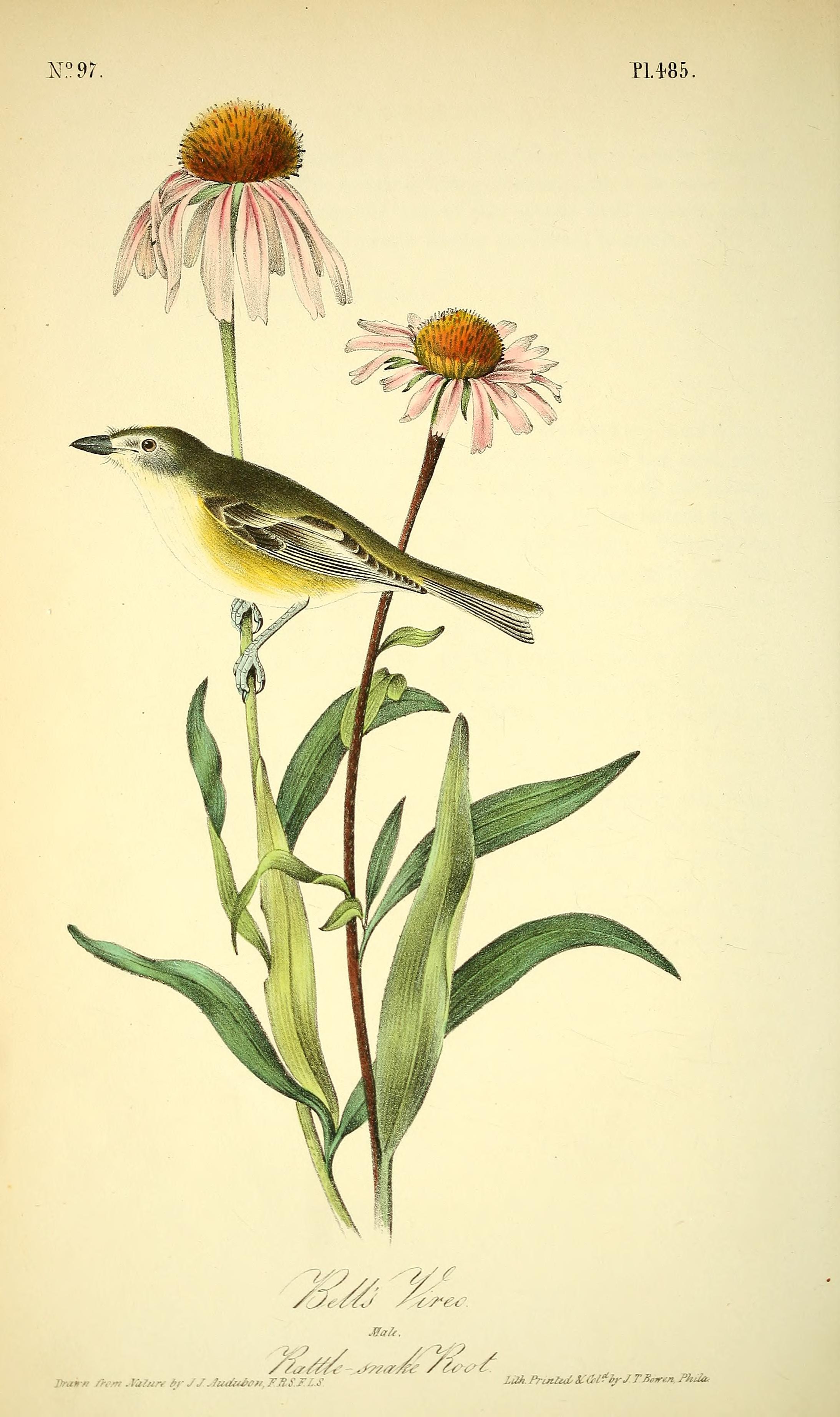
- Bell's VireoVireo bellii
- Belted KingfisherMegaceryle alcyon
- Black-and-White WarblerMniotilta varia
- Black-crowned Night-heronNycticorax nycticorax
- Blue GrosbeakPasserina caerulea
- Blue JayCyanocitta cristata
- Blue-gray GnatcatcherPolioptila caerulea
- Broad-winged HawkButeo platypterus
- Brown CreeperCerthia americana
- Brown ThrasherToxostoma rufum
- Brown-headed CowbirdMolothrus ater
- Canada GooseBranta canadensis
- Cedar WaxwingBombycilla cedrorum
- Cerulean WarblerDendroica cerulea
- Chimney SwiftChaetura pelagica
- Chipping SparrowSpizella passerina
- Cliff SwallowPetrochelidon pyrrhonota























Who uses this plant?
 18CaterpillarsGenus host records with ranges including AR
Genus host records with ranges including AR · Arctium
- Anagrapha falciferaCelery Looper Moth
- Apatelodes torrefactaSpotted Apatelodes
- Choristoneura rosaceanaOblique-Banded Leafroller Moth, Rosaceous Leaf Roller
- Epiblema scudderianaScudder's Epiblema, Goldenrod Gall Moth
- Feltia subterraneaSubterranean Dart, Granulate Cutworm
- Herpetogramma pertextalisBold-Feathered Grass Moth
- Melanchra pictaPainted Arches, Zebra Caterpillar Moth
- Ogdoconta cinereolaCommon Pinkband Groundling
- Papaipema cataphractaBurdock Border, Potato-Stalk Borer
- Papaipema nebrisStalk Borer
Show all 18
- Platyptilia carduidactylusArtichoke Plume Moth
- Ponometia candefactaOlive-Shaded Bird-Dropping Moth
- Ponometia erastrioidesSmall Bird-Dropping Moth
- Pyrrharctia isabellaIsabella Tiger Moth, Banded Woolybear
- Sparganothis sulfureanaSparganothis Fruitworm Moth, Sulfur Leafroller, False Yellow-Head
- Spilosoma virginicaVirginian Tiger Moth, Yellow Woolybear Moth, Yellow Bear
- Vanessa carduiPainted Lady, Cosmopolite
- Vanessa virginiensisAmerican Lady, American Painted Lady
 —BeesSoutheastern regional records
 1Specialist beesPollen specialists
Pollen specialists · Arctium
- Melissodes desponsus
 1BirdsRecorded genus food-resource interactions; not a state feeding claim
Recorded genus food-resource interactions; not a state feeding claim · Arctium
- Perdix perdixGray Partridge
Direct food only: birds recorded eating this genus across North America. Caterpillars on host plants also feed nesting birds. NC Native Plant Society: butterfly gardening
Plant details
- Family
- Asteraceae
- Hardiness
- Zones 3a–10b
- Soil pH
- Acidic to neutral
- Flower color
- Pink or purple
Safety has not been reviewed for this plant; check toxicity and thorns before planting.
Growing sources and scope
- Bloom · “Late June to November” · Weakley, Flora of the Southeastern United States (2025), Carolinas & Georgia edition · Carolinas and Georgia
- Flower color · “Pink or purple” · NC Extension Plant Toolbox
- Hardiness · “Zones 3a–10b” · NC Extension Plant Toolbox
- Height · “2–5 feet” · Minnesota Wildflowers
- Life cycle · “Biennial” · NC Extension Plant Toolbox
- Light · “Full sun (6 or more hours of direct sunlight a day); Partial shade (direct sunlight only part of the day, 2-6 hours)” · NC Extension Plant Toolbox
- Soil · “Dry; Moist (documented habitat)” · Weakley, Flora of the Southeastern United States (2025), Carolinas & Georgia edition · Carolinas and Georgia
- Soil pH · “Acidic to neutral” · NC Extension Plant Toolbox
Also known as
Common Burdock
Conservation status
| Arkansas rank | Not available |
|---|---|
| Global rank | GNR |
| AR status | Not verified |
| Federal status | Not verified |
Native alternatives
Find natives for your gardenSources
- Atlas of the Vascular Plants of Arkansas (2013)
- USDA PLANTS
- Weakley, Flora of the Southeastern United States (2025), Carolinas & Georgia edition
- Arkansas occurrence source
- Shropshire & Tallamy 2025, Lepidoptera of North America north of Mexico, ZooKeys 1261 (ODbL)
- Noori, Seltmann & Orr 2026, A curated and integrated dataset for exploring global bee-plant interactions (GloBI), Zenodo, CC BY 4.0
- Smith, Bachelder, Russell, Morales, Mosher & Seltmann 2024, Bee-Specialization-Modeling v0.6.1 (specialist host table compiled from J. Fowler's pollen specialist bee lists), Zenodo, CC BY 4.0
- Hurlbert, Olsen, Sawyer & Winner 2021, Avian Diet Database, Scientific Data 8: 260 (CC0)
- Narango, Tallamy & Shropshire 2020, Few keystone plant genera support the majority of Lepidoptera species, Nature Communications