

Crooked-stem Aster
Symphyotrichum prenanthoides
Found in moist or wet forests, roadbanks, fields. Weakley, Flora of the Southeastern United States (2025), Northern Tier edition What its natural habitat tells you
Native to Virginia. How scores work Is it native here?
Profile 100%
- Height
- 2–4 feet
- Spread
- 2 feet
- Light
- Full sun, Partial shade
- Soil moisture
- Usually moist
Space about 2 ft apart from its recorded spread, about 25 per 100 sq ft. Enter your bed size for a count
Will it fit your yard?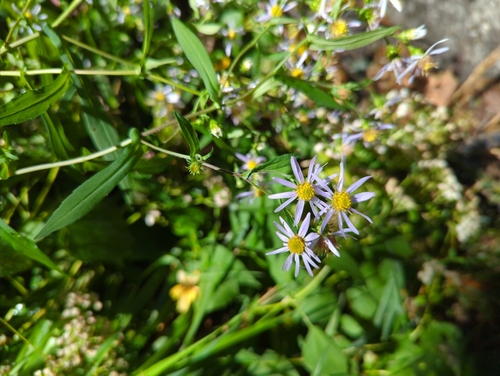
At a glance
- Life cycle
- Perennial
- Bloom
- August to October
- Fruiting season
- Summer to fall
Not yet recorded · Leaves
Recorded in 42 Virginia counties.
Natural habitats
Places it grows wild. Not a planting requirement. Each habitat page lists the plants and wildlife also found there.
Roadsides, fields and disturbed ground
Ground opened by people: roadsides, old fields, pastures, fencerows and lots.
Who uses this plant?
 96CaterpillarsGenus host records with ranges including VA
Genus host records with ranges including VA · Symphyotrichum
- Phyciodes tharosPearl Crescent
- Abagrotis magnicupidaOne-Dotted Dart
- Acharia stimuleaSaddleback Caterpillar Moth
- Agnorisma badinodisPale-Banded Dart
- Agrotis gladiariaSwordsman Dart, Clay-Backed Cut-Worm
- Allagrapha aereaUnspotted Looper Moth
- Biston betulariaSalt-and-Pepper Geometer, Cleft-Headed Looper
- Bucculatrix angustataNarrow Bucculatrix
- Cenopis reticulatanaReticulated Fruitworm Moth
- Chlorochlamys chloroleucariaBlackberry Looper Moth
Show all 96
- Chlosyne harrisiiHarris' Checkerspot
- Chlosyne nycteisSilvery Checkerspot
- Chytonix palliatriculaCloaked Marvel
- Clepsis clemensianaClemens' Clepsis
- Clepsis persicanaWhite Triangle Tortrix
- Cochylichroa hoffmananaHoffman's Cochlid Moth
- Condica sutorThe Cobbler, Cobbler Groundling
- Condica vidensWhite-Dotted Groundling
- Ctenoplusia oxygrammaSharp-Stigma Looper Moth
- Cucullia alfarataCamphorweed Cucullia, Halloween Paint, Camphorweed Cucullia
- Cucullia asteroidesThe Asteroid, Asteroid Paint, Goldenrod Hooded Owlet
- Cucullia convexipennisBrown Hooded Owlet, Calico Paint
- Cucullia floreaGray Hooded Owlet
- Cucullia speyeriSpeyer's Cucullia, Speyer's Paint
- Dichomeris bilobellaBilobed Dichomeris Moth
- Dichomeris flavocostellaCream-Edged Dichomeris
- Dichomeris juncidellaOrange-Dotted Dichomeris
- Dichomeris ochripalpellaShining Dichomeris Moth
- Dichomeris setosellaHairy Dichomeris
- Epiblema scudderianaScudder's Epiblema, Goldenrod Gall Moth
- Eucosma ochroterminanaBuff-Tipped Phaneta
- Eucosma parmatanaAster Eucosma, Aster Flowerhead Caterpillar
- Eucosma tomonanaAster-Head Phaneta
- Eupithecia miserulataCommon Eupithacia, Common Pug
- Eupithecia satyrataSatyr Pug
- Euplexia benesimilisAmerican Angle Shades
- Eupsilia deviaLost Sallow
- Eusarca confusariaConfused Eusarca
- Feltia herilisMaster's Dart
- Feltia jaculiferaDingy Cutworm
- Gnorimoschema gallaeasterellaGoldenrod Gall Moth
- Heliothis phloxiphagaSpotted Straw Sun Moth, Darker Spotted Straw Moth
- Herpetogramma pertextalisBold-Feathered Grass Moth
- Herpetogramma thestealisZigzag Herpetogramma, Subtle-Feathered Grass Moth
- Homoeosoma electellaSunflower Moth
- Hyppa xylinoidesCommon Hyppa
- Junonia coeniaCommon Buckeye
- Lacinipolia meditataThe Thinker
- Lacinipolia renigeraBristly Ground Cat, Bristly Cutworm Moth, Kidney Spotted "Mamestra"
- Lascoria ambigualisAmbiguous Moth, Ambiguous Litter Moth
- Leuconycta diphteroidesGreen Leuconycta
- Lioptilodes albistriolatusMousy Plume Moth
- Melanchra adjunctaHitched Arches
- Melanchra assimilisBlack Arches
- Melanchra pictaPainted Arches, Zebra Caterpillar Moth
- Mythimna unipunctaArmyworm Moth, White Speck
- Ochropleura implectaAmerican Flame-Shouldered Dart
- Orthodes majusculaRustic Quaker, Rustic Groundcat
- Palthis angulalisDark-Spotted Palthis
- Papaipema cataphractaBurdock Border, Potato-Stalk Borer
- Papaipema impecuniosaAster Borer
- Papaipema nebrisStalk Borer
- Pero morrisonariaMorrison's Pero
- Phyciodes cocytaNorthern Crescent, Crescentspot
- Phycitodes reliquellaWhite-Edged Phycitodes
- Platynota flavedanaBlack-Shaded Platynota
- Pleuroprucha insulsariaCommon Tan Wave
- Ponometia candefactaOlive-Shaded Bird-Dropping Moth
- Pseudorthodes vecorsSmall Brown Quaker, Small Brown Groundcat
- Pyrrharctia isabellaIsabella Tiger Moth, Banded Woolybear
- Schinia arcigeraArcigera Flower Moth
- Schinia septentrionalisNorthern Flower Moth
- Scopula inductataSoft-Lined Wave
- Sonia canadanaCanadian Sonia Moth
- Sparganothis sulfureanaSparganothis Fruitworm Moth, Sulfur Leafroller, False Yellow-Head
- Sparganothis unifascianaOne-Lined Sparganothis
- Spodoptera frugiperdaFall Armyworm Moth
- Spodoptera ornithogalliYellow-Striped Armyworm Moth, Cotton Cutworm
- Sutyna privataCheckered Sallow, Private Sallow
- Synchlora aerataWavy-Lined Emerald, Camouflaged Looper
- Synchlora frondariaSouthern Emerald
- Tornos scolopacinariaDimorphic Gray
- Trichoplusia niNi Moth, Cabbage Looper Moth
- Trichordestra legitimaStriped Garden Caterpillar Moth
- Udea rubigalisCelery Leaftier
- Vanessa virginiensisAmerican Lady, American Painted Lady
- Xestia smithiiSmith's Dart
- Astrotischeria astericola
- Bucculatrix cuneigera
- Carmenta ithacae
- Dichomeris agonia
- Hellinsia glenni
- Landryia impositella
- Paralobesia vernoniana
- Pseudotelphusa carduiella
- Xenotemna pallorana
 79BeesSoutheastern regional records
Southeastern regional records · Symphyotrichum
Individual names are not available yet.
Noori, Seltmann & Orr 2026, A curated and integrated dataset for exploring global bee-plant interactions (GloBI), Zenodo, CC BY 4.0 45Specialist beesPollen specialists
Pollen specialists · Symphyotrichum
- Andrena asteris
- Andrena asteroides
- Andrena braccata
- Andrena bullata
- Andrena canadensis
- Andrena chromotricha
- Andrena fulvipennis
- Andrena hirticincta
- Andrena nubecula
- Andrena placata
Show all 45
- Andrena simplex
- Anthophorula asteris
- Ashmeadiella bucconis
- Calliopsis coloradensis
- Colletes americanus
- Colletes compactus
- Colletes rufocinctus
- Colletes simulans
- Colletes speculiferus
- Dianthidium curvatum
- Dianthidium simile
- Dieunomia nevadensis
- Melissodes boltoniae
- Melissodes confusus
- Melissodes denticulatus
- Melissodes dentiventris
- Melissodes druriellus
- Melissodes fumosus
- Melissodes illatus
- Melissodes menuachus
- Melissodes niveus
- Melissodes subillatus
- Melissodes trinodis
- Melissodes vernoniae
- Melissodes wheeleri
- Paranthidium jugatorium
- Perdita bruneri
- Perdita ignota
- Perdita octomaculata
- Perdita xanthismae
- Protandrena aestivalis
- Protandrena andrenoides
- Protandrena citripes
- Protandrena compositarum
- Protandrena illinoiensis
 3BirdsRecorded genus food-resource interactions; not a state feeding claim
Recorded genus food-resource interactions; not a state feeding claim · Aster
- Alectoris chukarChukar
- Bonasa umbellusRuffed Grouse
- Centrocercus urophasianusGreater Sage-Grouse
Direct food only: birds recorded eating this genus across North America. Caterpillars on host plants also feed nesting birds. NC Native Plant Society: butterfly gardening
No records yet · Ants · Beetles · Flies · Adult butterflies / moths · Other wasps · Other insects
Plant details
- Family
- Asteraceae
- Hardiness
- Zones 4a–7b
- Soil pH
- Acidic to neutral
- Flower color
- Blue, yellow, purple or red
- Growth rate
- Moderate
- Growth habit
- Spreads by rhizomes
- Foliage color
- Green
- Fruit begins
- Summer
- Fruit ends
- Fall
Safety has not been reviewed for this plant; check toxicity and thorns before planting.
Growing sources and scope
- Bloom · “Late August to October” · Weakley, Flora of the Southeastern United States (2025), Carolinas & Georgia edition (ranked first; USDA PLANTS differs) · Carolinas and Georgia
- Flower color · “Blue, yellow, purple or red” · NC Extension Plant Toolbox (ranked first; USDA PLANTS, Lady Bird Johnson Wildflower Center differ)
- Foliage color · “Green” · USDA PLANTS · Nationwide species characteristics; local growing conditions may vary
- Fruit begins · “Summer” · USDA PLANTS · Nationwide species characteristics; local growing conditions may vary
- Fruit ends · “Fall” · USDA PLANTS · Nationwide species characteristics; local growing conditions may vary
- Growth habit · “Spreads by rhizomes” · USDA PLANTS · Nationwide species characteristics; local growing conditions may vary
- Growth rate · “Moderate” · USDA PLANTS · Nationwide species characteristics; local growing conditions may vary
- Hardiness · “Zones 4a–7b” · NC Extension Plant Toolbox
- Height · “2–4 feet” · NC Extension Plant Toolbox (ranked first; USDA PLANTS, Lady Bird Johnson Wildflower Center, Minnesota Wildflowers differ)
- Life cycle · “Perennial” · NC Extension Plant Toolbox
- Light · “Full sun (6 or more hours of direct sunlight a day); Partial shade (direct sunlight only part of the day, 2-6 hours)” · NC Extension Plant Toolbox (ranked first; Lady Bird Johnson Wildflower Center differs)
- Soil · “Moist” · NC Extension Plant Toolbox
- Soil pH · “Acidic to neutral” · NC Extension Plant Toolbox
- Spread · “2 feet” · NC Extension Plant Toolbox
Also known as
Aster prenanthoides; Crooked stem Aster; Zigzag Aster; aster
Conservation status
| Virginia rank | S4S5 |
|---|---|
| Global rank | G4G5 |
| VA status | Not verified |
| Federal status | Not verified |
Will it fit your yard?
Check this plant against your county, sun and soil moisture. Conditions are checked in your browser.
Growing cautions
- Spreads by rhizomes. USDA PLANTS lists its growth form as rhizomatous. USDA PLANTS
For planning only; these do not change the score or Fit.
Sources
- Digital Atlas of the Virginia Flora
- USDA PLANTS
- Vascular Plants of North Carolina (NC Natural Heritage Program)
- Weakley, Flora of the Southeastern United States (2025), Carolinas & Georgia edition
- NatureServe Explorer
- Shropshire & Tallamy 2025, Lepidoptera of North America north of Mexico, ZooKeys 1261 (ODbL)
- Noori, Seltmann & Orr 2026, A curated and integrated dataset for exploring global bee-plant interactions (GloBI), Zenodo, CC BY 4.0
- Smith, Bachelder, Russell, Morales, Mosher & Seltmann 2024, Bee-Specialization-Modeling v0.6.1 (specialist host table compiled from J. Fowler's pollen specialist bee lists), Zenodo, CC BY 4.0
- Hurlbert, Olsen, Sawyer & Winner 2021, Avian Diet Database, Scientific Data 8: 260 (CC0)
- Narango, Tallamy & Shropshire 2020, Few keystone plant genera support the majority of Lepidoptera species, Nature Communications