

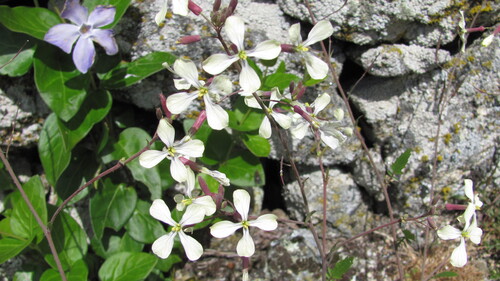
Wild Radish
Raphanus raphanistrum
—
Not native
Not native to Virginia. How scores work Is it native here?
Profile 71%
- Height
- 1–2.5 feet
- Light
- Full sun, Partial shade
- Soil moisture
- Usually moist
At a glance
- Life cycle
- Annual or biennial
Not yet recorded · Spread · Leaves · Bloom
This plant is missing most of its facts, so Quercus is looking them up in old botany books.
Recorded in 47 Virginia counties.
Ecological relationships
Who uses this plant?
 18CaterpillarsGenus host records with ranges including VA
Genus host records with ranges including VA · Raphanus
- Achyra rantalisGarden Webworm Moth
- Agrotis ipsilonIpsilon Dart, Black Cutworm, Greasy Cutworm
- Anarta trifoliiThe Nutmeg, Clover Cutworm
- Apamea devastatorGlassy Borer, Glassy Cutworm Moth
- Clepsis persicanaWhite Triangle Tortrix
- Elasmopalpus lignosellaLesser Cornstalk Borer
- Euxoa messoriaReaper Dart, Darksided Cutworm, Dark-Sided Cutworm
- Euxoa tessellataTessellate Dart, Striped Cutworm
- Evergestis pallidataPurple-Backed Cabbageworm Moth
- Evergestis rimosalisCross-Striped Cabbageworm, Cross-Shaped Cabbageworm
Show all 18
- Feltia subterraneaSubterranean Dart, Granulate Cutworm
- Mythimna unipunctaArmyworm Moth, White Speck
- Pontia protodiceCheckered White
- Spilosoma virginicaVirginian Tiger Moth, Yellow Woolybear Moth, Yellow Bear
- Spodoptera frugiperdaFall Armyworm Moth
- Trichoplusia niNi Moth, Cabbage Looper Moth
- Udea rubigalisCelery Leaftier
- Xanthorhoe labradorensisLabrador Carpet, Packard’s Carpet
 —BeesSoutheastern regional records
 —Specialist beesPollen specialists
 2BirdsRecorded genus food-resource interactions; not a state feeding claim
Recorded genus food-resource interactions; not a state feeding claim · Raphanus
- Callipepla californicaCalifornia Quail
- Haemorhous mexicanusHouse Finch
Direct food only: birds recorded eating this genus across North America. Caterpillars on host plants also feed nesting birds. NC Native Plant Society: butterfly gardening
Growing and identification
Plant details
- Family
- Brassicaceae
- Soil pH
- Acidic to alkaline
- Flower color
- Yellow, pink, purple or white
What its natural habitat tells you
Safety has not been reviewed for this plant; check toxicity and thorns before planting.
Growing sources and scope
- Flower color · “Yellow, pink, purple or white” · NC Extension Plant Toolbox
- Height · “1–2.5 feet” · Minnesota Wildflowers
- Life cycle · “Annual or biennial” · NC Extension Plant Toolbox (ranked first; Minnesota Wildflowers differs)
- Light · “Full sun (6 or more hours of direct sunlight a day); Partial shade (direct sunlight only part of the day, 2-6 hours)” · NC Extension Plant Toolbox
- Soil · “Moist” · NC Extension Plant Toolbox
- Soil pH · “Acidic to alkaline” · NC Extension Plant Toolbox
Also known as
Charlock
Conservation status
| Virginia rank | SNA |
|---|---|
| Global rank | GNR |
| VA status | Not verified |
| Federal status | Not verified |
Native alternatives
Find natives for your gardenSources
- Digital Atlas of the Virginia Flora
- USDA PLANTS
- NatureServe Explorer
- Shropshire & Tallamy 2025, Lepidoptera of North America north of Mexico, ZooKeys 1261 (ODbL)
- Noori, Seltmann & Orr 2026, A curated and integrated dataset for exploring global bee-plant interactions (GloBI), Zenodo, CC BY 4.0
- Smith, Bachelder, Russell, Morales, Mosher & Seltmann 2024, Bee-Specialization-Modeling v0.6.1 (specialist host table compiled from J. Fowler's pollen specialist bee lists), Zenodo, CC BY 4.0
- Hurlbert, Olsen, Sawyer & Winner 2021, Avian Diet Database, Scientific Data 8: 260 (CC0)
- Narango, Tallamy & Shropshire 2020, Few keystone plant genera support the majority of Lepidoptera species, Nature Communications