

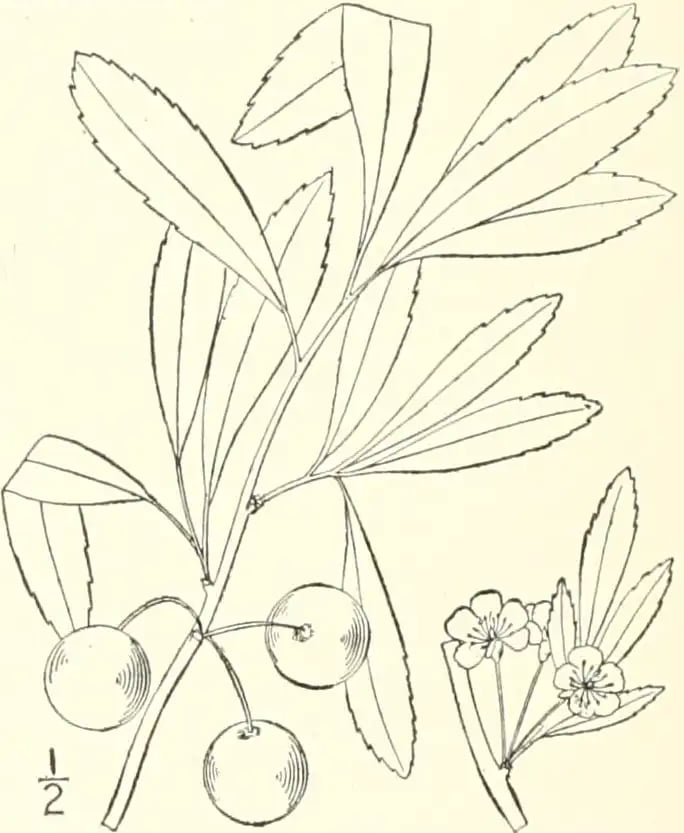
Prunus cuneata. Flora of the District of Columbia and vicinity (1919), Albert Spear Hitchock
“8. Prunus cuneata Raf. Thickets in sandy soil; infrequent. May.”
Listed in this book as Prunus cuneata
Prunus cuneata. Flora of the District of Columbia and vicinity (1919), Albert Spear Hitchock
Text on this page, read from the scan
. Prunus virginiana L. CHOKE CHERRY. Thickets and river banks; rare. May. Northern states, south to Ga. (Padus virginiana Mill.) 3. Prunus americana Marsh. WILD PLUM. Thickets and fence rows; frequent. Apr. Southern states, north to Conn. 4, Prunus cerasus L. SouR CHERRY. Occasionally escaped from cultivation. Apr. Native of the Old World. 5. Prunus avium L. SWEET CHERRY. Occasionally escaped from cultivation, along fence rows. Apr. Native of the Old World. 6. Prunus mahaleb L. MAHALEB. Roadsides and thickets; infrequent. May. Originally from Eur. 7, Prunus angustifolia Marsh. CHICKASAW PLUM. Thickets; frequent. Apr. Southern states, north to Del. (P. chicasa Michx.) 8. Prunus cuneata Raf. Thickets in sandy soil; infrequent. May. Northern states, south to N. C. 82. CAESALPINIACEAE. Senna Family. Leaves simple, entire; flowers reddish purple; pods winged. Trees..... 1. CERCIS. Leaves compound, of numerous leaflets; flowers yellow or green; pods not winged. Plants trees, armed with spines; flowers small, inconspicuous, greenish. 2. GLEDITSIA. Plants herbaceous, unarmed; flowers mostly large, showy, bright yellow. Plants pumesialy glabrous or nearly so; leaflets large, mostly 3.5-5 em. long; pods PUM OBST SEAS. BR Ee ica epee ee 3. CASSIA. Plants annual; leaflets small, mostly less than 2 cm. long; pods not jointed. 4. CHAMAECRISTA. 1. CERCIS L. 1. Cercis ca
Out of copyright. Scan courtesy of the Biodiversity Heritage Library.


