

Hoary Cress
Lepidium draba
Found in disturbed areas. FloraQuest, phone app (app page) What its natural habitat tells you
Not native to Virginia. How scores work Is it native here?
Profile 35%
- Height
- 8–24 inches
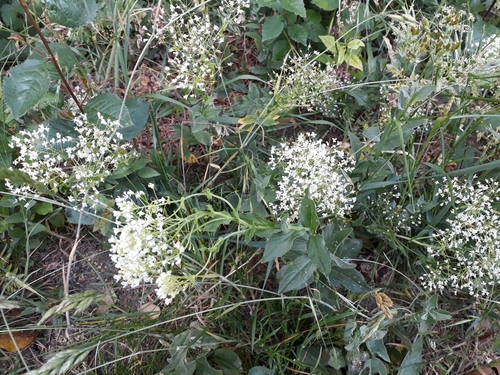
At a glance
- Life cycle
- Perennial
Not yet recorded · Spread · Light · Soil · Leaves · Bloom
This plant is missing most of its facts, so Quercus is looking them up in old botany books.
Recorded in 4 Virginia counties.
Natural habitats
Places it grows wild. Not a planting requirement. Each habitat page lists the plants and wildlife also found there.
Roadsides, fields and disturbed ground
Ground opened by people: roadsides, old fields, pastures, fencerows and lots.
Who uses this plant?
 10CaterpillarsGenus host records with ranges including VA
Genus host records with ranges including VA · Lepidium
- Anthocharis mideaFalcate Orangetip
- Chlorochlamys chloroleucariaBlackberry Looper Moth
- Euchloe olympiaOlympia Marble, Rosy Marble
- Eustixia pupulaSpotted Peppergrass Moth
- Feltia subterraneaSubterranean Dart, Granulate Cutworm
- Plutella porrectellaDame's Violet Moth, Dame's Rocket Moth
- Pontia protodiceCheckered White
- Spodoptera frugiperdaFall Armyworm Moth
- Thyridopteryx ephemeraeformisEvergreen Bagworm Moth
- Xanthorhoe labradorensisLabrador Carpet, Packard’s Carpet
 —BeesSoutheastern regional records
 —Specialist beesPollen specialists
 5BirdsRecorded genus food-resource interactions; not a state feeding claim
Recorded genus food-resource interactions; not a state feeding claim · Lepidium
- Callipepla californicaCalifornia Quail
- Centrocercus urophasianusGreater Sage-Grouse
- Columbina passerinaCommon Ground Dove
- Perdix perdixGray Partridge
- Zenaida macrouraMourning Dove
Direct food only: birds recorded eating this genus across North America. Caterpillars on host plants also feed nesting birds. NC Native Plant Society: butterfly gardening
Plant details
- Family
- Brassicaceae
Safety has not been reviewed for this plant; check toxicity and thorns before planting.
Growing sources and scope
- Height · “8–24 inches” · Minnesota Wildflowers
- Life cycle · “Perennial” · Minnesota Wildflowers
Also known as
Hoarycress; White Top Cress; White Topped Cress; Whitetop Cress; Whitetopped Cress; Whitlow Grass; Whitlowgrass
Conservation status
| Virginia rank | Not available |
|---|---|
| Global rank | Not available |
| VA status | Not verified |
| Federal status | Not verified |
Native alternatives
Find natives for your gardenSources
- Digital Atlas of the Virginia Flora
- Shropshire & Tallamy 2025, Lepidoptera of North America north of Mexico, ZooKeys 1261 (ODbL)
- Noori, Seltmann & Orr 2026, A curated and integrated dataset for exploring global bee-plant interactions (GloBI), Zenodo, CC BY 4.0
- Smith, Bachelder, Russell, Morales, Mosher & Seltmann 2024, Bee-Specialization-Modeling v0.6.1 (specialist host table compiled from J. Fowler's pollen specialist bee lists), Zenodo, CC BY 4.0
- Hurlbert, Olsen, Sawyer & Winner 2021, Avian Diet Database, Scientific Data 8: 260 (CC0)
- Narango, Tallamy & Shropshire 2020, Few keystone plant genera support the majority of Lepidoptera species, Nature Communications