

Woodland Lettuce
Lactuca floridana
Found in moist and moderately dry forests. Weakley, Flora of the Southeastern United States (2025), Northern Tier edition What its natural habitat tells you
Native to Virginia. How scores work Is it native here?
Profile 100%
- Height
- 2–7 feet
- Spread
- 1–2 feet
- Light
- Deep shade, Partial shade
- Soil moisture
- Usually moist
Space about 1.5 ft apart from its recorded spread, about 44 per 100 sq ft. Enter your bed size for a count
Will it fit your yard?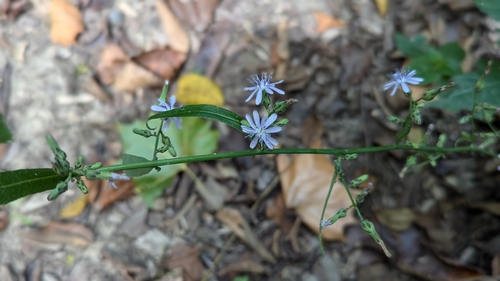
At a glance
- Life cycle
- Annual or biennial
- Bloom
- Summer and fall
Not yet recorded · Leaves
Recorded in 78 Virginia counties.
Natural habitats
Places it grows wild. Not a planting requirement. Each habitat page lists the plants and wildlife also found there.
Forests between dry and moist, often oak-hickory on slopes.
Who uses this plant?
 55CaterpillarsGenus host records with ranges including VA
Genus host records with ranges including VA · Lactuca
- Agrotis ipsilonIpsilon Dart, Black Cutworm, Greasy Cutworm
- Agrotis vetustaOld Man Dart
- Anagrapha falciferaCelery Looper Moth
- Anarta trifoliiThe Nutmeg, Clover Cutworm
- Apamea amputatrixYellow-Headed Cutworm Moth
- Apamea devastatorGlassy Borer, Glassy Cutworm Moth
- Apantesis carlottaCarlotta's Tiger Moth
- Apantesis virgoVirgin Tiger Moth
- Arctia parthenosSt. Lawrence Tiger Moth
- Autographa precationisCommon Looper Moth
Show all 55
- Cerastis tenebriferaReddish Speckled Dart
- Chrysodeixis includensSoybean Looper Moth
- Chytolita morbidalisMorbid Owlet
- Condica vecorsDusky Groundling
- Cucullia intermediaIntermediate Cucullia, Goldenrod Cutworm, Dashed Paint, Intermediate Hooded Owlet Moth
- Dichomeris ligulellaPalmerworm
- Estigmene acreaSalt Marsh Moth, Acrea Moth
- Euxoa messoriaReaper Dart, Darksided Cutworm, Dark-Sided Cutworm
- Euxoa tessellataTessellate Dart, Striped Cutworm
- Feltia herilisMaster's Dart
- Feltia jaculiferaDingy Cutworm
- Feltia subterraneaSubterranean Dart, Granulate Cutworm
- Helicoverpa zeaCorn Earworm Moth
- Heliothis phloxiphagaSpotted Straw Sun Moth, Darker Spotted Straw Moth
- Homoeosoma electellaSunflower Moth
- Hyalophora cecropiaCecropia Silkmoth, Cecropia Moth
- Hyles lineataWhite-Lined Sphinx
- Lacinipolia implicataImplicit Arches
- Lacinipolia renigeraBristly Ground Cat, Bristly Cutworm Moth, Kidney Spotted "Mamestra"
- Macaria ulsterataBirch Angle, Peacock Moth
- Manduca sextaCarolina Sphinx, Tomatoe Sphinx, Tobacco Hornworm
- Megalographa bilobaBilobed Looper Moth
- Mythimna unipunctaArmyworm Moth, White Speck
- Pagara simplexMouse-Colored Lichen Moth
- Papaipema cataphractaBurdock Border, Potato-Stalk Borer
- Phalaenostola metonalisPale Epidelta, Pale Phalaenostola
- Phycitodes reliquellaWhite-Edged Phycitodes
- Platynota stultanaOmnivorous Leafroller
- Pyrrharctia isabellaIsabella Tiger Moth, Banded Woolybear
- Scopula cacuminariaFrosted Tan Wave
- Spaelotis clandestinaClandestine Dart, W-Marked Cutworm
- Spilosoma congruaAgreeable Tiger Moth
- Spodoptera eridaniaSouthern Armyworm Moth
- Spodoptera frugiperdaFall Armyworm Moth
- Spodoptera ornithogalliYellow-Striped Armyworm Moth, Cotton Cutworm
- Spoladea recurvalisHawaiian Beet Webworm
- Sutyna privataCheckered Sallow, Private Sallow
- Trichoplusia niNi Moth, Cabbage Looper Moth
- Udea rubigalisCelery Leaftier
- Vanessa carduiPainted Lady, Cosmopolite
- Xanthopastis regnatrixConvict Caterpillar, Spanish Quaker, Spanish Moth
- Xestia c-nigrumSpotted Cut-Worm, Setaceous Hebrew Character, Lesser Black-letter Dart
- Xestia dolosaGreater Black-Letter Dart, Greater Spotted Cutworm
- Eucosma ornatula
- Thyraylia bunteana
 24BeesSoutheastern regional records
Southeastern regional records · Lactuca
Individual names are not available yet.
Noori, Seltmann & Orr 2026, A curated and integrated dataset for exploring global bee-plant interactions (GloBI), Zenodo, CC BY 4.0 9Specialist beesPollen specialists
Pollen specialists · Lactuca
- Andrena chromotricha
- Andrena runcinatae
- Ashmeadiella bucconis
- Dianthidium curvatum
- Dianthidium simile
- Melissodes confusus
- Melissodes illatus
- Melissodes subillatus
- Melissodes vernoniae
 7BirdsRecorded genus food-resource interactions; not a state feeding claim
Recorded genus food-resource interactions; not a state feeding claim · Lactuca
- Callipepla californicaCalifornia Quail
- Centrocercus urophasianusGreater Sage-Grouse
- Dendragapus obscurusDusky Grouse
- Meleagris gallopavoWild Turkey
- Oreortyx pictusMountain Quail
- Perdix perdixGray Partridge
- Zonotrichia leucophrysWhite-crowned Sparrow
Direct food only: birds recorded eating this genus across North America. Caterpillars on host plants also feed nesting birds. NC Native Plant Society: butterfly gardening
No records yet · Ants · Beetles · Flies · Adult butterflies / moths · Other wasps · Other insects
Plant details
- Family
- Asteraceae
- Soil pH
- Acidic to neutral
- Flower color
- Blue, purple or white
Safety has not been reviewed for this plant; check toxicity and thorns before planting.
Growing sources and scope
- Bloom · “Summer and fall” · NC Extension Plant Toolbox (ranked first; Weakley, Flora of the Southeastern United States (2025), Carolinas & Georgia edition differs)
- Flower color · “Blue, purple or white” · NC Extension Plant Toolbox (ranked first; Lady Bird Johnson Wildflower Center differs)
- Height · “2–7 feet” · NC Extension Plant Toolbox (ranked first; Lady Bird Johnson Wildflower Center, Minnesota Wildflowers differ)
- Life cycle · “Annual or biennial” · NC Extension Plant Toolbox
- Light · “Deep shade (less than 2 hours to no direct sunlight); Partial shade (direct sunlight only part of the day, 2-6 hours)” · NC Extension Plant Toolbox (ranked first; Lady Bird Johnson Wildflower Center, Missouri Botanical Garden Plant Finder differ)
- Soil · “Moist; Occasionally wet” · NC Extension Plant Toolbox (ranked first; Lady Bird Johnson Wildflower Center, Missouri Botanical Garden Plant Finder differ)
- Soil pH · “Acidic to neutral” · NC Extension Plant Toolbox
- Spread · “1–2 feet” · NC Extension Plant Toolbox
Also known as
Woodland Blue Lettuce
Conservation status
| Virginia rank | S3S4 |
|---|---|
| Global rank | G5 |
| VA status | Not verified |
| Federal status | Not verified |
Will it fit your yard?
Check this plant against your county, sun and soil moisture. Conditions are checked in your browser.
Sources
- Digital Atlas of the Virginia Flora
- USDA PLANTS
- Vascular Plants of North Carolina (NC Natural Heritage Program)
- Weakley, Flora of the Southeastern United States (2025), Northern Tier edition
- NatureServe Explorer
- Shropshire & Tallamy 2025, Lepidoptera of North America north of Mexico, ZooKeys 1261 (ODbL)
- Noori, Seltmann & Orr 2026, A curated and integrated dataset for exploring global bee-plant interactions (GloBI), Zenodo, CC BY 4.0
- Smith, Bachelder, Russell, Morales, Mosher & Seltmann 2024, Bee-Specialization-Modeling v0.6.1 (specialist host table compiled from J. Fowler's pollen specialist bee lists), Zenodo, CC BY 4.0
- Hurlbert, Olsen, Sawyer & Winner 2021, Avian Diet Database, Scientific Data 8: 260 (CC0)
- Narango, Tallamy & Shropshire 2020, Few keystone plant genera support the majority of Lepidoptera species, Nature Communications