

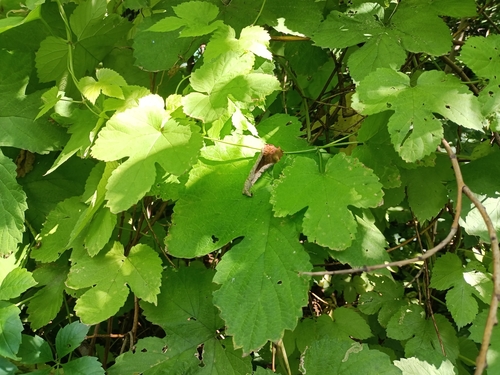
Humulus lupulus
Humulus lupulus
Found in disturbed areas. Weakley, Flora of the Southeastern United States (2025), Northern Tier edition What its natural habitat tells you
Not native to Virginia. How scores work Is it native here?
Profile 71%
- Height
- 15–20 feet
- Spread
- 3–6 feet
- Light
- Full sun, Partial shade
- Soil moisture
- Usually moist
At a glance
- Life cycle
- Perennial
Not yet recorded · Leaves · Bloom
This plant is missing most of its facts, so Quercus is looking them up in old botany books.
Recorded in 39 Virginia counties.
Natural habitats
Places it grows wild. Not a planting requirement. Each habitat page lists the plants and wildlife also found there.
Roadsides, fields and disturbed ground
Ground opened by people: roadsides, old fields, pastures, fencerows and lots.
Who uses this plant?
 24CaterpillarsGenus host records with ranges including VA
Genus host records with ranges including VA · Humulus
- Polygonia interrogationisQuestion Mark
- Actias lunaLuna Moth
- Automeris ioIo Moth
- Celastrina neglectaSummer Azure
- Diachrysia ballucaSplendid Brass Looper, Green-Patched Looper
- Erannis tiliariaLinden Looper Moth, Western Winter Moth, Lime Looper
- Eudryas grataBeautiful Wood-Nymph
- Hyalophora cecropiaCecropia Silkmoth, Cecropia Moth
- Hydraecia immanisHop Borer, Hop Vine Borer
- Hypena humuliHop Snout Moth, Hop Vine Snout, Hop Looper
Show all 24
- Hyphantria cuneaFall Webworm
- Iridopsis humariaSmall Purplish Gray
- Lophocampa caryaeHickory Tussock Moth, Hickory Tiger Moth
- Melanchra pictaPainted Arches, Zebra Caterpillar Moth
- Nematocampa resistariaFilament Bearer, Horned Spanworm Moth
- Nymphalis antiopaMourning Cloak
- Nymphalis l-albumCompton Tortoiseshell
- Orgyia leucostigmaWhite-Marked Tussock Moth
- Papaipema rutilaMayapple Borer
- Papilio cresphontesEastern Giant Swallowtail
- Papilio glaucusEastern Tiger Swallowtail
- Polygonia commaEastern Comma
- Strymon melinusGray Hairstreak
- Thyridopteryx ephemeraeformisEvergreen Bagworm Moth
 —BeesSoutheastern regional records
 —Specialist beesPollen specialists
 —BirdsRecorded genus food-resource interactions; not a state feeding claim
Plant details
- Family
- Cannabaceae
- Hardiness
- Zones 5a–8b
- Soil pH
- Acidic to alkaline
- Flower color
- Yellow, green or white
Safety has not been reviewed for this plant; check toxicity and thorns before planting.
Growing sources and scope
- Flower color · “Yellow, green or white” · NC Extension Plant Toolbox (ranked first; Lady Bird Johnson Wildflower Center differs)
- Hardiness · “Zones 5a–8b” · NC Extension Plant Toolbox
- Height · “15–20 feet” · NC Extension Plant Toolbox (ranked first; Minnesota Wildflowers differs)
- Life cycle · “Perennial” · NC Extension Plant Toolbox
- Light · “Full sun (6 or more hours of direct sunlight a day); Partial shade (direct sunlight only part of the day, 2-6 hours)” · NC Extension Plant Toolbox
- Soil · “Moist; Occasionally wet” · NC Extension Plant Toolbox
- Soil pH · “Acidic to alkaline” · NC Extension Plant Toolbox
- Spread · “3–6 feet” · NC Extension Plant Toolbox
Conservation status
| Virginia rank | S4 |
|---|---|
| Global rank | G5TNR |
| VA status | Not verified |
| Federal status | Not verified |
Native alternatives
Find natives for your gardenSources
- Weakley, Flora of the Southeastern United States (2025), Northern Tier edition
- USDA PLANTS
- NatureServe Explorer
- Virginia occurrence source
- Shropshire & Tallamy 2025, Lepidoptera of North America north of Mexico, ZooKeys 1261 (ODbL)
- Noori, Seltmann & Orr 2026, A curated and integrated dataset for exploring global bee-plant interactions (GloBI), Zenodo, CC BY 4.0
- Smith, Bachelder, Russell, Morales, Mosher & Seltmann 2024, Bee-Specialization-Modeling v0.6.1 (specialist host table compiled from J. Fowler's pollen specialist bee lists), Zenodo, CC BY 4.0
- Hurlbert, Olsen, Sawyer & Winner 2021, Avian Diet Database, Scientific Data 8: 260 (CC0)
- Narango, Tallamy & Shropshire 2020, Few keystone plant genera support the majority of Lepidoptera species, Nature Communications