

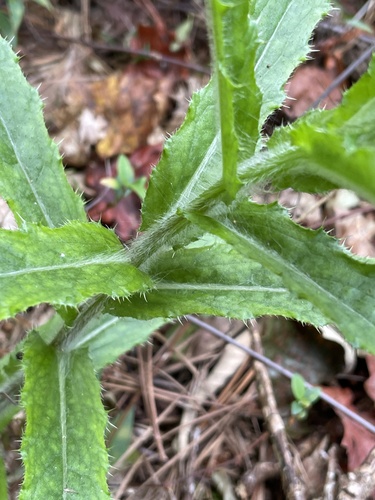
Sandhill Thistle
Cirsium repandum
Found in longleaf pine sandhills, other dry sandy habitats. Weakley, Flora of the Southeastern United States (2025), Northern Tier edition What its natural habitat tells you
Native to Virginia. How scores work Is it native here?
Profile 94%
- Height
- Up to about 32 inches
- Light
- Partial shade, Full sun
- Soil moisture
- Dry to wet
At a glance
- Life cycle
- Perennial
- Bloom
- May to July
Not yet recorded · Spread · Leaves
Recorded in 1 Virginia county.
Natural habitats
Places it grows wild. Not a planting requirement. Each habitat page lists the plants and wildlife also found there.
Dry, deep-sand ridges with longleaf pine and turkey oak, kept open by fire.
Also found with this plant
Wildlife whose habitat models include habitats this plant grows in, in Virginia. Shared habitat, not food. 79 animals.
- White-throated SparrowZonotrichia albicollis
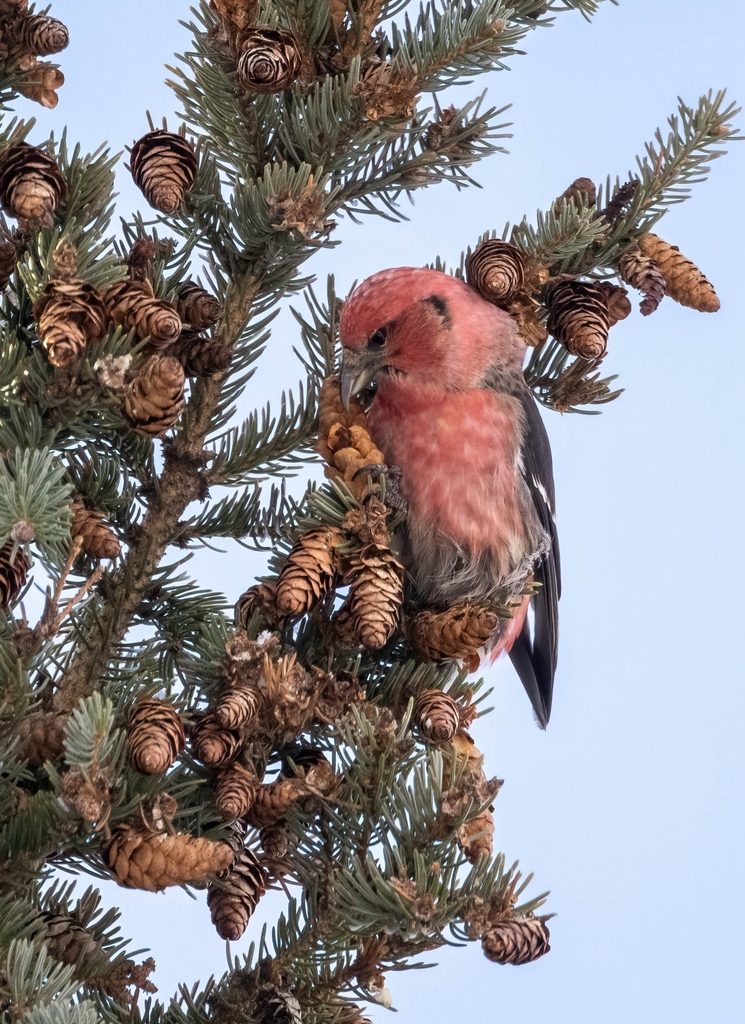
- White-winged CrossbillLoxia leucoptera
- Wild TurkeyMeleagris gallopavo
- Yellow-bellied SapsuckerSphyrapicus varius
- Yellow-breasted ChatIcteria virens
- Yellow-rumped WarblerDendroica coronata
- Yellow-throated WarblerDendroica dominica






Who uses this plant?
 34CaterpillarsGenus host records with ranges including VA
Genus host records with ranges including VA · Cirsium
- Achyra rantalisGarden Webworm Moth
- Anagrapha falciferaCelery Looper Moth
- Autographa precationisCommon Looper Moth
- Calephelis virginiensisNorthern Metalmark
- Cenopis reticulatanaReticulated Fruitworm Moth
- Choristoneura rosaceanaOblique-Banded Leafroller Moth, Rosaceous Leaf Roller
- Dicymolomia julianalisJulia's Dicymolomia
- Epiblema scudderianaScudder's Epiblema, Goldenrod Gall Moth
- Homoeosoma electellaSunflower Moth
- Lipocosmodes fuliginosalisSooty Lipocosmodes
Show all 34
- Megalographa bilobaBilobed Looper Moth
- Orthodes cynicaCynical Quaker, Cynical Groundcat
- Papaipema arctivorensNorthern Burdock Borer Moth
- Papaipema cataphractaBurdock Border, Potato-Stalk Borer
- Papaipema cerussataIronweed Borer Moth
- Papaipema insulidensRagwort Stem Borer
- Papaipema nebrisStalk Borer
- Papilio glaucusEastern Tiger Swallowtail
- Paralobesia viteanaAmerican Vine Moth, Grape Berry Moth
- Phlogophora irisOlive Angle Shades
- Phyciodes tharosPearl Crescent, Crescentspot
- Phycitodes reliquellaWhite-Edged Phycitodes
- Platyptilia carduidactylusArtichoke Plume Moth
- Pyrausta subsequalisMottled Pyrausta
- Synchlora frondariaSouthern Emerald
- Udea rubigalisCelery Leaftier
- Vanessa carduiPainted Lady, Cosmopolite
- Vanessa virginiensisAmerican Lady, American Painted Lady
- Walshia miscecolorellaSweetclover Root Borer Moth
- Xestia c-nigrumSpotted Cut-Worm, Setaceous Hebrew Character, Lesser Black-letter Dart
- Xestia dolosaGreater Black-Letter Dart, Greater Spotted Cutworm
- Hedya cyanana
- Homoeosoma pedionnastes
- Pseudotelphusa carduiella
 60BeesSoutheastern regional records
Southeastern regional records · Cirsium
Individual names are not available yet.
Noori, Seltmann & Orr 2026, A curated and integrated dataset for exploring global bee-plant interactions (GloBI), Zenodo, CC BY 4.0 12Specialist beesPollen specialists
Pollen specialists · Cirsium
- Andrena nubecula
- Andrena placata
- Andrena runcinatae
- Andrena simplex
- Diadasia enavata
- Megachile pugnata
- Melissodes confusus
- Melissodes desponsus
- Melissodes illatus
- Melissodes rivalis
Show all 12
- Osmia chalybea
- Osmia texana
 6BirdsRecorded genus food-resource interactions; not a state feeding claim
Recorded genus food-resource interactions; not a state feeding claim · Cirsium
- Callipepla californicaCalifornia Quail
- Columbina passerinaCommon Ground Dove
- Meleagris gallopavoWild Turkey
- Perdix perdixGray Partridge
- Spizella pusillaField Sparrow
- Zenaida macrouraMourning Dove
Direct food only: birds recorded eating this genus across North America. Caterpillars on host plants also feed nesting birds. NC Native Plant Society: butterfly gardening
No records yet · Ants · Beetles · Flies · Adult butterflies / moths · Other wasps · Other insects
Plant details
- Family
- Asteraceae
- Flower color
- Purple
Safety has not been reviewed for this plant; check toxicity and thorns before planting.
Growing sources and scope
- Bloom · “May to July” · Weakley, Flora of the Southeastern United States (2025), Carolinas & Georgia edition · Carolinas and Georgia
- Flower color · “Purple” · Lady Bird Johnson Wildflower Center
- Height · “Up to about 32 inches” · Lady Bird Johnson Wildflower Center
- Life cycle · “Perennial” · Lady Bird Johnson Wildflower Center
- Light · “Partial shade; Full sun (documented habitat)” · Weakley, Flora of the Southeastern United States (2025), Carolinas & Georgia edition · Carolinas and Georgia
- primary_flower_color · “purple” · Lady Bird Johnson Wildflower Center
- Soil · “Dry; Moist; Wet (documented habitat)” · Weakley, Flora of the Southeastern United States (2025), Carolinas & Georgia edition · Carolinas and Georgia
Also known as
Carduus repandus; plumeless thistle; plumeless-thistle
Conservation status
| Virginia rank | SH |
|---|---|
| Global rank | G5 |
| VA status | Not verified |
| Federal status | Not verified |
Will it fit your yard?
Check this plant against your county, sun and soil moisture. Conditions are checked in your browser.
Sources
- Virginia DCR Natural Heritage rare plant list
- Digital Atlas of the Virginia Flora
- USDA PLANTS
- Vascular Plants of North Carolina (NC Natural Heritage Program)
- Weakley, Flora of the Southeastern United States (2025), Carolinas & Georgia edition
- NatureServe Explorer
- Shropshire & Tallamy 2025, Lepidoptera of North America north of Mexico, ZooKeys 1261 (ODbL)
- Noori, Seltmann & Orr 2026, A curated and integrated dataset for exploring global bee-plant interactions (GloBI), Zenodo, CC BY 4.0
- Smith, Bachelder, Russell, Morales, Mosher & Seltmann 2024, Bee-Specialization-Modeling v0.6.1 (specialist host table compiled from J. Fowler's pollen specialist bee lists), Zenodo, CC BY 4.0
- Hurlbert, Olsen, Sawyer & Winner 2021, Avian Diet Database, Scientific Data 8: 260 (CC0)
- Narango, Tallamy & Shropshire 2020, Few keystone plant genera support the majority of Lepidoptera species, Nature Communications