Ecological relationships
Who uses this plant?
 18CaterpillarsGenus host records with ranges including SC
Genus host records with ranges including SC · Vicia
- Anicla illapsaSnowy Dart
- Archips argyrospilaFruit-Tree Leafroller Moth
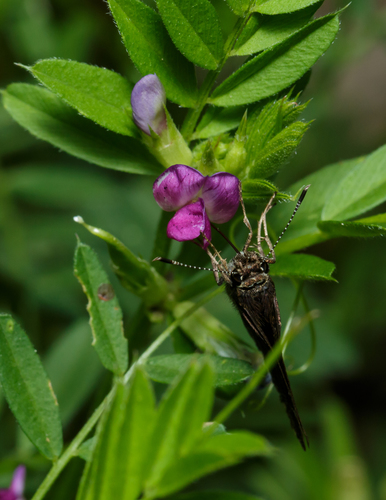
- Caenurgia chlorophaVetch Looper Moth
- Cecropterus pyladesNorthern Cloudywing
- Colias eurythemeOrange Sulphur, Alfalfa Butterfly
- Colias philodiceClouded Sulphur, Clover Butterfly
- Cupido comyntasEastern Tailed-Blue
- Elasmopalpus lignosellaLesser Cornstalk Borer
- Eurema dairaBarred Yellow, Barred Sulphur
- Gesta baptisiaeWild Indigo Duskywing, Baptisia Duskywing
Show all 18
- Glaucopsyche lygdamusSilvery Blue
- Helicoverpa zeaCorn Earworm Moth
- Hypena scabraGreen Cloverworm Bomolocha, Black Snout
- Mocis latipesSmall Mocis, Striped Grass Looper
- Spodoptera frugiperdaFall Armyworm Moth
- Strymon melinusGray Hairstreak
- Urbanus proteusLong-Tailed Skipper, Bean Leaf Roller
- Filatima xanthuris
 —BeesSoutheastern regional records
 1Specialist beesPollen specialists
 10BirdsRecorded genus food-resource interactions; not a state feeding claim
Recorded genus food-resource interactions; not a state feeding claim · Vicia
- Bonasa umbellusRuffed Grouse
- Callipepla californicaCalifornia Quail
- Colinus virginianusNorthern Bobwhite
- Columbina passerinaCommon Ground Dove
- Cyrtonyx montezumaeMontezuma Quail
- Francolinus francolinusBlack Francolin
- Meleagris gallopavoWild Turkey
- Oreortyx pictusMountain Quail
- Perdix perdixGray Partridge
- Zenaida macrouraMourning Dove
Growing and identification
Plant details
- Family
- Fabaceae
- Hardiness
- Zones 2a–10b
- Soil pH
- Neutral
- Flower color
- Purple
- Growth rate
- Rapid
- Growth habit
- Single stem
- Foliage color
- Green
- Fruit begins
- Spring
- Fruit ends
- Spring
Safety has not been reviewed for this plant; check toxicity and thorns before planting.
Growing sources and scope
- Bloom · “Early spring” · USDA PLANTS · Nationwide species characteristics; local growing conditions may vary
- Flower color · “Purple” · NC Extension Plant Toolbox
- Foliage color · “Green” · USDA PLANTS · Nationwide species characteristics; local growing conditions may vary
- Fruit begins · “Spring” · USDA PLANTS · Nationwide species characteristics; local growing conditions may vary
- Fruit ends · “Spring” · USDA PLANTS · Nationwide species characteristics; local growing conditions may vary
- Growth habit · “Single stem” · USDA PLANTS · Nationwide species characteristics; local growing conditions may vary
- Growth rate · “Rapid” · USDA PLANTS · Nationwide species characteristics; local growing conditions may vary
- Hardiness · “Zones 2a–10b” · NC Extension Plant Toolbox
- Height · “About 4 feet” · USDA PLANTS · Nationwide species characteristics; local growing conditions may vary
- Leaf retention · “Deciduous” · USDA PLANTS · Nationwide species characteristics; local growing conditions may vary
- Life cycle · “Annual” · NC Extension Plant Toolbox
- Light · “Full sun (6 or more hours of direct sunlight a day); Partial shade (direct sunlight only part of the day, 2-6 hours)” · NC Extension Plant Toolbox
- primary_flower_color · “purple” · USDA PLANTS
- Soil · “Moist; Occasionally dry” · NC Extension Plant Toolbox
- Soil pH · “Neutral” · NC Extension Plant Toolbox
Also known as
Common Vetch
Conservation status
| South Carolina rank | Not available |
|---|---|
| Global rank | GNR |
| SC status | Not verified |
| Federal status | Not verified |
Native alternatives
Find natives for your gardenSources
- tnky_atlas
- usda
- South Carolina occurrence source
- Shropshire & Tallamy 2025, Lepidoptera of North America north of Mexico, ZooKeys 1261 (ODbL)
- Noori, Seltmann & Orr 2026, A curated and integrated dataset for exploring global bee-plant interactions (GloBI), Zenodo, CC BY 4.0
- Smith, Bachelder, Russell, Morales, Mosher & Seltmann 2024, Bee-Specialization-Modeling v0.6.1 (specialist host table compiled from J. Fowler's pollen specialist bee lists), Zenodo, CC BY 4.0
- Hurlbert, Olsen, Sawyer & Winner 2021, Avian Diet Database, Scientific Data 8: 260 (CC0)
- Narango, Tallamy & Shropshire 2020, Few keystone plant genera support the majority of Lepidoptera species, Nature Communications