

White Heath Aster
Symphyotrichum ericoides
Native to Mississippi. How scores work Is it native here?
Profile 88%
- Height
- 1.5–3 feet
- Spread
- 1–1.5 feet
- Light
- Full sun
- Soil moisture
- Dry to average
Space about 1 ft apart from its recorded spread, about 100 per 100 sq ft. Enter your bed size for a count
Will it fit your yard?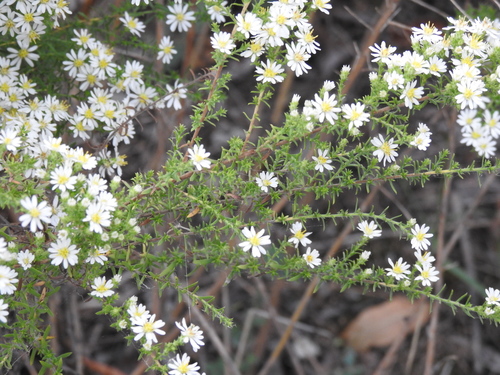
Rare or protected plant. Specialist conservation planting; excluded from routine garden suggestions. Plant caution source
Hidden from default planting suggestions. Wildlife value and native status remain unchanged.
At a glance
- Life cycle
- Perennial
- Leaves
- Deciduous
Recorded in 6 Mississippi counties.
Who uses this plant?
 69CaterpillarsGenus host records with ranges including MS
Genus host records with ranges including MS · Symphyotrichum
- Phyciodes tharosPearl Crescent
- Abagrotis magnicupidaOne-Dotted Dart
- Acharia stimuleaSaddleback Caterpillar Moth
- Agnorisma badinodisPale-Banded Dart
- Agrotis gladiariaSwordsman Dart, Clay-Backed Cut-Worm
- Allagrapha aereaUnspotted Looper Moth
- Anthanassa texanaTexan Crescent
- Bucculatrix angustataNarrow Bucculatrix
- Cenopis reticulatanaReticulated Fruitworm Moth
- Chlorochlamys chloroleucariaBlackberry Looper Moth
Show all 69
- Chlosyne gorgoneGorgone Checkerspot
- Chlosyne nycteisSilvery Checkerspot
- Chytonix palliatriculaCloaked Marvel
- Condica sutorThe Cobbler, Cobbler Groundling
- Condica vidensWhite-Dotted Groundling
- Ctenoplusia oxygrammaSharp-Stigma Looper Moth
- Cucullia asteroidesThe Asteroid, Asteroid Paint, Goldenrod Hooded Owlet
- Dichomeris juncidellaOrange-Dotted Dichomeris
- Dichomeris ochripalpellaShining Dichomeris Moth
- Dichomeris setosellaHairy Dichomeris
- Epiblema scudderianaScudder's Epiblema, Goldenrod Gall Moth
- Eucosma parmatanaAster Eucosma, Aster Flowerhead Caterpillar
- Eucosma tomonanaAster-Head Phaneta
- Eupithecia miserulataCommon Eupithacia, Common Pug
- Euplexia benesimilisAmerican Angle Shades
- Eusarca confusariaConfused Eusarca
- Feltia herilisMaster's Dart
- Feltia jaculiferaDingy Cutworm
- Heliothis phloxiphagaSpotted Straw Sun Moth, Darker Spotted Straw Moth
- Herpetogramma pertextalisBold-Feathered Grass Moth
- Herpetogramma thestealisZigzag Herpetogramma, Subtle-Feathered Grass Moth
- Homoeosoma electellaSunflower Moth
- Junonia coeniaCommon Buckeye
- Lacinipolia meditataThe Thinker
- Lacinipolia renigeraBristly Ground Cat, Bristly Cutworm Moth, Kidney Spotted "Mamestra"
- Lascoria ambigualisAmbiguous Moth, Ambiguous Litter Moth
- Leuconycta diphteroidesGreen Leuconycta
- Lioptilodes albistriolatusMousy Plume Moth
- Mythimna unipunctaArmyworm Moth, White Speck
- Orthodes majusculaRustic Quaker, Rustic Groundcat
- Palthis angulalisDark-Spotted Palthis
- Papaipema cataphractaBurdock Border, Potato-Stalk Borer
- Papaipema nebrisStalk Borer
- Phycitodes reliquellaWhite-Edged Phycitodes
- Platynota flavedanaBlack-Shaded Platynota
- Pleuroprucha insulsariaCommon Tan Wave
- Ponometia candefactaOlive-Shaded Bird-Dropping Moth
- Pyrrharctia isabellaIsabella Tiger Moth, Banded Woolybear
- Schinia arcigeraArcigera Flower Moth
- Schinia septentrionalisNorthern Flower Moth
- Scopula inductataSoft-Lined Wave
- Sparganothis sulfureanaSparganothis Fruitworm Moth, Sulfur Leafroller, False Yellow-Head
- Spodoptera frugiperdaFall Armyworm Moth
- Spodoptera ornithogalliYellow-Striped Armyworm Moth, Cotton Cutworm
- Synchlora aerataWavy-Lined Emerald, Camouflaged Looper
- Synchlora frondariaSouthern Emerald
- Tornos scolopacinariaDimorphic Gray
- Trichoplusia niNi Moth, Cabbage Looper Moth
- Udea rubigalisCelery Leaftier
- Vanessa virginiensisAmerican Lady, American Painted Lady
- Acrocercops astericola
- Carmenta ithacae
- Coleophora dextrella
- Dichomeris agonia
- Hellinsia glenni
- Landryia impositella
- Paralobesia vernoniana
- Pseudotelphusa carduiella
- Xenotemna pallorana
 79BeesSoutheastern regional records
Southeastern regional records · Symphyotrichum
Individual names are not available yet.
Noori, Seltmann & Orr 2026, A curated and integrated dataset for exploring global bee-plant interactions (GloBI), Zenodo, CC BY 4.0 45Specialist beesPollen specialists
Pollen specialists · Symphyotrichum
- Andrena asteris
- Andrena asteroides
- Andrena braccata
- Andrena bullata
- Andrena canadensis
- Andrena chromotricha
- Andrena fulvipennis
- Andrena hirticincta
- Andrena nubecula
- Andrena placata
Show all 45
- Andrena simplex
- Anthophorula asteris
- Ashmeadiella bucconis
- Calliopsis coloradensis
- Colletes americanus
- Colletes compactus
- Colletes rufocinctus
- Colletes simulans
- Colletes speculiferus
- Dianthidium curvatum
- Dianthidium simile
- Dieunomia nevadensis
- Melissodes boltoniae
- Melissodes confusus
- Melissodes denticulatus
- Melissodes dentiventris
- Melissodes druriellus
- Melissodes fumosus
- Melissodes illatus
- Melissodes menuachus
- Melissodes niveus
- Melissodes subillatus
- Melissodes trinodis
- Melissodes vernoniae
- Melissodes wheeleri
- Paranthidium jugatorium
- Perdita bruneri
- Perdita ignota
- Perdita octomaculata
- Perdita xanthismae
- Protandrena aestivalis
- Protandrena andrenoides
- Protandrena citripes
- Protandrena compositarum
- Protandrena illinoiensis
 3BirdsRecorded genus food-resource interactions; not a state feeding claim
Recorded genus food-resource interactions; not a state feeding claim · Aster
- Alectoris chukarChukar
- Bonasa umbellusRuffed Grouse
- Centrocercus urophasianusGreater Sage-Grouse
Direct food only: birds recorded eating this genus across North America. Caterpillars on host plants also feed nesting birds. NC Native Plant Society: butterfly gardening
No records yet · Ants · Beetles · Flies · Adult butterflies / moths · Other wasps · Other insects
Plant details
- Family
- Asteraceae
- Hardiness
- Zones 3a–9b
- Soil pH
- Alkaline
- Flower color
- Yellow, purple, red or white
What its natural habitat tells you
Growing sources and scope
- Flower color · “Yellow, purple, red or white” · NC Extension Plant Toolbox
- Hardiness · “Zones 3a–9b” · NC Extension Plant Toolbox
- Height · “1.5–3 feet” · NC Extension Plant Toolbox (ranked first; Minnesota Wildflowers differs)
- Leaves · “Deciduous” · NC Extension Plant Toolbox
- Life cycle · “Perennial” · NC Extension Plant Toolbox
- Light · “Full sun (6 or more hours of direct sunlight a day)” · NC Extension Plant Toolbox
- Soil · “Occasionally dry” · NC Extension Plant Toolbox
- Soil pH · “Alkaline” · NC Extension Plant Toolbox
- Spread · “1–1.5 feet” · NC Extension Plant Toolbox
Also known as
Squarrose White Aster
Conservation status
| Mississippi rank | S2 |
|---|---|
| Global rank | G5 |
| MS status | Not verified |
| Federal status | Not verified |
Will it fit your yard?
Check this plant against your county, sun and soil moisture. Conditions are checked in your browser.
Sources
- NatureServe Explorer
- USDA PLANTS
- Vascular Plants of North Carolina (NC Natural Heritage Program)
- Mississippi occurrence source
- Shropshire & Tallamy 2025, Lepidoptera of North America north of Mexico, ZooKeys 1261 (ODbL)
- Noori, Seltmann & Orr 2026, A curated and integrated dataset for exploring global bee-plant interactions (GloBI), Zenodo, CC BY 4.0
- Smith, Bachelder, Russell, Morales, Mosher & Seltmann 2024, Bee-Specialization-Modeling v0.6.1 (specialist host table compiled from J. Fowler's pollen specialist bee lists), Zenodo, CC BY 4.0
- Hurlbert, Olsen, Sawyer & Winner 2021, Avian Diet Database, Scientific Data 8: 260 (CC0)
- Narango, Tallamy & Shropshire 2020, Few keystone plant genera support the majority of Lepidoptera species, Nature Communications