

Wrinkle-leaf Goldenrod
Solidago rugosa
Arching sprays of yellow flowers bring late-season color above rough, wrinkled leaves.
Native to Mississippi (estimated). How scores work Is it native here?
Profile 100%
- Height
- 2–5 feet
- Spread
- 1.5–2.5 feet
- Light
- Full sun, Partial shade
- Soil moisture
- Somewhat dry to moist
Space about 2 ft apart from its recorded spread, about 25 per 100 sq ft. Enter your bed size for a count
Will it fit your yard?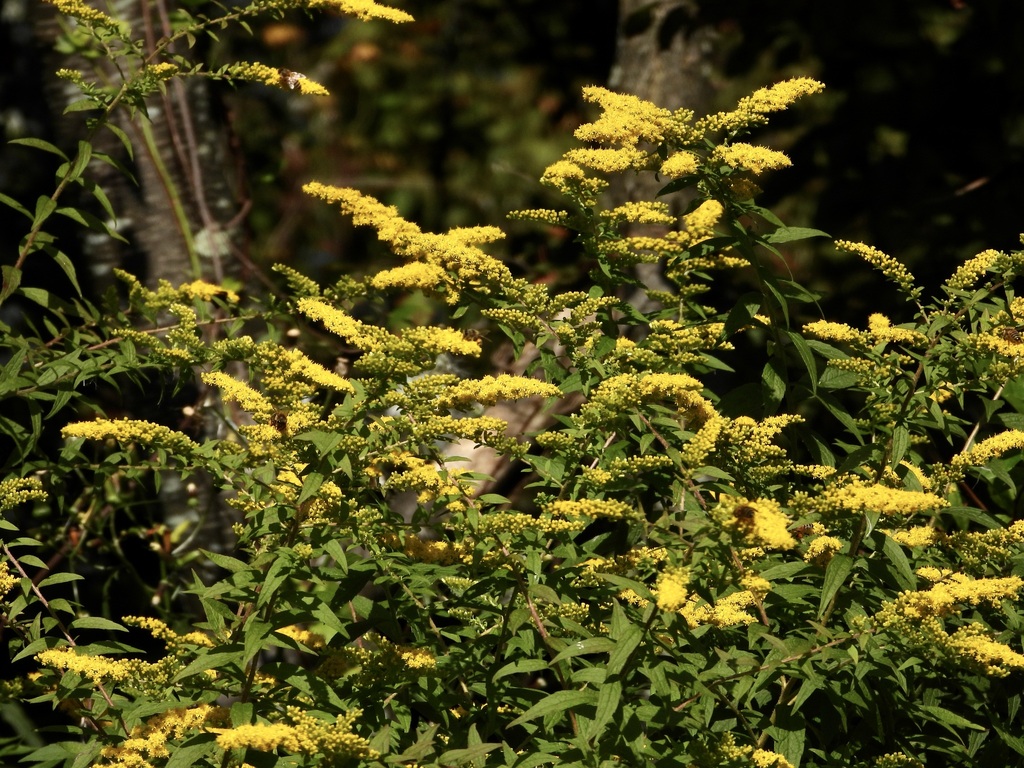
At a glance
- Life cycle
- Herbaceous perennial
- Leaves
- Deciduous
- Bloom
- August to October
- Fruiting season
- Fall
Recorded in 38 Mississippi counties.
Care
- Grows best in moist soil; tolerates occasional dry spells.
Who uses this plant?
 90CaterpillarsGenus host records with ranges including MS
Genus host records with ranges including MS · Solidago
- Aethes sexdentataSix-Toothed Aethes
- Agnorisma badinodisPale-Banded Dart
- Agonopterix pulvipennellaGoldenrod Leaffolder, Featherduster Agonopterix
- Agrotis gladiariaSwordsman Dart, Clay-Backed Cut-Worm
- Alsophila pometariaFall Cankerworm Moth
- Amorbia humerosanaWhite-Lined Leafroller Moth
- Anavitrinella pampinariaCommon Gray, Cranberry Spanworm
- Ancylis floridanaStrawberry Leafroller
- Archips purpuranaOmnivorous Leafroller Moth
- Argyrotaenia ivanaIvana Leafroller Moth
Show all 90
- Argyrotaenia velutinanaRed-Banded Leafroller Moth, Jack Pine Tube Moth
- Bucculatrix angustataNarrow Bucculatrix
- Chlorochlamys chloroleucariaBlackberry Looper Moth
- Chlosyne nycteisSilvery Checkerspot
- Choristoneura rosaceanaOblique-Banded Leafroller Moth, Rosaceous Leaf Roller
- Chrysodeixis includensSoybean Looper Moth
- Cisseps fulvicollisYellow-Collared Scape Moth
- Condica sutorThe Cobbler, Cobbler Groundling
- Condica vidensWhite-Dotted Groundling
- Cremastobombycia solidaginisGoldenrod Leafminer
- Ctenoplusia oxygrammaSharp-Stigma Looper Moth
- Cucullia asteroidesThe Asteroid, Asteroid Paint, Goldenrod Hooded Owlet
- Dichomeris inserrataIndented Dichomeris
- Dichomeris juncidellaOrange-Dotted Dichomeris
- Dichomeris ochripalpellaShining Dichomeris Moth
- Dichomeris setosellaHairy Dichomeris
- Endothenia hebesanaVerbena Bud Moth
- Epiblema otiosanaBidens Borer Moth
- Epiblema scudderianaScudder's Epiblema, Goldenrod Gall Moth
- Epiblema tripartitanaThree-Parted Epiblema
- Episimus argutanaSumac Leaftier
- Eucosma raracanaReddish Eucosma, Reddish Phaneta
- Euphydryas phaetonThe Baltimore, The Black Checker
- Eupithecia miserulataCommon Eupithacia, Common Pug
- Eusarca confusariaConfused Eusarca
- Feltia jaculiferaDingy Cutworm
- Gnorimoschema gallaesolidaginisGoldenrod Gall Moth
- Helicoverpa zeaCorn Earworm Moth
- Hellinsia kellicottiiGoldenrod Borer Plume Moth
- Herpetogramma aeglealisSerpentine Webworm
- Herpetogramma pertextalisBold-Feathered Grass Moth
- Herpetogramma thestealisZigzag Herpetogramma, Subtle-Feathered Grass Moth
- Iridopsis humariaSmall Purplish Gray
- Iridopsis larvariaBent-Line Gray
- Lacinipolia meditataThe Thinker
- Leuconycta diphteroidesGreen Leuconycta
- Lioptilodes albistriolatusMousy Plume Moth
- Nephelodes miniansBronzed Cutworm
- Orthodes cynicaCynical Quaker, Cynical Groundcat
- Orthodes majusculaRustic Quaker, Rustic Groundcat
- Ostrinia obumbratalisSmartweed Borer
- Palthis angulalisDark-Spotted Palthis
- Papaipema rutilaMayapple Borer
- Pelochrista cataclystianaSolidaga Eucosma, Solidaga Pelochrista
- Pelochrista derelictaDerelict Eucosma
- Pelochrista dorsisignatanaTriangle-Backed Eucosma
- Pelochrista robinsonanaRobinson's Pelochrista, Robinson's Eucosma
- Pelochrista similianaSimilar Eucosma
- Platynota idaeusalisTufted Apple-Bud Moth
- Platynota stultanaOmnivorous Leafroller
- Pleuroprucha insulsariaCommon Tan Wave
- Pseudeustrotia carneolaPink-Barred Lithacodia, Pink-Barred Pseudeustrotia
- Schinia nundinaGoldenrod Flower Moth
- Sonia constrictanaConstricted Sonia
- Sparganothis distinctaDistinct Sparganothis
- Sparganothis sulfureanaSparganothis Fruitworm Moth, Sulfur Leafroller, False Yellow-Head
- Spodoptera ornithogalliYellow-Striped Armyworm Moth, Cotton Cutworm
- Synchlora aerataWavy-Lined Emerald, Camouflaged Looper
- Synchlora frondariaSouthern Emerald
- Tricholita signataSignate Quaker, Signate Groundcat
- Udea rubigalisCelery Leaftier
- Utetheisa ornatrixOrnate Moth, Pink Underwing, Rattlebox Moth, Bella Moth
- Xanthotype urticariaFalse Crocus Geometer
- Xestia dolosaGreater Black-Letter Dart, Greater Spotted Cutworm
- Zale lunataLunate Zale
- Anania mysippusalis
- Bucculatrix magnella
- Bucculatrix solidaginiella
- Coleophora dextrella
- Dichomeris agonia
- Epiblema desertana
- Epiblema obfuscana
- Hahncappsia marculenta
- Hellinsia glenni
- Hellinsia lacteodactylus
- Helvibotys helvialis
- Pelochrista mobilensis
- Pelochrista vagana
- Rolandylis fusca
- Xenotemna pallorana
 82BeesSoutheastern regional records
Southeastern regional records · Solidago
Individual names are not available yet.
Noori, Seltmann & Orr 2026, A curated and integrated dataset for exploring global bee-plant interactions (GloBI), Zenodo, CC BY 4.0 36Specialist beesPollen specialists
Pollen specialists · Solidago
- Andrena asteris
- Andrena braccata
- Andrena canadensis
- Andrena chromotricha
- Andrena fulvipennis
- Andrena hirticincta
- Andrena nubecula
- Andrena placata
- Andrena simplex
- Calliopsis coloradensis
Show all 36
- Colletes americanus
- Colletes compactus
- Colletes rufocinctus
- Colletes simulans
- Colletes solidaginis
- Colletes speculiferus
- Colletes thysanellae
- Dianthidium simile
- Megachile inimica
- Megachile xylocopoides
- Melissodes coreopsis
- Melissodes dentiventris
- Melissodes druriellus
- Melissodes fumosus
- Melissodes illatus
- Melissodes niveus
- Melissodes trinodis
- Perdita boltoniae
- Perdita bruneri
- Perdita laticincta
- Perdita octomaculata
- Perdita swenki
- Protandrena aestivalis
- Protandrena andrenoides
- Protandrena citripes
- Protandrena compositarum
 2BirdsRecorded genus food-resource interactions; not a state feeding claim
Recorded genus food-resource interactions; not a state feeding claim · Solidago
- Centrocercus urophasianusGreater Sage-Grouse
- Meleagris gallopavoWild Turkey
Direct food only: birds recorded eating this genus across North America. Caterpillars on host plants also feed nesting birds. NC Native Plant Society: butterfly gardening
Songbirds — Eat the seeds
No records yet · Ants · Beetles · Flies · Adult butterflies / moths · Other wasps · Other insects
Plant details
- Family
- Asteraceae
- Hardiness
- Zones 4a–8b
- Soil pH
- Acidic to neutral
- Flower color
- Yellow
- Growth rate
- Rapid
- Growth habit
- Spreads by rhizomes
- Foliage color
- Green
- Fruit begins
- Fall
- Fruit ends
- Fall
What its natural habitat tells you
Safety has not been reviewed for this plant; check toxicity and thorns before planting.
Choose a site with reliable moisture. Suitable for naturalized plantings and rain gardens. NC State Extension
Growing sources and scope
- Bloom · “Late summer” · USDA PLANTS (ranked first; Prairie Moon 2026 Cultural Guide differs) · Nationwide species characteristics; local growing conditions may vary
- Flower color · “Yellow” · NC Extension Plant Toolbox
- Foliage color · “Green” · USDA PLANTS · Nationwide species characteristics; local growing conditions may vary
- Fruit begins · “Fall” · NC Extension Plant Toolbox (ranked first; USDA PLANTS differs) · Species profile fruit display season; not a local ripening date
- Fruit ends · “Fall” · NC Extension Plant Toolbox · Species profile fruit display season; not a local ripening date
- Growth habit · “Spreads by rhizomes” · USDA PLANTS · Nationwide species characteristics; local growing conditions may vary
- Growth rate · “Rapid” · USDA PLANTS · Nationwide species characteristics; local growing conditions may vary
- Hardiness · “Zones 4a–8b” · NC Extension Plant Toolbox (ranked first; Missouri Botanical Garden Plant Finder differs)
- Height · “2–5 feet” · Tennessee Smart Yards (ranked first; USDA PLANTS, Lady Bird Johnson Wildflower Center, Missouri Botanical Garden Plant Finder, Prairie Moon 2026 Cultural Guide differ) · Published Tennessee growing guidance; exact cached scientific heading
- Leaves · “Deciduous” · NC Extension Plant Toolbox
- Life cycle · “Perennial” · NC Extension Plant Toolbox
- Light · “Full sun (6 or more hours of direct sunlight a day); Partial shade (direct sunlight only part of the day, 2-6 hours)” · NC Extension Plant Toolbox (ranked first; Tennessee Smart Yards, Virginia DCR Piedmont, Virginia DCR Coastal Plain, Lady Bird Johnson Wildflower Center, Missouri Botanical Garden Plant Finder, Prairie Moon 2026 Cultural Guide differ)
- primary_flower_color · “yellow” · USDA PLANTS
- Soil · “Moist; Occasionally dry” · NC Extension Plant Toolbox (ranked first; Tennessee Smart Yards, Virginia DCR Piedmont, Virginia DCR Coastal Plain, Lady Bird Johnson Wildflower Center, Missouri Botanical Garden Plant Finder, Prairie Moon 2026 Cultural Guide differ)
- Soil pH · “Acidic to neutral” · NC Extension Plant Toolbox
- Spread · “1.5–2.5 feet” · Missouri Botanical Garden Plant Finder
Recognizing it
Hairy stems and deeply veined, toothed leaves; many small yellow heads on arching branches. Identification source
Also known as
Rough Leaf Goldenrod; Wrinkle Leaf Goldenrod
Conservation status
| Mississippi rank | SNR |
|---|---|
| Global rank | G5 |
| MS status | Not verified |
| Federal status | Not verified |
Will it fit your yard?
Check this plant against your county, sun and soil moisture. Conditions are checked in your browser.
Growing cautions
- Spreads aggressively. Spreads rapidly by rhizomes and slowly by re-seeding. Tennessee Smart Yards
For planning only; these do not change the score or Fit.
Sources
- USDA PLANTS
- Vascular Plants of North Carolina (NC Natural Heritage Program)
- Mississippi occurrence source
- Shropshire & Tallamy 2025, Lepidoptera of North America north of Mexico, ZooKeys 1261 (ODbL)
- Noori, Seltmann & Orr 2026, A curated and integrated dataset for exploring global bee-plant interactions (GloBI), Zenodo, CC BY 4.0
- Smith, Bachelder, Russell, Morales, Mosher & Seltmann 2024, Bee-Specialization-Modeling v0.6.1 (specialist host table compiled from J. Fowler's pollen specialist bee lists), Zenodo, CC BY 4.0
- Hurlbert, Olsen, Sawyer & Winner 2021, Avian Diet Database, Scientific Data 8: 260 (CC0)
- Narango, Tallamy & Shropshire 2020, Few keystone plant genera support the majority of Lepidoptera species, Nature Communications
- NC State Extension