

Black-eyed Susan
Rudbeckia hirta
Golden flowers, a dark central dome, and rough, hairy foliage. A self-seeding biennial or short-lived perennial.
Native to Mississippi (estimated). How scores work Is it native here?
Profile 100%
- Height
- 2–4 feet
- Spread
- 1–2 feet
- Light
- Full sun, Partial shade
- Soil moisture
- Somewhat dry to moist
Space about 1.5 ft apart from its recorded spread, about 44 per 100 sq ft. Enter your bed size for a count
Will it fit your yard?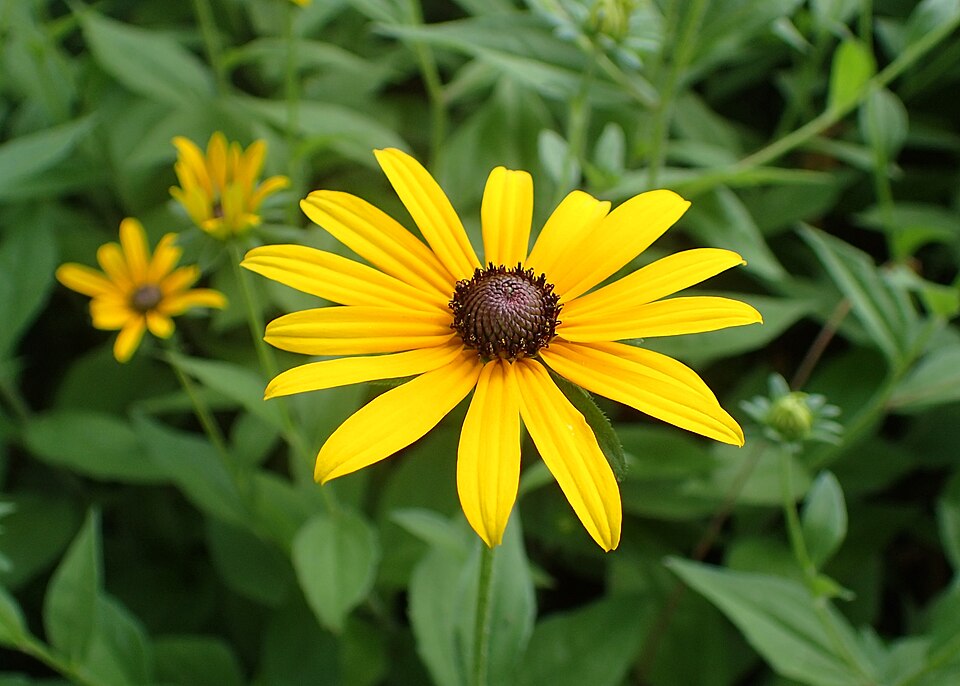

At a glance
- Life cycle
- Biennial / short-lived perennial
- Leaves
- Deciduous
- Bloom
- May to July
- Fruiting season
- Summer to fall
Striped: May continue with deadheading.
Recorded in 72 Mississippi counties.
Care
- Optional bloom tip: Removing spent flowers can extend blooming into fall.
Who uses this plant?
 16CaterpillarsGenus host records with ranges including MS
Genus host records with ranges including MS · Rudbeckia
- Chlosyne nycteisSilvery Checkerspot
- Acharia stimuleaSaddleback Caterpillar Moth
- Adaina ambrosiaeAmbrosia Plume Moth, Ragweed Plume Moth
- Archips griseaGray Archips
- Chlorochlamys chloroleucariaBlackberry Looper Moth
- Epiblema carolinanaGray-Blotched Epiblema
- Epiblema tripartitanaThree-Parted Epiblema
- Eupithecia miserulataCommon Eupithacia, Common Pug
- Homoeosoma electellaSunflower Moth
- Papaipema cataphractaBurdock Border, Potato-Stalk Borer
Show all 16
- Papaipema nebrisStalk Borer
- Synchlora aerataWavy-Lined Emerald, Camouflaged Looper
- Synchlora frondariaSouthern Emerald
- Vanessa carduiPainted Lady, Cosmopolite
- Isophrictis rudbeckiella
- Paralobesia rhoifructana
 56BeesSoutheastern regional records
Southeastern regional records · Rudbeckia
Individual names are not available yet.
Noori, Seltmann & Orr 2026, A curated and integrated dataset for exploring global bee-plant interactions (GloBI), Zenodo, CC BY 4.0 25Specialist beesPollen specialists
Pollen specialists · Rudbeckia
- Andrena aliciae
- Andrena asteris
- Andrena rudbeckiae
- Diadasia enavata
- Dieunomia bolliana
- Dieunomia heteropoda
- Megachile inimica
- Megachile parallela
- Megachile pugnata
- Megachile xylocopoides
Show all 25
- Melissodes bidentis
- Melissodes boltoniae
- Melissodes coreopsis
- Melissodes denticulatus
- Melissodes dentiventris
- Melissodes desponsus
- Melissodes druriellus
- Melissodes illatus
- Melissodes subillatus
- Melissodes trinodis
- Melissodes wheeleri
- Paranthidium jugatorium
- Perdita octomaculata
- Protandrena albitarsis
- Protandrena andrenoides
 —BirdsRecorded genus food-resource interactions; not a state feeding claim
 1AntsRecorded seed interactions
- Solenopsis invicta
Solenopsis invicta: Seed predation.
Beetles 5
- Acmaeodera pulchella
- Centrinus scutellum album
- Diabrotica 12-punctata
- Mordella scutellaris
- Typocerus sinuatus
Flower visits · Carlinville, Illinois, USA
Flies 15
- Archytas analis
- Eristalis latifrons
- Exoprosopa decora
- Exoprosopa emarginata
- Exoprosopa fascipennis
- Helophilus latifrons
- Phthiria cincta
- Phthiria sulphurea
- Sapromyza vulgaris
- Scepsis fulvicollis
Show all 15
- Spallanzania hesperidarum
- Sphaerophoria cylindrica
- Trichophora ruficauda
- Volucella fasciata
- Zodion fulvifrons
Flower visits · Carlinville, Illinois, USA
Adult butterflies / moths 5
- Argynnis cybele
- Limochores taumas
- Phyciodes tharos
- Plusia simplex
- Thecla calanus
Flower visits · Carlinville, Illinois, USA
Other wasps 4
- Leionotus arvensis
- Priononyx thomae
- Sphex nigricans
- Stictiella pictifrons
Flower visits · Carlinville, Illinois, USA
Other insects 1
- Lygus pratensis
Flower visits · Carlinville, Illinois, USA
Plant details
- Family
- Asteraceae
- Hardiness
- Zones 3a–8b
- Soil pH
- Acidic to alkaline
- Flower color
- Yellow, orange or red
- Growth rate
- Rapid
- Growth habit
- Single stem
- Foliage color
- Green
- Fruit begins
- Summer
- Fruit ends
- Fall
What its natural habitat tells you
Safety has not been reviewed for this plant; check toxicity and thorns before planting.
Clay, loam, or sand. Avoid excess fertilizer; deadheading can extend flowering. Watch for powdery mildew, slugs, and snails. NC State Extension
Growing sources and scope
- Bloom · “Summer” · USDA PLANTS (ranked first; Prairie Moon 2026 Cultural Guide differs) · Nationwide species characteristics; local growing conditions may vary
- Flower color · “Yellow, orange or red” · NC Extension Plant Toolbox (ranked first; USDA PLANTS, Lady Bird Johnson Wildflower Center, Prairie Moon 2026 Cultural Guide differ)
- Foliage color · “Green” · USDA PLANTS · Nationwide species characteristics; local growing conditions may vary
- Fruit begins · “Summer” · NC Extension Plant Toolbox · Species profile fruit display season; not a local ripening date
- Fruit ends · “Fall” · NC Extension Plant Toolbox (ranked first; USDA PLANTS differs) · Species profile fruit display season; not a local ripening date
- Growth habit · “Single stem” · USDA PLANTS · Nationwide species characteristics; local growing conditions may vary
- Growth rate · “Rapid” · USDA PLANTS · Nationwide species characteristics; local growing conditions may vary
- Hardiness · “Zones 3a–8b” · NC Extension Plant Toolbox (ranked first; Missouri Botanical Garden Plant Finder differs)
- Height · “2–4 feet” · NC Extension Plant Toolbox (ranked first; Tennessee Smart Yards, USDA PLANTS, Lady Bird Johnson Wildflower Center, Missouri Botanical Garden Plant Finder, Minnesota Wildflowers, Prairie Moon 2026 Cultural Guide differ)
- Leaves · “Deciduous” · NC Extension Plant Toolbox
- Life cycle · “Biennial or perennial” · NC Extension Plant Toolbox (ranked first; Lady Bird Johnson Wildflower Center, Minnesota Wildflowers differ)
- Light · “Full sun (6 or more hours of direct sunlight a day); Partial shade (direct sunlight only part of the day, 2-6 hours)” · NC Extension Plant Toolbox (ranked first; Tennessee Smart Yards, Virginia DCR Piedmont, Virginia DCR Coastal Plain, Lady Bird Johnson Wildflower Center, Missouri Botanical Garden Plant Finder, Prairie Moon 2026 Cultural Guide differ)
- Soil · “Moist; Occasionally dry” · NC Extension Plant Toolbox (ranked first; Tennessee Smart Yards, Virginia DCR Piedmont, Virginia DCR Coastal Plain, Lady Bird Johnson Wildflower Center, Missouri Botanical Garden Plant Finder, Prairie Moon 2026 Cultural Guide differ)
- Soil pH · “Acidic to alkaline” · NC Extension Plant Toolbox (ranked first; Lady Bird Johnson Wildflower Center differs)
- Spread · “1–2 feet” · NC Extension Plant Toolbox
Recognizing it
Hairy stems; rough, simple leaves arranged alternately; yellow rays around a raised brown center. Lower leaves form a basal rosette. Identification source
Also known as
Black eyed Susan; Blackeyed Susan
Conservation status
| Mississippi rank | SNR |
|---|---|
| Global rank | G5 |
| MS status | Not verified |
| Federal status | Not verified |
Will it fit your yard?
Check this plant against your county, sun and soil moisture. Conditions are checked in your browser.
Growing cautions
- Self-seeds. Freely self-seeds. NC State Extension Plant Toolbox
For planning only; these do not change the score or Fit.
Sources
- USDA PLANTS
- Vascular Plants of North Carolina (NC Natural Heritage Program)
- Mississippi occurrence source
- Shropshire & Tallamy 2025, Lepidoptera of North America north of Mexico, ZooKeys 1261 (ODbL)
- Noori, Seltmann & Orr 2026, A curated and integrated dataset for exploring global bee-plant interactions (GloBI), Zenodo, CC BY 4.0
- Smith, Bachelder, Russell, Morales, Mosher & Seltmann 2024, Bee-Specialization-Modeling v0.6.1 (specialist host table compiled from J. Fowler's pollen specialist bee lists), Zenodo, CC BY 4.0
- Hurlbert, Olsen, Sawyer & Winner 2021, Avian Diet Database, Scientific Data 8: 260 (CC0)
- Narango, Tallamy & Shropshire 2020, Few keystone plant genera support the majority of Lepidoptera species, Nature Communications
- NC State Extension