

Swamp Azalea
Rhododendron viscosum
Native to Mississippi (estimated). How scores work Is it native here?
Profile 88%
- Height
- 2–8 feet
- Spread
- 3–8 feet
- Light
- Full sun, Partial shade
- Soil moisture
- Usually moist
Space about 5.5 ft apart from its recorded spread, about 3 per 100 sq ft. Enter your bed size for a count
Will it fit your yard?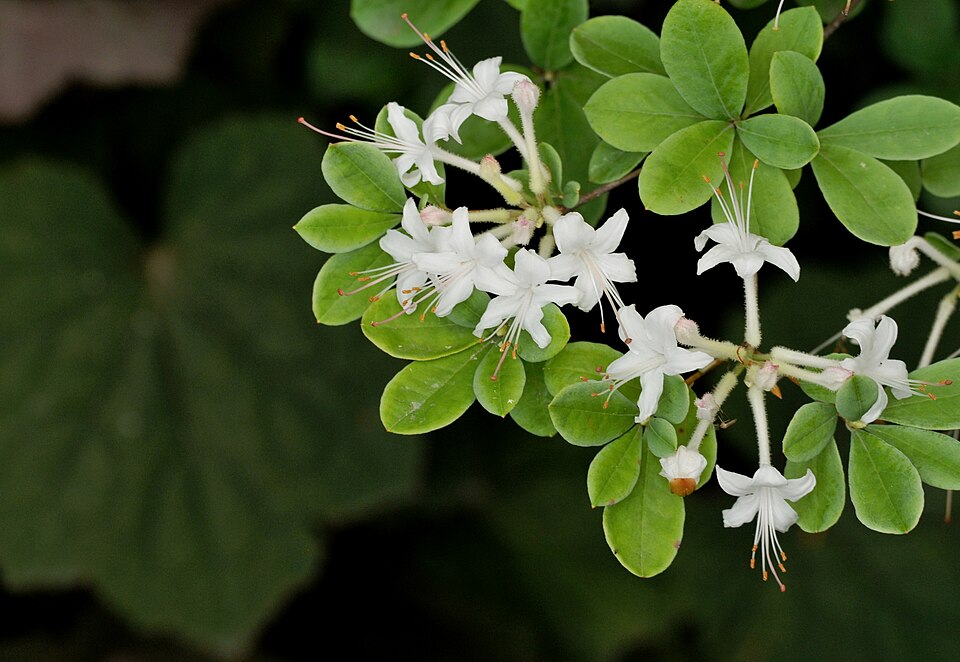

At a glance
- Life cycle
- Woody perennial
- Leaves
- Deciduous, semi-evergreen or evergreen
- Bloom
- No set bloom season
- Fruiting season
- Summer to fall
Recorded in 11 Mississippi counties.
Care
- Keep roots out of constant standing water.
Who uses this plant?
 52CaterpillarsGenus host records with ranges including MS
Genus host records with ranges including MS · Rhododendron
- Acharia stimuleaSaddleback Caterpillar Moth
- Acronicta oblinitaSmeared Dagger
- Acronicta tritonaGray Dagger, Triton Dagger
- Amphipyra pyramidoidesMiranda Underwing, Copper Underwing, Copper Amphipyra
- Apatelodes torrefactaSpotted Apatelodes
- Archips argyrospilaFruit-Tree Leafroller Moth
- Automeris ioIo Moth
- Callophrys augustinusThe Brown Elfin
- Callosamia prometheaPromethea Silkmoth, Promethea Moth
- Caloptilia violacellaTick-Trefoil Caloptilia
Show all 52
- Catocala andromedaeAndromeda Underwing
- Choristoneura rosaceanaOblique-Banded Leafroller Moth, Rosaceous Leaf Roller
- Coelodasys unicornisUnicorn Caterpillar Moth
- Darapsa choerilusAzalea Sphinx
- Darapsa versicolorHydrangea Sphinx
- Datana majorMajor Datana, Azalea Caterpillar
- Datana ministraYellow-Necked Caterpillar Moth
- Dichomeris ligulellaPalmerworm
- Egira alternansAlternate Woodling
- Hyalophora cecropiaCecropia Silkmoth, Cecropia Moth
- Hyles lineataWhite-Lined Sphinx
- Hyphantria cuneaFall Webworm
- Megalopyge opercularisSouthern Flannel Moth, Puss Caterpillar
- Melanolophia canadariaCanadian Melanolphia, Variable Redmarked Looper
- Morrisonia confusaConfused Woodgrain
- Oedemasia concinnaRed-Humped Caterpillar, Red-Humped Appleworm
- Oiketicus abbotiiAbbot's Bagworm Moth
- Olethreutes permundanaRaspberry Leafroller
- Orgyia leucostigmaWhite-Marked Tussock Moth
- Orthosia hibisciSpeckled Green Fruitworm Moth, Speckled Green Quaker
- Palthis angulalisDark-Spotted Palthis
- Papilio troilusSpicebush Swallowtail
- Platynota flavedanaBlack-Shaded Platynota
- Platynota stultanaOmnivorous Leafroller
- Prolimacodes badiaSkiff Moth, Skiff Caterpillar
- Rheumaptera prunivorataFerguson's Scallop Shell, Cherry Scallop Shell
- Satyrium kingiKing's Hairstreak
- Satyrium liparopsStriped Hairstreak
- Schizura ipomaeaeMorning-Glory Prominent, Checkered-Fringe Prominent
- Scopula limboundataLarge Lace-Border
- Sparganothis sulfureanaSparganothis Fruitworm Moth, Sulfur Leafroller, False Yellow-Head
- Sphinx kalmiaeFawn Sphinx, Laurel Sphinx
- Spodoptera eridaniaSouthern Armyworm Moth
- Spodoptera latifasciaOrange-Striped Armyworm, Velvet Armyworm Moth
- Spodoptera ornithogalliYellow-Striped Armyworm Moth, Cotton Cutworm
- Strymon melinusGray Hairstreak
- Synanthedon rhododendriRhododendron Borer
- Thyridopteryx ephemeraeformisEvergreen Bagworm Moth
- Trichoplusia niNi Moth, Cabbage Looper Moth
- Xanthotype urticariaFalse Crocus Geometer
- Epinotia septemberana
- Paralobesia rhoifructana
 24BeesSoutheastern regional records
Southeastern regional records · Rhododendron
Individual names are not available yet.
Noori, Seltmann & Orr 2026, A curated and integrated dataset for exploring global bee-plant interactions (GloBI), Zenodo, CC BY 4.0 2Specialist beesPollen specialists
Pollen specialists · Rhododendron
- Andrena carolina
- Andrena cornelli
 5BirdsRecorded genus food-resource interactions; not a state feeding claim
Recorded genus food-resource interactions; not a state feeding claim · Rhododendron
- Bonasa umbellusRuffed Grouse
- Falcipennis canadensisSpruce Grouse
- Lagopus lagopusWillow Ptarmigan
- Pinicola enucleatorPine Grosbeak
- Plectrophenax nivalisSnow Bunting
Direct food only: birds recorded eating this genus across North America. Caterpillars on host plants also feed nesting birds. NC Native Plant Society: butterfly gardening
No records yet · Ants · Beetles · Flies · Adult butterflies / moths · Other wasps · Other insects
Plant details
- Family
- Ericaceae
- Hardiness
- Zones 4a–9b
- Soil pH
- Acidic
- Flower color
- White
- Growth rate
- Slow
- Growth habit
- Several stems
- Foliage color
- Green
- Fruit begins
- Summer
- Fruit ends
- Fall
What its natural habitat tells you
Safety has not been reviewed for this plant; check toxicity and thorns before planting.
Growing sources and scope
- Bloom · “No set bloom season” · USDA PLANTS · Nationwide species characteristics; local growing conditions may vary
- Flower color · “White” · NC Extension Plant Toolbox (ranked first; USDA PLANTS, Lady Bird Johnson Wildflower Center differ)
- Foliage color · “Green” · USDA PLANTS · Nationwide species characteristics; local growing conditions may vary
- Fruit begins · “Summer” · NC Extension Plant Toolbox · Species profile fruit display season; not a local ripening date
- Fruit ends · “Fall” · NC Extension Plant Toolbox · Species profile fruit display season; not a local ripening date
- Growth habit · “Several stems” · USDA PLANTS · Nationwide species characteristics; local growing conditions may vary
- Growth rate · “Slow” · USDA PLANTS · Nationwide species characteristics; local growing conditions may vary
- Hardiness · “Zones 4a–9b” · NC Extension Plant Toolbox
- Height · “2–8 feet” · NC Extension Plant Toolbox (ranked first; USDA PLANTS differs)
- Leaves · “Deciduous, semi-evergreen or evergreen” · NC Extension Plant Toolbox (ranked first; Lady Bird Johnson Wildflower Center differs)
- Life cycle · “Woody perennial” · NC Extension Plant Toolbox (ranked first; Lady Bird Johnson Wildflower Center differs)
- Light · “Full sun (6 or more hours of direct sunlight a day); Partial shade (direct sunlight only part of the day, 2-6 hours)” · NC Extension Plant Toolbox (ranked first; Tennessee Smart Yards, Virginia DCR Piedmont, Virginia DCR Coastal Plain, Lady Bird Johnson Wildflower Center differ)
- Soil · “Moist; Occasionally wet” · NC Extension Plant Toolbox (ranked first; Tennessee Smart Yards, Virginia DCR Piedmont, Virginia DCR Coastal Plain, Lady Bird Johnson Wildflower Center differ)
- Soil pH · “Acidic” · NC Extension Plant Toolbox
- Spread · “3–8 feet” · NC Extension Plant Toolbox
Also known as
Clammy Azalea
Conservation status
| Mississippi rank | SNR |
|---|---|
| Global rank | G5 |
| MS status | Not verified |
| Federal status | Not verified |
Will it fit your yard?
Check this plant against your county, sun and soil moisture. Conditions are checked in your browser.
Growing cautions
- Needs good drainage. Keep roots out of constant standing water. NC State Extension Plant Toolbox
For planning only; these do not change the score or Fit.
Sources
- USDA PLANTS
- Vascular Plants of North Carolina (NC Natural Heritage Program)
- Mississippi occurrence source
- Shropshire & Tallamy 2025, Lepidoptera of North America north of Mexico, ZooKeys 1261 (ODbL)
- Noori, Seltmann & Orr 2026, A curated and integrated dataset for exploring global bee-plant interactions (GloBI), Zenodo, CC BY 4.0
- Smith, Bachelder, Russell, Morales, Mosher & Seltmann 2024, Bee-Specialization-Modeling v0.6.1 (specialist host table compiled from J. Fowler's pollen specialist bee lists), Zenodo, CC BY 4.0
- Hurlbert, Olsen, Sawyer & Winner 2021, Avian Diet Database, Scientific Data 8: 260 (CC0)
- Narango, Tallamy & Shropshire 2020, Few keystone plant genera support the majority of Lepidoptera species, Nature Communications