

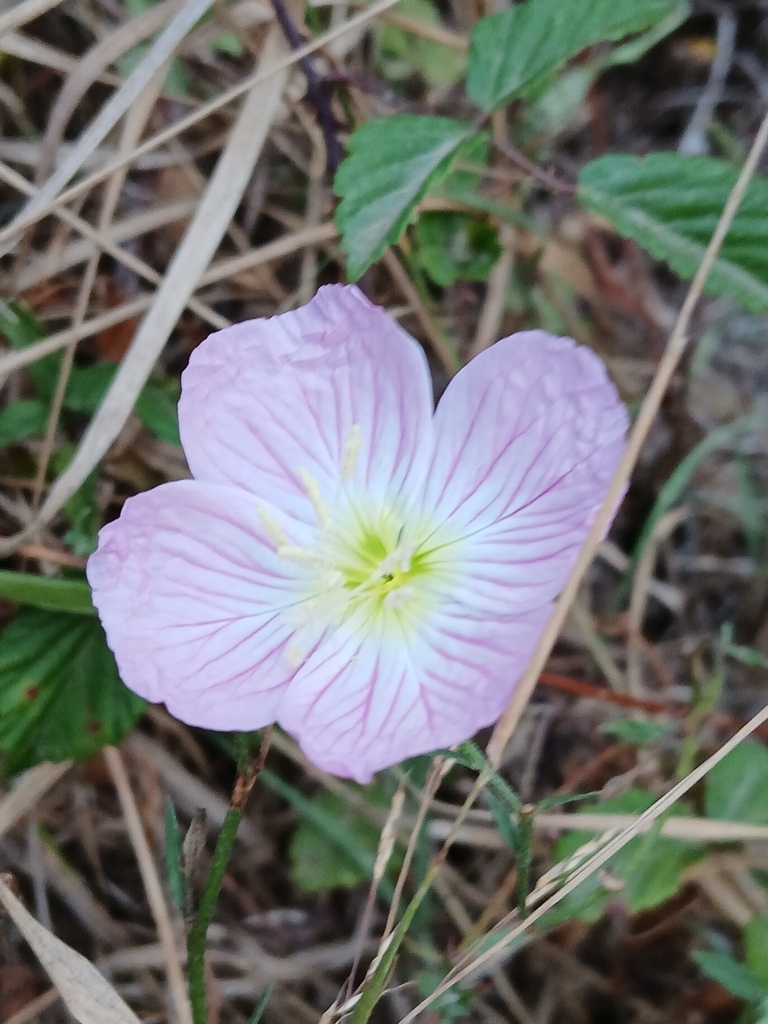
Pink Evening-primrose
Oenothera speciosa
Found in grasslands, prairies, glades, roadsides and fields, also cultivated as an ornamental. Weakley, Flora of the Southeastern United States (2025), South Central edition What its natural habitat tells you
Not native to Mississippi. How scores work Is it native here?
Profile 71%
- Height
- 18–24 inches
- Light
- Full sun, Partial shade
- Soil moisture
- Somewhat dry to moist
At a glance
- Life cycle
- Perennial
- Leaves
- Deciduous
Not yet recorded · Spread · Bloom
Recorded in 62 Mississippi counties.
Natural habitats
Places it grows wild. Not a planting requirement. Each habitat page lists the plants and wildlife also found there.
Open, grass-dominated places kept open by fire, grazing or thin soil, from tallgrass prairie to Piedmont prairies.
Roadsides, fields and disturbed ground
Ground opened by people: roadsides, old fields, pastures, fencerows and lots.
Who uses this plant?
 22CaterpillarsGenus host records with ranges including MS
Genus host records with ranges including MS · Oenothera
- Amphion floridensisNessus Sphinx
- Apantesis argeArge Tiger Moth
- Atroposia oenotheranaPrimrose Cochylid
- Desmia funeralisGrape Leaffolder Moth
- Eudryas unioPearly Wood-Nymph
- Euhagena emphytiformisGaura Borer Moth
- Eumorpha fasciatusBanded Sphinx
- Eupithecia miserulataCommon Eupithacia, Common Pug
- Hyles lineataWhite-Lined Sphinx
- Mompha albocapitellaWhite-Based Mompha
Show all 22
- Mompha circumscriptellaCircumscript Mompha
- Mompha eloisellaRed-Streaked Mompha
- Papaipema nebrisStalk Borer
- Proserpinus gauraeProud Sphinx
- Schinia floridaPrimrose Flower Moth, Evening Primrose Flower Moth
- Schinia gauraeClouded Crimson
- Sparganothis sulfureanaSparganothis Fruitworm Moth, Sulfur Leafroller, False Yellow-Head
- Spodoptera eridaniaSouthern Armyworm Moth
- Dichomeris agonia
- Mompha brevivittella
- Mompha rufocristatella
- Mompha stellella
 —BeesSoutheastern regional records
 4Specialist beesPollen specialists
Pollen specialists · Oenothera
- Lasioglossum aberrans
- Lasioglossum lusorium
- Lasioglossum oenotherae
- Melissodes fimbriatus
 5BirdsRecorded genus food-resource interactions; not a state feeding claim
Recorded genus food-resource interactions; not a state feeding claim · Oenothera
- Columbina passerinaCommon Ground Dove
- Meleagris gallopavoWild Turkey
- Ortalis vetulaPlain Chachalaca
- Tympanuchus pallidicinctusLesser Prairie-Chicken
- Zenaida macrouraMourning Dove
Direct food only: birds recorded eating this genus across North America. Caterpillars on host plants also feed nesting birds. NC Native Plant Society: butterfly gardening
Plant details
- Family
- Onagraceae
- Hardiness
- Zones 5a–8b
- Soil pH
- Neutral to alkaline
- Flower color
- Pink or white
Safety has not been reviewed for this plant; check toxicity and thorns before planting.
Growing sources and scope
- Flower color · “Pink or white” · NC Extension Plant Toolbox (ranked first; Lady Bird Johnson Wildflower Center differs)
- Hardiness · “Zones 5a–8b” · NC Extension Plant Toolbox
- Height · “18–24 inches” · Tennessee Smart Yards (ranked first; Lady Bird Johnson Wildflower Center differs) · Published Tennessee growing guidance; exact cached scientific heading
- Leaves · “Deciduous” · NC Extension Plant Toolbox (ranked first; Lady Bird Johnson Wildflower Center differs)
- Life cycle · “Perennial” · NC Extension Plant Toolbox
- Light · “Full sun (6 or more hours of direct sunlight a day); Partial shade (direct sunlight only part of the day, 2-6 hours)” · NC Extension Plant Toolbox (ranked first; Tennessee Smart Yards, Lady Bird Johnson Wildflower Center differ)
- Soil · “Moist; Occasionally dry” · NC Extension Plant Toolbox (ranked first; Tennessee Smart Yards, Lady Bird Johnson Wildflower Center differ)
- Soil pH · “Neutral to alkaline” · NC Extension Plant Toolbox
Also known as
Pink Evening primrose; Pink Ladies; Showy Evening Primrose
Conservation status
| Mississippi rank | SNR |
|---|---|
| Global rank | G5 |
| MS status | Not verified |
| Federal status | Not verified |
Native alternatives
Find natives for your gardenSources
- Weakley, Flora of the Southeastern United States (2025), South Central edition
- USDA PLANTS
- Mississippi occurrence source
- Shropshire & Tallamy 2025, Lepidoptera of North America north of Mexico, ZooKeys 1261 (ODbL)
- Noori, Seltmann & Orr 2026, A curated and integrated dataset for exploring global bee-plant interactions (GloBI), Zenodo, CC BY 4.0
- Smith, Bachelder, Russell, Morales, Mosher & Seltmann 2024, Bee-Specialization-Modeling v0.6.1 (specialist host table compiled from J. Fowler's pollen specialist bee lists), Zenodo, CC BY 4.0
- Hurlbert, Olsen, Sawyer & Winner 2021, Avian Diet Database, Scientific Data 8: 260 (CC0)
- Narango, Tallamy & Shropshire 2020, Few keystone plant genera support the majority of Lepidoptera species, Nature Communications