

Deptford Pink
Dianthus armeria
Found in fields, roadsides, pastures.
Source 1
What its natural habitat tells you
-30
Harmful
Not native to Mississippi. How scores work Is it native here?
Profile 82%
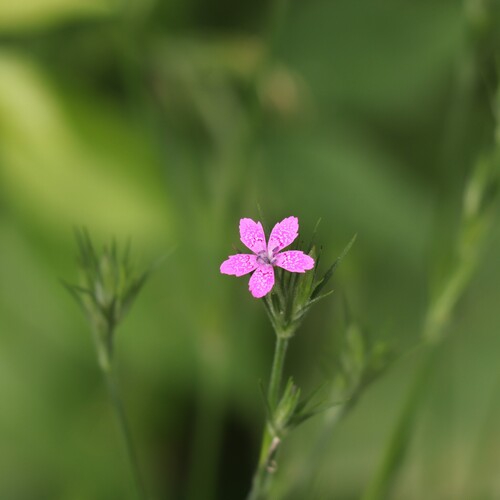
- Height
- 8–24 inches
- Spread
- Not recorded
- Light
- Full sun, Partial shade
- Soil moisture
- Somewhat dry to moist
- Life cycle
- Annual or biennial
- Leaves
- Not recorded
- Bloom
- May to September
JFMAMJJASOND
Do not plant. Listed invasive in Mississippi.
Where it grows in Mississippi
County records and the places it grows wild. Neither is a planting requirement.
6 Mississippi counties with a record
Natural habitats
- Plate in preparationRoadsides, fields and disturbed groundGround opened by people: roadsides, old fields, pastures, fencerows and lots.
Ecological relationships
Wildlife it supports
 14CaterpillarsGenus host records with ranges including MS
Genus host records with ranges including MS · Dianthus
- Chloridea virescensTobacco Budworm Moth
- Chlorochlamys chloroleucariaBlackberry Looper Moth
- Choristoneura rosaceanaOblique-Banded Leafroller Moth, Rosaceous Leaf Roller
- Hadena capsularisCapsule Moth
- Helicoverpa zeaCorn Earworm Moth
- Papaipema nebrisStalk Borer
- Platynota flavedanaBlack-Shaded Platynota
- Platynota rostranaOmnivorous Platynota
- Platynota stultanaOmnivorous Leafroller
- Pyrrharctia isabellaIsabella Tiger Moth, Banded Woolybear
Show all 14
- Spodoptera eridaniaSouthern Armyworm Moth
- Spodoptera frugiperdaFall Armyworm Moth
- Spodoptera ornithogalliYellow-Striped Armyworm Moth, Cotton Cutworm
- Trichoplusia niNi Moth, Cabbage Looper Moth
Source 2
No bees, Specialist bees or Birds recorded for this plant yet.
Growing and identification
Plant details
Not yet recorded · Spread · Leaves
- Family
- Caryophyllaceae
- Hardiness
- Zones 3a–8b
- Soil pH
- Neutral
- Flower color
- Pink, purple or white
Safety has not been reviewed for this plant; check toxicity and thorns before planting.
Native alternatives
Find natives for your gardenSources
- Weakley, Flora of the Southeastern United States (2025), Carolinas & Georgia edition Bloom; Natural habitat
- Shropshire & Tallamy 2025, Lepidoptera of North America north of Mexico, ZooKeys 1261 (ODbL) Caterpillars
- NC Extension Plant Toolbox Flower color; Hardiness; Life cycle; Light; Soil; Soil pH
- Minnesota Wildflowers Height
- Conservation source Conservation status
- Global and federal source Conservation status
- Noori, Seltmann & Orr 2026, A curated and integrated dataset for exploring global bee-plant interactions (GloBI), Zenodo, CC BY 4.0 Bees
- Smith, Bachelder, Russell, Morales, Mosher & Seltmann 2024, Bee-Specialization-Modeling v0.6.1 (specialist host table compiled from J. Fowler's pollen specialist bee lists), Zenodo, CC BY 4.0 Specialist bees
- Hurlbert, Olsen, Sawyer & Winner 2021, Avian Diet Database, Scientific Data 8: 260 (CC0) Birds
- USDA PLANTS
- Narango, Tallamy & Shropshire 2020, Few keystone plant genera support the majority of Lepidoptera species, Nature Communications
Each fact, its source and scope
- Bloom · “May to September” · Weakley, Flora of the Southeastern United States (2025), Carolinas & Georgia edition · Carolinas and Georgia
- Flower color · “Pink, purple or white” · NC Extension Plant Toolbox
- Hardiness · “Zones 3a–8b” · NC Extension Plant Toolbox
- Height · “8–24 inches” · Minnesota Wildflowers
- Life cycle · “Annual or biennial” · NC Extension Plant Toolbox
- Light · “Full sun (6 or more hours of direct sunlight a day); Partial shade (direct sunlight only part of the day, 2-6 hours)” · NC Extension Plant Toolbox
- Soil · “Moist; Occasionally dry” · NC Extension Plant Toolbox
- Soil pH · “Neutral” · NC Extension Plant Toolbox