

Prostrate Knotweed
Polygonum aviculare
In the Carolinas and Georgia, found in disturbed areas. Weakley, Flora of the Southeastern United States (2025), Carolinas & Georgia edition What its natural habitat tells you
Not native to Louisiana. How scores work Is it native here?
Profile 82%
- Height
- 3–8 inches
- Spread
- 2–3 feet
- Light
- Full sun, Partial shade
- Soil moisture
- Somewhat dry to moist
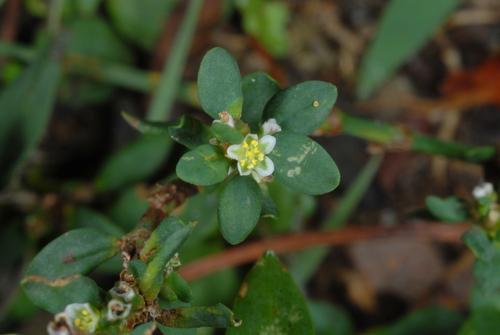
Plant this instead
Choose your county to list local plants first.
No recorded swaps for this county. Try the garden finder.
At a glance
- Life cycle
- Annual or perennial
- Leaves
- Evergreen
- Bloom
- March to November
Recorded in 46 Louisiana parishes.
Natural habitats
Places it grows wild. Not a planting requirement. Each habitat page lists the plants and wildlife also found there.
Roadsides, fields and disturbed ground
Ground opened by people: roadsides, old fields, pastures, fencerows and lots.
Who uses this plant?
 40CaterpillarsGenus host records with ranges including LA
Genus host records with ranges including LA · Polygonum
- Achyra rantalisGarden Webworm Moth
- Acronicta insularisHenry's Marsh Moth, Cattail Caterpillar
- Acronicta oblinitaSmeared Dagger
- Anticlea multiferataMany-Lined Carpet
- Apantesis argeArge Tiger Moth
- Apantesis naisNais Tiger Moth
- Archips semiferanusOak Leafroller Moth
- Calothysanis amaturariaCross-Lined Wave
- Chionodes discoocellellaEyeringed Chionodes
- Coleophora cratipennellaStreaked Coleophora
Show all 40
- Costaconvexa centrostrigariaBent-Lined Carpet
- Elophila obliteralisWaterlily Leafcutter Moth
- Emmelina monodactylaMorning-Glory Plume Moth
- Epiblema otiosanaBidens Borer Moth
- Eusarca confusariaConfused Eusarca
- Feltia subterraneaSubterranean Dart, Granulate Cutworm
- Haematopis gratariaChickweed Geometer
- Helicoverpa zeaCorn Earworm Moth
- Homophoberia apicosaBlack Wedge-Spot, Smartweed Groundling
- Hyles lineataWhite-Lined Sphinx
- Hypena scabraGreen Cloverworm Bomolocha, Black Snout
- Maliattha synochitisBlack-Dotted Lithacodia, Black-Dotted Glyph, Brass-Dotted Grass Moth
- Melanolophia canadariaCanadian Melanolphia, Variable Redmarked Looper
- Metarranthis duariaRuddy Metarranthis
- Nephelodes miniansBronzed Cutworm
- Nomophila nearcticaLucerne Moth, American Celery Webworm
- Orthonama obstipataThe Gem
- Ostrinia obumbratalisSmartweed Borer
- Ostrinia penitalisAmerican Lotus Borer, Lily Moth
- Parapoynx obscuralisObscure Pondweed Moth
- Patania silicalisHerbivorous Patania, Herbivorous Pleuroptya
- Prochoerodes lineolaLarge Maple Spanworm Moth
- Pseudeustrotia carneolaPink-Barred Lithacodia, Pink-Barred Pseudeustrotia
- Saucrobotys futilalisDogbane Saucrobotys
- Schinia scissoidesDivided Flower Moth
- Schinia spinosaeSpinose Flower Moth
- Scopula limboundataLarge Lace-Border
- Spilosoma congruaAgreeable Tiger Moth
- Spilosoma virginicaVirginian Tiger Moth, Yellow Woolybear Moth, Yellow Bear
- Strymon melinusGray Hairstreak
 —BeesSoutheastern regional records
 —Specialist beesPollen specialists
 58BirdsRecorded genus food-resource interactions; not a state feeding claim
Recorded genus food-resource interactions; not a state feeding claim · Polygonum
- Agelaius phoeniceusRed-winged Blackbird
- Aix sponsaWood Duck
- Alectoris chukarChukar
- Anas acutaNorthern Pintail
- Anas creccaGreen-winged Teal
- Anas platyrhynchosMallard
- Anser albifronsGreater White-fronted Goose
- Anthus rubescensAmerican Pipit
- Aythya affinisLesser Scaup
- Aythya americanaRedhead
Show all 58
- Aythya collarisRing-necked Duck
- Aythya valisineriaCanvasback
- Bonasa umbellusRuffed Grouse
- Bucephala clangulaCommon Goldeneye
- Callipepla californicaCalifornia Quail
- Centrocercus urophasianusGreater Sage-Grouse
- Colinus virginianusNorthern Bobwhite
- Columba liviaRock Pigeon
- Columbina passerinaCommon Ground Dove
- Coturnicops noveboracensisYellow Rail
- Dendragapus obscurusDusky Grouse
- Dendrocygna autumnalisBlack-bellied Whistling-Duck
- Dolichonyx oryzivorusBobolink
- Eremophila alpestrisHorned Lark
- Euphagus cyanocephalusBrewer's Blackbird
- Francolinus francolinusBlack Francolin
- Fulica americanaAmerican Coot
- Gallinula galeataCommon Gallinule
- Haemorhous mexicanusHouse Finch
- Junco hyemalisDark-eyed Junco
- Lagopus lagopusWillow Ptarmigan
- Mareca americanaAmerican Wigeon
- Meleagris gallopavoWild Turkey
- Melospiza melodiaSong Sparrow
- Melozone crissalisCalifornia Towhee
- Molothrus aterBrown-headed Cowbird
- Oreortyx pictusMountain Quail
- Oxyura jamaicensisRuddy Duck
- Passer domesticusHouse Sparrow
- Perdix perdixGray Partridge
- Pheucticus melanocephalusBlack-headed Grosbeak
- Pinicola enucleatorPine Grosbeak
- Pipilo maculatusSpotted Towhee
- Porzana carolinaSora
- Quiscalus quisculaCommon Grackle
- Rallus elegansKing Rail
- Rallus limicolaVirginia Rail
- Sialia mexicanaWestern Bluebird
- Sialia sialisEastern Bluebird
- Spinus psaltriaLesser Goldfinch
- Spizella passerinaChipping Sparrow
- Sturnus vulgarisEuropean Starling
- Turdus migratoriusAmerican Robin
- Tympanuchus phasianellusSharp-tailed Grouse
- Vireo griseusWhite-eyed Vireo
- Zenaida macrouraMourning Dove
- Zonotrichia atricapillaGolden-crowned Sparrow
- Zonotrichia leucophrysWhite-crowned Sparrow
Direct food only: birds recorded eating this genus across North America. Caterpillars on host plants also feed nesting birds. NC Native Plant Society: butterfly gardening
Plant details
- Family
- Polygonaceae
- Hardiness
- Zones 2a–10b
- Soil pH
- Acidic to alkaline
- Flower color
- Pink or white
Safety has not been reviewed for this plant; check toxicity and thorns before planting.
Growing sources and scope
- Bloom · “March to November” · Weakley, Flora of the Southeastern United States (2025), Carolinas & Georgia edition · Carolinas and Georgia
- Flower color · “Pink or white” · NC Extension Plant Toolbox
- Hardiness · “Zones 2a–10b” · NC Extension Plant Toolbox
- Height · “3–8 inches” · NC Extension Plant Toolbox
- Leaves · “Evergreen” · NC Extension Plant Toolbox
- Life cycle · “Annual or perennial” · NC Extension Plant Toolbox
- Light · “Full sun (6 or more hours of direct sunlight a day); Partial shade (direct sunlight only part of the day, 2-6 hours)” · NC Extension Plant Toolbox
- Soil · “Moist; Occasionally dry” · NC Extension Plant Toolbox
- Soil pH · “Acidic to alkaline” · NC Extension Plant Toolbox
- Spread · “2–3 feet” · NC Extension Plant Toolbox
Also known as
Common Knotweed
Conservation status
| Louisiana rank | SNR |
|---|---|
| Global rank | GNR |
| LA status | Not verified |
| Federal status | Not verified |
Sources
- USDA PLANTS
- Weakley, Flora of the Southeastern United States (2025), Carolinas & Georgia edition
- Louisiana occurrence source
- Shropshire & Tallamy 2025, Lepidoptera of North America north of Mexico, ZooKeys 1261 (ODbL)
- Noori, Seltmann & Orr 2026, A curated and integrated dataset for exploring global bee-plant interactions (GloBI), Zenodo, CC BY 4.0
- Smith, Bachelder, Russell, Morales, Mosher & Seltmann 2024, Bee-Specialization-Modeling v0.6.1 (specialist host table compiled from J. Fowler's pollen specialist bee lists), Zenodo, CC BY 4.0
- Hurlbert, Olsen, Sawyer & Winner 2021, Avian Diet Database, Scientific Data 8: 260 (CC0)
- Narango, Tallamy & Shropshire 2020, Few keystone plant genera support the majority of Lepidoptera species, Nature Communications