

Mountain Laurel
Kalmia latifolia
In the Carolinas and Georgia, found in forests and woodlands; sandhills. Weakley, Flora of the Southeastern United States (2025), Carolinas & Georgia edition What its natural habitat tells you
Native to Louisiana. How scores work Is it native here?
Profile 100%
- Height
- 4–15 feet
- Spread
- 4–8 feet
- Light
- Dappled sunlight, Full sun, Partial shade
- Soil moisture
- Somewhat dry to moist
Space about 6 ft apart from its recorded spread, about 3 per 100 sq ft. Enter your bed size for a count
Will it fit your yard?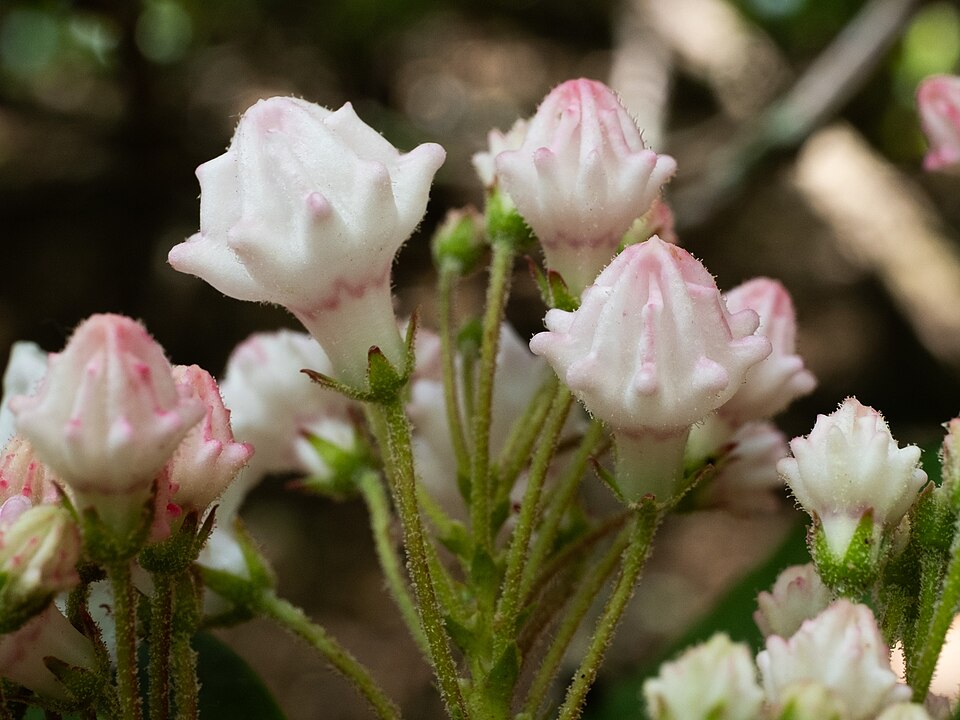

Poisonous if eaten. Consider children and pets when choosing where to plant. Plant caution source
Rare or protected plant. Specialist conservation planting; excluded from routine garden suggestions. Plant caution source
Hidden from default planting suggestions. Wildlife value and native status remain unchanged.
At a glance
- Life cycle
- Woody perennial
- Leaves
- Evergreen
- Bloom
- March to July
- Fruiting season
- August to October
Recorded in 7 Louisiana parishes.
Natural habitats
Places it grows wild. Not a planting requirement. Each habitat page lists the plants and wildlife also found there.
Forest or woodland where the source does not say how moist or dry.
Dry, deep-sand ridges with longleaf pine and turkey oak, kept open by fire.
Who uses this plant?
 16CaterpillarsGenus host records with ranges including LA
Genus host records with ranges including LA · Kalmia
- Acleris maculidorsanaStained-Back Leafroller Moth
- Archips georgianaFireworm, Georgia Leafroller
- Callophrys augustinusThe Brown Elfin
- Callosamia prometheaPromethea Silkmoth, Promethea Moth
- Darapsa choerilusAzalea Sphinx
- Hyphantria cuneaFall Webworm
- Morrisonia evictaBicolored Woodgrain
- Orgyia leucostigmaWhite-Marked Tussock Moth
- Papilio palamedesPalamedes Swallowtail
- Phlogophora periculosaBrown Angle Shades
Show all 16
- Prionapteryx nebuliferaClouded Veneer Moth
- Probole amicariaFriendly Probole
- Pseudexentera cressonianaShagbark Hickory Leafroller
- Sphinx kalmiaeFawn Sphinx, Laurel Sphinx
- Cenopis karacana
- Paralobesia rhoifructana
 6BeesSoutheastern regional records
Southeastern regional records · Kalmia
Individual names are not available yet.
Noori, Seltmann & Orr 2026, A curated and integrated dataset for exploring global bee-plant interactions (GloBI), Zenodo, CC BY 4.0 3Specialist beesPollen specialists
Pollen specialists · Kalmia
- Andrena bradleyi
- Andrena kalmiae
- Colletes productus
 3BirdsRecorded genus food-resource interactions; not a state feeding claim
Recorded genus food-resource interactions; not a state feeding claim · Kalmia
- Bonasa umbellusRuffed Grouse
- Lagopus lagopusWillow Ptarmigan
- Lagopus leucuraWhite-tailed Ptarmigan
Direct food only: birds recorded eating this genus across North America. Caterpillars on host plants also feed nesting birds. NC Native Plant Society: butterfly gardening
No records yet · Ants · Beetles · Flies · Adult butterflies / moths · Other wasps · Other insects
Plant details
- Family
- Ericaceae
- Hardiness
- Zones 4a–9b
- Soil pH
- Acidic
- Flower color
- Pink, purple or white
- Growth rate
- Slow
- Growth habit
- Several stems
- Foliage color
- Green
- Fruit begins
- August
- Fruit ends
- October
Growing sources and scope
- Bloom · “March to July” · Weakley, Flora of the Southeastern United States (2025), Carolinas & Georgia edition (ranked first; USDA PLANTS differs) · Carolinas and Georgia
- Flower color · “Pink, purple or white” · NC Extension Plant Toolbox (ranked first; USDA PLANTS, Lady Bird Johnson Wildflower Center differ)
- Foliage color · “Green” · USDA PLANTS · Nationwide species characteristics; local growing conditions may vary
- Fruit begins · “August” · Weakley, Flora of the Southeastern United States (2025), Carolinas & Georgia edition (ranked first; USDA PLANTS differs) · Carolinas and Georgia
- Fruit ends · “October” · Weakley, Flora of the Southeastern United States (2025), Carolinas & Georgia edition (ranked first; USDA PLANTS differs) · Carolinas and Georgia
- Growth habit · “Several stems” · USDA PLANTS · Nationwide species characteristics; local growing conditions may vary
- Growth rate · “Slow” · USDA PLANTS · Nationwide species characteristics; local growing conditions may vary
- Hardiness · “Zones 4a–9b” · NC Extension Plant Toolbox
- Height · “4–15 feet” · NC Extension Plant Toolbox (ranked first; USDA PLANTS, Lady Bird Johnson Wildflower Center differ)
- Leaves · “Evergreen” · NC Extension Plant Toolbox
- Life cycle · “Woody perennial” · NC Extension Plant Toolbox (ranked first; Lady Bird Johnson Wildflower Center differs)
- Light · “Dappled sunlight (shade through upper canopy all day); Full sun (6 or more hours of direct sunlight a day); Partial shade (direct sunlight only part of the day, 2-6 hours)” · NC Extension Plant Toolbox (ranked first; Tennessee Smart Yards, Virginia Cooperative Extension, Virginia DCR Piedmont, Virginia DCR Coastal Plain, Lady Bird Johnson Wildflower Center differ)
- Soil · “Moist; Occasionally dry” · NC Extension Plant Toolbox (ranked first; Tennessee Smart Yards, Virginia Cooperative Extension, Virginia DCR Piedmont, Virginia DCR Coastal Plain, Lady Bird Johnson Wildflower Center differ)
- Soil pH · “Acidic” · NC Extension Plant Toolbox
- Spread · “4–8 feet” · NC Extension Plant Toolbox
Also known as
Hunter Laurel
Conservation status
| Louisiana rank | S2 |
|---|---|
| Global rank | G5 |
| LA status | Not verified |
| Federal status | Not verified |
Will it fit your yard?
Check this plant against your county, sun and soil moisture. Conditions are checked in your browser.
Sources
- Weakley, Flora of the Southeastern United States (2025), Florida edition
- USDA PLANTS
- Vascular Plants of North Carolina (NC Natural Heritage Program)
- NatureServe Explorer
- Louisiana occurrence source
- Shropshire & Tallamy 2025, Lepidoptera of North America north of Mexico, ZooKeys 1261 (ODbL)
- Noori, Seltmann & Orr 2026, A curated and integrated dataset for exploring global bee-plant interactions (GloBI), Zenodo, CC BY 4.0
- Smith, Bachelder, Russell, Morales, Mosher & Seltmann 2024, Bee-Specialization-Modeling v0.6.1 (specialist host table compiled from J. Fowler's pollen specialist bee lists), Zenodo, CC BY 4.0
- Hurlbert, Olsen, Sawyer & Winner 2021, Avian Diet Database, Scientific Data 8: 260 (CC0)
- Narango, Tallamy & Shropshire 2020, Few keystone plant genera support the majority of Lepidoptera species, Nature Communications