

Desert Goosefoot
Chenopodium pratericola
In the Carolinas and Georgia, found in sandy soils, roadsides, disturbed areas. Weakley, Flora of the Southeastern United States (2025), Carolinas & Georgia edition What its natural habitat tells you
Native status: sources disagree, under review. How scores work Is it native here?
Profile 76%
- Height
- 6 inches–2.5 feet
- Light
- Partial shade, Full sun
- Soil moisture
- Dry to wet
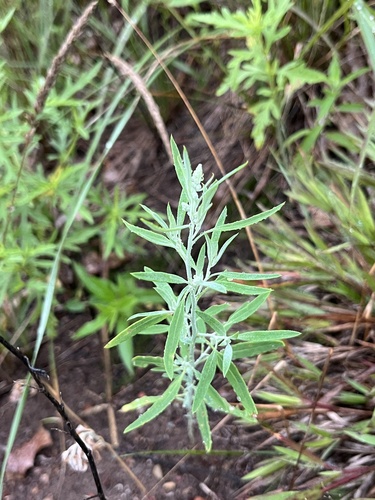
At a glance
- Life cycle
- Annual
- Bloom
- May to November
Not yet recorded · Spread · Leaves
Recorded in 4 Louisiana parishes.
Natural habitats
Places it grows wild. Not a planting requirement. Each habitat page lists the plants and wildlife also found there.
Roadsides, fields and disturbed ground
Ground opened by people: roadsides, old fields, pastures, fencerows and lots.
Who uses this plant?
 32CaterpillarsGenus host records with ranges including LA
Genus host records with ranges including LA · Chenopodium
- Achyra rantalisGarden Webworm Moth
- Amyna strictaEight-Spot Moth
- Apantesis argeArge Tiger Moth
- Apantesis naisNais Tiger Moth
- Apantesis partheniceParthenice Tiger Moth
- Blepharomastix ranalisHollow-Spotted Blepharomastix Moth
- Burnsius communisCommon Checkered-Skipper
- Cenopis reticulatanaReticulated Fruitworm Moth
- Chrysodeixis includensSoybean Looper Moth
- Emmelina monodactylaMorning-Glory Plume Moth
Show all 32
- Epiblema otiosanaBidens Borer Moth
- Epiblema strenuanaRagweed Borer
- Feltia repletaReplete Dart
- Helicoverpa zeaCorn Earworm Moth
- Herpetogramma bipunctalisSouthern Beet Webworm, Two-Spotted Herpetogramma
- Hyles lineataWhite-Lined Sphinx
- Hyphantria cuneaFall Webworm
- Orgyia leucostigmaWhite-Marked Tussock Moth
- Papaipema nebrisStalk Borer
- Pholisora catullusCommon Sootywing
- Platynota stultanaOmnivorous Leafroller
- Rachiplusia ouGray Looper
- Spilosoma congruaAgreeable Tiger Moth
- Spilosoma virginicaVirginian Tiger Moth, Yellow Woolybear Moth, Yellow Bear
- Spodoptera eridaniaSouthern Armyworm Moth
- Spodoptera frugiperdaFall Armyworm Moth
- Spodoptera ornithogalliYellow-Striped Armyworm Moth, Cotton Cutworm
- Spoladea recurvalisHawaiian Beet Webworm
- Staphylus hayhurstiiHayhurst's Scallopwing, Scalloped Sooty Wing, Scalloped Sootywing
- Trichoplusia niNi Moth, Cabbage Looper Moth
- Vanessa carduiPainted Lady, Cosmopolite
- Virbia aurantiacaOrange Virbia, Orange Holomelina
 —BeesSoutheastern regional records
 —Specialist beesPollen specialists
 24BirdsRecorded genus food-resource interactions; not a state feeding claim
Recorded genus food-resource interactions; not a state feeding claim · Chenopodium
- Acanthis flammeaCommon Redpoll
- Agelaius phoeniceusRed-winged Blackbird
- Anthus rubescensAmerican Pipit
- Aythya collarisRing-necked Duck
- Calcarius lapponicusLapland Longspur
- Calcarius ornatusChestnut-collared Longspur
- Callipepla californicaCalifornia Quail
- Callipepla gambeliiGambel's Quail
- Euphagus cyanocephalusBrewer's Blackbird
- Mareca americanaAmerican Wigeon
Show all 24
- Meleagris gallopavoWild Turkey
- Melospiza melodiaSong Sparrow
- Melozone crissalisCalifornia Towhee
- Molothrus aterBrown-headed Cowbird
- Perdix perdixGray Partridge
- Plectrophenax nivalisSnow Bunting
- Pooecetes gramineusVesper Sparrow
- Rallus limicolaVirginia Rail
- Rhynchophanes mccowniiMcCown's Longspur
- Spinus psaltriaLesser Goldfinch
- Spizella breweriBrewer's Sparrow
- Vireo flavifronsYellow-throated Vireo
- Zenaida macrouraMourning Dove
- Zonotrichia leucophrysWhite-crowned Sparrow
Direct food only: birds recorded eating this genus across North America. Caterpillars on host plants also feed nesting birds. NC Native Plant Society: butterfly gardening
Plant details
- Family
- Chenopodiaceae
- Flower color
- Green
Safety has not been reviewed for this plant; check toxicity and thorns before planting.
Growing sources and scope
- Bloom · “May to November” · Weakley, Flora of the Southeastern United States (2025), Carolinas & Georgia edition · Carolinas and Georgia
- Flower color · “Green” · Lady Bird Johnson Wildflower Center
- Height · “6 inches–2.5 feet” · Minnesota Wildflowers
- Life cycle · “Annual” · Minnesota Wildflowers
- Light · “Partial shade; Full sun (documented habitat)” · Weakley, Flora of the Southeastern United States (2025), Carolinas & Georgia edition · Carolinas and Georgia
- primary_flower_color · “green” · Lady Bird Johnson Wildflower Center
- Soil · “Dry; Moist; Wet (documented habitat)” · Weakley, Flora of the Southeastern United States (2025), Carolinas & Georgia edition · Carolinas and Georgia
Also known as
Chenopodium desiccatum var. leptophylloides; Desert Goose Foot; Nettle Leaf Goose Foot; Nettle Leaf Goosefoot; Nettle Leaved Goose Foot; Nettle Leaved Goosefoot; Nettleleaf Goose Foot; Nettleleaf Goosefoot; Nettleleaved Goose Foot; Nettleleaved Goosefoot
Conservation status
| Louisiana rank | SNA |
|---|---|
| Global rank | G5 |
| LA status | Not verified |
| Federal status | Not verified |
Will it fit your yard?
Check this plant against your county, sun and soil moisture. Conditions are checked in your browser.
Sources
- NatureServe Explorer
- USDA PLANTS
- Weakley, Flora of the Southeastern United States (2025)
- Louisiana occurrence source
- Shropshire & Tallamy 2025, Lepidoptera of North America north of Mexico, ZooKeys 1261 (ODbL)
- Noori, Seltmann & Orr 2026, A curated and integrated dataset for exploring global bee-plant interactions (GloBI), Zenodo, CC BY 4.0
- Smith, Bachelder, Russell, Morales, Mosher & Seltmann 2024, Bee-Specialization-Modeling v0.6.1 (specialist host table compiled from J. Fowler's pollen specialist bee lists), Zenodo, CC BY 4.0
- Hurlbert, Olsen, Sawyer & Winner 2021, Avian Diet Database, Scientific Data 8: 260 (CC0)
- Narango, Tallamy & Shropshire 2020, Few keystone plant genera support the majority of Lepidoptera species, Nature Communications