

Common Milkweed
Asclepias syriaca
A colony-forming milkweed with fragrant pink flower clusters and broad leaves. In the Carolinas and Georgia, found in prairies, floodplains, pastures, roadsides, disturbed areas. Weakley, Flora of the Southeastern United States (2025), Carolinas & Georgia edition What its natural habitat tells you
Native to Louisiana (estimated). How scores work Is it native here?
Profile 94%
- Height
- 3–5 feet
- Spread
- 8–12 inches per stem, colonies spread
- Light
- Full sun
- Soil moisture
- Dry to average
Space about 1 ft apart from its recorded spread, about 100 per 100 sq ft. Enter your bed size for a count
Will it fit your yard?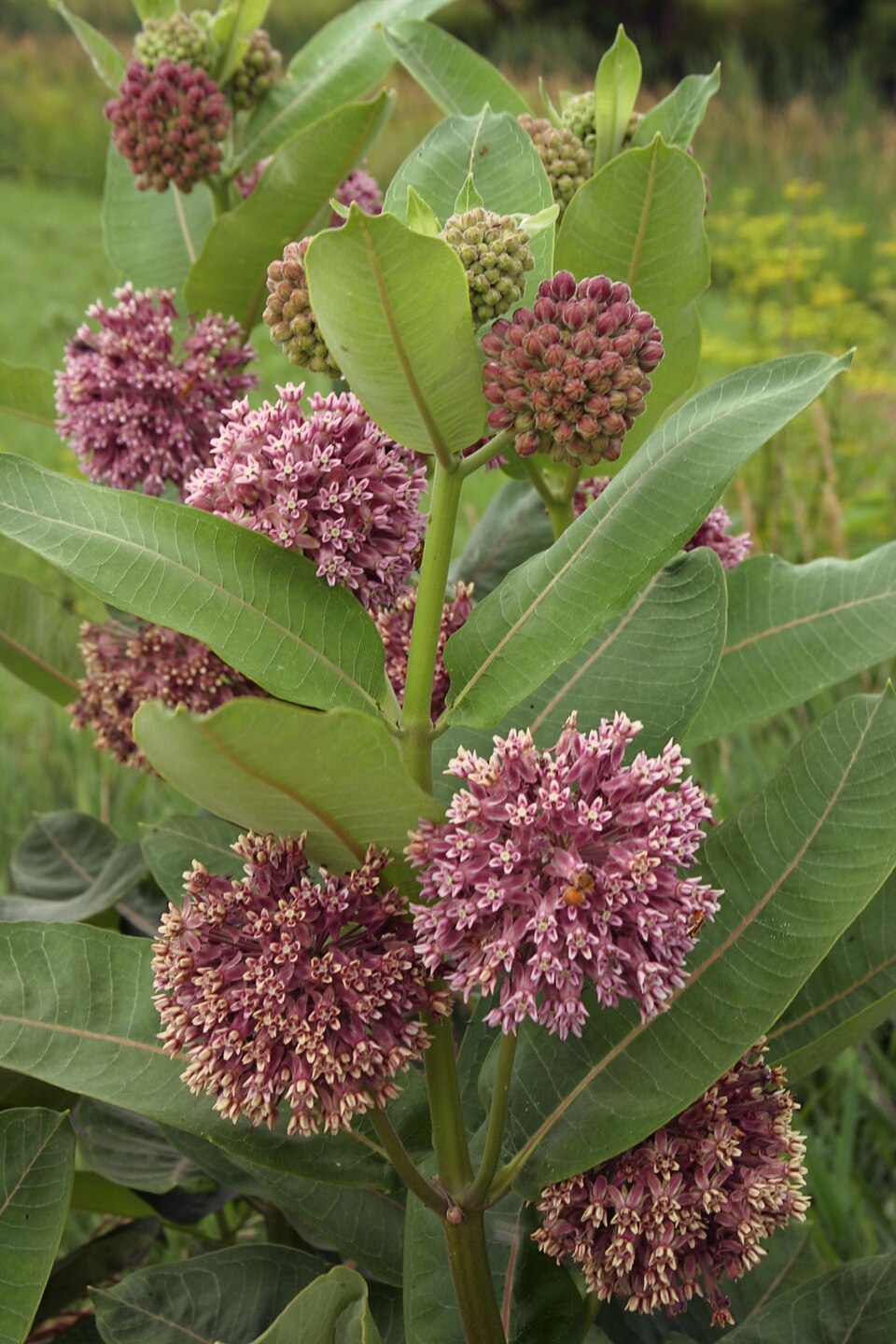
At a glance
- Life cycle
- Herbaceous perennial
- Leaves
- Deciduous
- Bloom
- June to August
- Fruiting season
- July to September
Recorded in 3 Louisiana parishes.
Natural habitats
Places it grows wild. Not a planting requirement. Each habitat page lists the plants and wildlife also found there.
Open, grass-dominated places kept open by fire, grazing or thin soil, from tallgrass prairie to Piedmont prairies.
Floodplain and bottomland forests
Forests on low ground beside rivers and streams that flood from time to time.
Roadsides, fields and disturbed ground
Ground opened by people: roadsides, old fields, pastures, fencerows and lots.
Who uses this plant?
 14CaterpillarsGenus host records with ranges including LA
Genus host records with ranges including LA · Asclepias
- Danaus plexippusMonarch
- Agathodes monstralisSky-Pointing Moth
- Cycnia collarisUnexpected Cycnia
- Cycnia teneraDelicate Cycnia, Dogbane Tiger Moth
- Danaus gilippusQueen
- Euchaetes egleMilkweed Tussock Moth or Milkweed Tiger Moth
- Hyalophora cecropiaCecropia Silkmoth, Cecropia Moth
- Papaipema nebrisStalk Borer
- Platynota flavedanaBlack-Shaded Platynota
- Pygarctia spragueiSprague's Pygarctia Moth
Show all 14
- Pyrrharctia isabellaIsabella Tiger Moth, Banded Woolybear
- Spodoptera frugiperdaFall Armyworm Moth
- Strymon melinusGray Hairstreak
- Pygarctia eglenensis
 59BeesSoutheastern regional records
Southeastern regional records · Asclepias
Individual names are not available yet.
Noori, Seltmann & Orr 2026, A curated and integrated dataset for exploring global bee-plant interactions (GloBI), Zenodo, CC BY 4.0 0Specialist beesPollen specialists
 1BirdsRecorded genus food-resource interactions; not a state feeding claim
Recorded genus food-resource interactions; not a state feeding claim · Asclepias
- Ortalis vetulaPlain Chachalaca
Direct food only: birds recorded eating this genus across North America. Caterpillars on host plants also feed nesting birds. NC Native Plant Society: butterfly gardening
Beetles 2
- Photinus pyralis
- Trichius piger
Flower visits · Carlinville, Illinois, USA
Flies 13
- Anthrax sinuosa
- Archytas analis
- Belvosia bifasciata
- Belvosia unifasciata
- Cistogaster occidua
- Culex stimulans
- Mallota illinoensis
- Odontomyia cincta
- Physocephala texana
- Scepsis fulvicollis
Show all 13
- Spallanzania hesperidarum
- Stomoxys calcitrans
- Tropidia quadrata
Flower visits · Carlinville, Illinois, USA
Adult butterflies / moths 13
- Achalarus lycidas
- Agrotis ypsilon
- Anosia plexippus
- Argynnis cybele
- Drasteria erechtea
- Limochores taumas
- Loxostege similalis
- Papilio asterias
- Pholisora catullus
- Polygonia interrogationis
Show all 13
- Speyeria idalia
- Thecla calanus
- Vanessa atalanta
Flower visits · Carlinville, Illinois, USA
Other wasps 7
- Ammobia ichneumonea
- Bembix nubillipennis
- Cerceris clypeata
- Leionotus arvensis
- Priononyx atrata
- Priononyx thomae
- Tachytes mandibularis
Flower visits · Carlinville, Illinois, USA
Other insects 5
- Euschistus variolarius
- Lygaeus turcicus
- Lygus pratensis
- Podisus spinosus
- Sinea diadema
Flower visits · Carlinville, Illinois, USA
No records yet · Ants
Plant details
- Family
- Apocynaceae
- Hardiness
- Zones 3a–9b
- Flower color
- Green, pink, purple or white
- Fruit begins
- July
- Fruit ends
- September
Safety has not been reviewed for this plant; check toxicity and thorns before planting.
Give spreading roots room in a meadow or naturalized patch. All parts are poisonous if eaten. NC State Extension
Growing sources and scope
- Bloom · “June to August” · Weakley, Flora of the Southeastern United States (2025), Carolinas & Georgia edition · Carolinas and Georgia
- Flower color · “Green, pink, purple or white” · NC Extension Plant Toolbox (ranked first; Prairie Moon 2026 Cultural Guide differs)
- Fruit begins · “July” · Weakley, Flora of the Southeastern United States (2025), Carolinas & Georgia edition · Carolinas and Georgia
- Fruit ends · “September” · Weakley, Flora of the Southeastern United States (2025), Carolinas & Georgia edition · Carolinas and Georgia
- Hardiness · “Zones 3a–9b” · NC Extension Plant Toolbox
- Height · “3–5 feet” · NC Extension Plant Toolbox (ranked first; Tennessee Smart Yards, Minnesota Wildflowers, Prairie Moon 2026 Cultural Guide differ)
- Leaves · “Deciduous” · NC Extension Plant Toolbox
- Life cycle · “Perennial” · NC Extension Plant Toolbox
- Light · “Full sun (6 or more hours of direct sunlight a day)” · NC Extension Plant Toolbox (ranked first; Tennessee Smart Yards, Virginia Cooperative Extension, Virginia DCR Piedmont, Prairie Moon 2026 Cultural Guide differ)
- Soil · “Occasionally dry” · NC Extension Plant Toolbox (ranked first; Tennessee Smart Yards, Virginia Cooperative Extension, Virginia DCR Piedmont, Prairie Moon 2026 Cultural Guide differ)
- Spread · “8–12 inches” · NC Extension Plant Toolbox
Recognizing it
Opposite, broad leaves with downy undersides; warty seed pods and milky sap. Identification source
Conservation status
| Louisiana rank | SNR |
|---|---|
| Global rank | G5 |
| LA status | Not verified |
| Federal status | Not verified |
Will it fit your yard?
Check this plant against your county, sun and soil moisture. Conditions are checked in your browser.
Growing cautions
- Spreads aggressively. Spreads rapidly by rhizomes and self-seeds. Tennessee Smart Yards
For planning only; these do not change the score or Fit.
Sources
- USDA PLANTS
- Vascular Plants of North Carolina (NC Natural Heritage Program)
- Weakley, Flora of the Southeastern United States (2025)
- Louisiana occurrence source
- Shropshire & Tallamy 2025, Lepidoptera of North America north of Mexico, ZooKeys 1261 (ODbL)
- Noori, Seltmann & Orr 2026, A curated and integrated dataset for exploring global bee-plant interactions (GloBI), Zenodo, CC BY 4.0
- Smith, Bachelder, Russell, Morales, Mosher & Seltmann 2024, Bee-Specialization-Modeling v0.6.1 (specialist host table compiled from J. Fowler's pollen specialist bee lists), Zenodo, CC BY 4.0
- Hurlbert, Olsen, Sawyer & Winner 2021, Avian Diet Database, Scientific Data 8: 260 (CC0)
- Narango, Tallamy & Shropshire 2020, Few keystone plant genera support the majority of Lepidoptera species, Nature Communications
- NC State Extension