

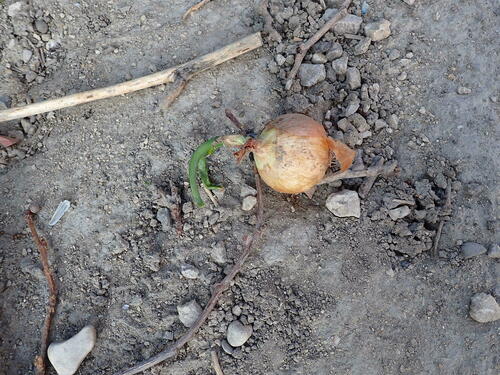
Garden Onion
Allium cepa
In the Carolinas and Georgia, found in persisting from gardens, or appearing around compost or trash piles. Weakley, Flora of the Southeastern United States (2025), Carolinas & Georgia edition What its natural habitat tells you
Not native to Louisiana. How scores work Is it native here?
Profile 82%
- Height
- 1–1.5 feet
- Spread
- 6 inches–1 foot
- Light
- Full sun
- Soil moisture
- Usually moist
Plant this instead
Choose your county to list local plants first.
No recorded swaps for this county. Try the garden finder.
At a glance
- Life cycle
- Perennial, from a bulb
- Bloom
- May to June
- Fruiting season
- July
Not yet recorded · Leaves
Recorded in 2 Louisiana parishes.
Who uses this plant?
 18CaterpillarsGenus host records with ranges including LA
Genus host records with ranges including LA · Allium
- Agrotis gladiariaSwordsman Dart, Clay-Backed Cut-Worm
- Agrotis ipsilonIpsilon Dart, Black Cutworm, Greasy Cutworm
- Agrotis malefidaRascal Dart, Pale-Sided Cut-Worm, Shagreened Cut-Worm
- Anicla infectaGreen Cutworm Moth
- Archips argyrospilaFruit-Tree Leafroller Moth
- Ascia monusteGreat Southern White
- Chrysodeixis includensSoybean Looper Moth
- Elasmopalpus lignosellaLesser Cornstalk Borer
- Estigmene acreaSalt Marsh Moth, Acrea Moth
- Feltia repletaReplete Dart
Show all 18
- Feltia subterraneaSubterranean Dart, Granulate Cutworm
- Mythimna unipunctaArmyworm Moth, White Speck
- Spilosoma virginicaVirginian Tiger Moth, Yellow Woolybear Moth, Yellow Bear
- Spodoptera eridaniaSouthern Armyworm Moth
- Spodoptera frugiperdaFall Armyworm Moth
- Spodoptera latifasciaOrange-Striped Armyworm, Velvet Armyworm Moth
- Spodoptera ornithogalliYellow-Striped Armyworm Moth, Cotton Cutworm
- Xestia dolosaGreater Black-Letter Dart, Greater Spotted Cutworm
 —BeesSoutheastern regional records
 —Specialist beesPollen specialists
 2BirdsRecorded genus food-resource interactions; not a state feeding claim
Recorded genus food-resource interactions; not a state feeding claim · Allium
- Alectoris chukarChukar
- Meleagris gallopavoWild Turkey
Direct food only: birds recorded eating this genus across North America. Caterpillars on host plants also feed nesting birds. NC Native Plant Society: butterfly gardening
Plant details
- Family
- Alliaceae
- Hardiness
- Zones 5a–10b
- Soil pH
- Neutral to alkaline
- Flower color
- White
- Fruit begins
- July
- Fruit ends
- July
Safety has not been reviewed for this plant; check toxicity and thorns before planting.
Growing sources and scope
- Bloom · “May to June” · Weakley, Flora of the Southeastern United States (2025), Carolinas & Georgia edition · Carolinas and Georgia
- Flower color · “White” · NC Extension Plant Toolbox
- Fruit begins · “July” · Weakley, Flora of the Southeastern United States (2025), Carolinas & Georgia edition · Carolinas and Georgia
- Fruit ends · “July” · Weakley, Flora of the Southeastern United States (2025), Carolinas & Georgia edition · Carolinas and Georgia
- Hardiness · “Zones 5a–10b” · NC Extension Plant Toolbox
- Height · “1–1.5 feet” · NC Extension Plant Toolbox
- Life cycle · “Perennial, from a bulb” · NC Extension Plant Toolbox
- Light · “Full sun (6 or more hours of direct sunlight a day)” · NC Extension Plant Toolbox
- primary_flower_color · “white” · NC Extension Plant Toolbox
- Soil · “Moist” · NC Extension Plant Toolbox
- Soil pH · “Neutral to alkaline” · NC Extension Plant Toolbox
- Spread · “6 inches–1 foot” · NC Extension Plant Toolbox
Conservation status
| Louisiana rank | SNA |
|---|---|
| Global rank | GNR |
| LA status | Not verified |
| Federal status | Not verified |
Sources
- NatureServe Explorer
- USDA PLANTS
- Weakley, Flora of the Southeastern United States (2025), Carolinas & Georgia edition
- Louisiana occurrence source
- Shropshire & Tallamy 2025, Lepidoptera of North America north of Mexico, ZooKeys 1261 (ODbL)
- Noori, Seltmann & Orr 2026, A curated and integrated dataset for exploring global bee-plant interactions (GloBI), Zenodo, CC BY 4.0
- Smith, Bachelder, Russell, Morales, Mosher & Seltmann 2024, Bee-Specialization-Modeling v0.6.1 (specialist host table compiled from J. Fowler's pollen specialist bee lists), Zenodo, CC BY 4.0
- Hurlbert, Olsen, Sawyer & Winner 2021, Avian Diet Database, Scientific Data 8: 260 (CC0)
- Narango, Tallamy & Shropshire 2020, Few keystone plant genera support the majority of Lepidoptera species, Nature Communications