Rare or protected plant. Specialist conservation planting; excluded from routine garden suggestions. Plant caution source
Hidden from default planting suggestions. Wildlife value and native status remain unchanged.
Ecological relationships
Who uses this plant?
 5CaterpillarsGenus host records with ranges including KY
Genus host records with ranges including KY · Silphium
- Eucosma giganteanaGiant Eucosma
- Papaipema baptisiaeWild Indigo Borer, Indigo Stem Borer
- Papaipema nebrisStalk Borer
- Papaipema silphiiSilphius Borer
- Tricholita notataX
 —BeesSoutheastern regional records
 7Specialist beesPollen specialists
Pollen specialists · Silphium
- Dianthidium curvatum
- Dieunomia heteropoda
- Megachile parallela
- Melissodes dentiventris
- Melissodes vernoniae
- Melissodes wheeleri
- Paranthidium jugatorium
 —BirdsRecorded genus food-resource interactions; not a state feeding claim
Growing and identification
Plant details
- Family
- Asteraceae
- Hardiness
- Zones 3–8
- Flower color
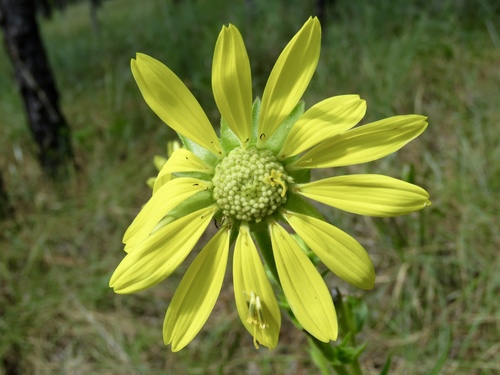
- Yellow
Growing sources and scope
- Bloom · “June to September” · Prairie Moon 2026 Cultural Guide · Nursery cultural guide; height in flower; moisture categories retained as printed
- Flower color · “Yellow” · Prairie Moon 2026 Cultural Guide · Nursery cultural guide; height in flower; moisture categories retained as printed
- Hardiness · “Zones 3–8” · Missouri Botanical Garden Plant Finder
- Height · “About 8 feet in flower” · Prairie Moon 2026 Cultural Guide · Nursery cultural guide; height in flower; moisture categories retained as printed
- Life cycle · “Perennial” · Minnesota Wildflowers
- Light · “Full sun (6+ hours); Part shade (3–6 hours)” · Prairie Moon 2026 Cultural Guide · Nursery cultural guide; height in flower; moisture categories retained as printed
- Soil · “Wet-mesic; Mesic; Dry-mesic; Dry” · Prairie Moon 2026 Cultural Guide · Nursery cultural guide; height in flower; moisture categories retained as printed
- Spread · “1.5–3 feet” · Missouri Botanical Garden Plant Finder
Also known as
Compass Plant
Conservation status
| Kentucky rank | S2 |
|---|---|
| Global rank | Not available |
| KY status | Not verified |
| Federal status | Not verified |
In your garden
Will it fit your spot?
Check this plant against your county, sun and soil moisture. Conditions are checked in your browser.
Choose a county to begin.
Sources
- tnky_atlas
- Shropshire & Tallamy 2025, Lepidoptera of North America north of Mexico, ZooKeys 1261 (ODbL)
- Noori, Seltmann & Orr 2026, A curated and integrated dataset for exploring global bee-plant interactions (GloBI), Zenodo, CC BY 4.0
- Smith, Bachelder, Russell, Morales, Mosher & Seltmann 2024, Bee-Specialization-Modeling v0.6.1 (specialist host table compiled from J. Fowler's pollen specialist bee lists), Zenodo, CC BY 4.0
- Hurlbert, Olsen, Sawyer & Winner 2021, Avian Diet Database, Scientific Data 8: 260 (CC0)
- Narango, Tallamy & Shropshire 2020, Few keystone plant genera support the majority of Lepidoptera species, Nature Communications