Rare or protected plant. Specialist conservation planting; excluded from routine garden suggestions. Plant caution source
Hidden from default planting suggestions. Wildlife value and native status remain unchanged.

Ecological relationships
Who uses this plant?
 2CaterpillarsGenus host records with ranges including KY
Genus host records with ranges including KY · Cypripedium
- Cenopis reticulatanaReticulated Fruitworm Moth
- Polychrysia morigera
 —BeesSoutheastern regional records
 —Specialist beesPollen specialists
 —BirdsRecorded genus food-resource interactions; not a state feeding claim
Growing and identification
Plant details
- Family
- Orchidaceae
- Flower color
- White, red, yellow or brown
Growing sources and scope
- Flower color · “White, red, yellow or brown” · Lady Bird Johnson Wildflower Center
- Height · “Up to about 3 feet” · Lady Bird Johnson Wildflower Center
- Life cycle · “Perennial” · Lady Bird Johnson Wildflower Center
- Light · “Partial shade; Full shade (documented habitat)” · FloraQuest: Carolinas, Georgia (Southeastern Flora Team) · Carolinas and Georgia
- Soil · “Moist; Wet (documented habitat)” · FloraQuest: Carolinas, Georgia (Southeastern Flora Team) · Carolinas and Georgia
Also known as
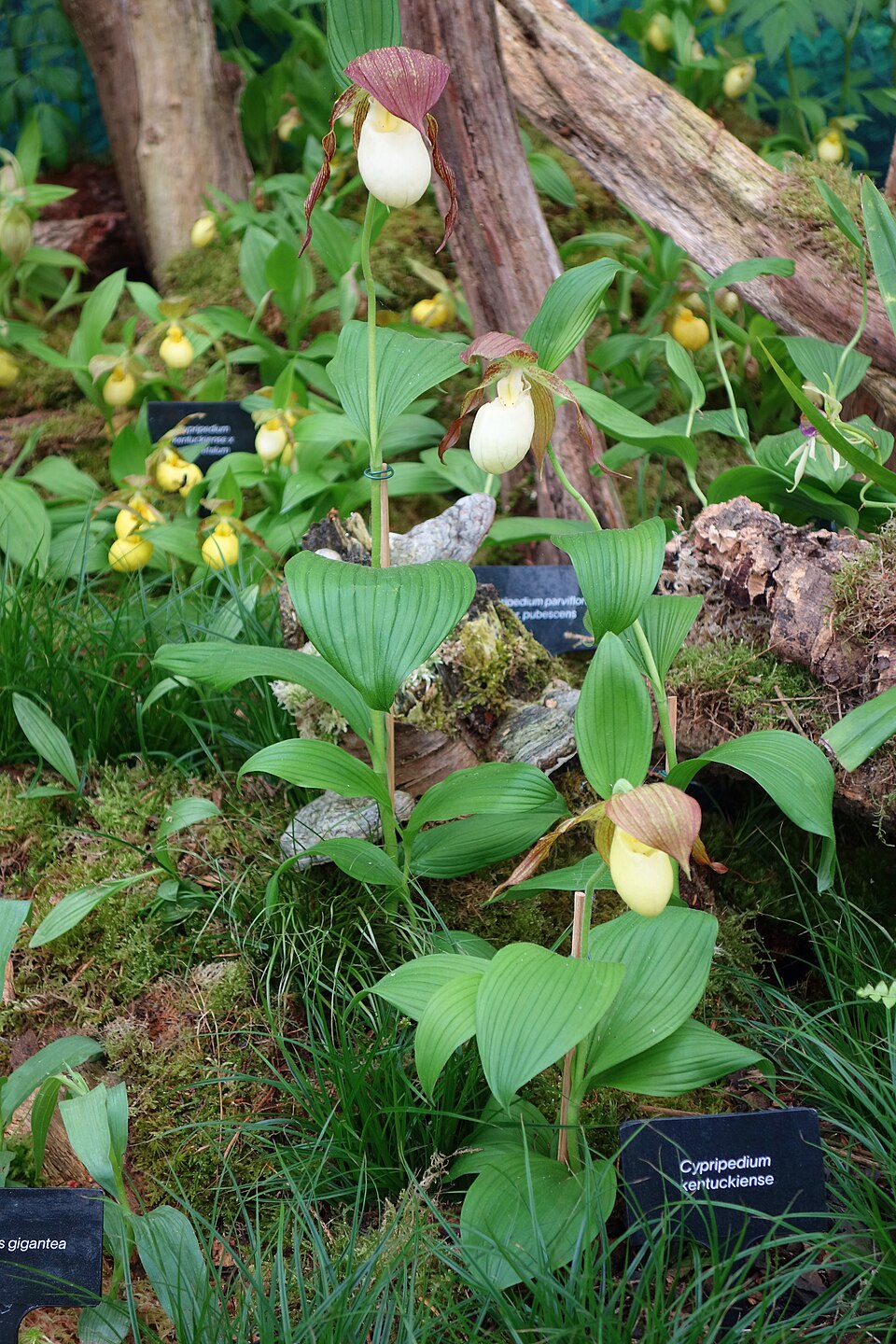
Kentucky Ladys Slipper; Kentucky Moccasin Flower
Conservation status
| Kentucky rank | S1S2 |
|---|---|
| Global rank | Not available |
| KY status | Not verified |
| Federal status | Not verified |
In your garden
Will it fit your spot?
Check this plant against your county, sun and soil moisture. Conditions are checked in your browser.
Choose a county to begin.
Sources
- tnky_atlas
- Shropshire & Tallamy 2025, Lepidoptera of North America north of Mexico, ZooKeys 1261 (ODbL)
- Noori, Seltmann & Orr 2026, A curated and integrated dataset for exploring global bee-plant interactions (GloBI), Zenodo, CC BY 4.0
- Smith, Bachelder, Russell, Morales, Mosher & Seltmann 2024, Bee-Specialization-Modeling v0.6.1 (specialist host table compiled from J. Fowler's pollen specialist bee lists), Zenodo, CC BY 4.0
- Hurlbert, Olsen, Sawyer & Winner 2021, Avian Diet Database, Scientific Data 8: 260 (CC0)
- Narango, Tallamy & Shropshire 2020, Few keystone plant genera support the majority of Lepidoptera species, Nature Communications