Do not plant. Listed invasive in Kentucky.
Ecological relationships
Who uses this plant?
 32CaterpillarsGenus host records with ranges including KY
Genus host records with ranges including KY · Cirsium
- Achyra rantalisGarden Webworm Moth
- Anagrapha falciferaCelery Looper Moth
- Autographa precationisCommon Looper Moth
- Calephelis muticumSwamp Metalmark
- Cenopis reticulatanaReticulated Fruitworm Moth
- Choristoneura rosaceanaOblique-Banded Leafroller Moth, Rosaceous Leaf Roller
- Dicymolomia julianalisJulia's Dicymolomia
- Epiblema scudderianaScudder's Epiblema, Goldenrod Gall Moth
- Homoeosoma electellaSunflower Moth
- Lipocosmodes fuliginosalisSooty Lipocosmodes
Show all 32
- Megalographa bilobaBilobed Looper Moth
- Orthodes cynicaCynical Quaker, Cynical Groundcat
- Papaipema arctivorensNorthern Burdock Borer Moth
- Papaipema cataphractaBurdock Border, Potato-Stalk Borer
- Papaipema cerussataIronweed Borer Moth
- Papaipema insulidensRagwort Stem Borer
- Papaipema nebrisStalk Borer
- Papilio glaucusEastern Tiger Swallowtail
- Paralobesia viteanaAmerican Vine Moth, Grape Berry Moth
- Phlogophora irisOlive Angle Shades
- Phyciodes tharosPearl Crescent, Crescentspot
- Phycitodes reliquellaWhite-Edged Phycitodes
- Platyptilia carduidactylusArtichoke Plume Moth
- Pyrausta subsequalisMottled Pyrausta
- Synchlora frondariaSouthern Emerald
- Udea rubigalisCelery Leaftier
- Vanessa carduiPainted Lady, Cosmopolite
- Vanessa virginiensisAmerican Lady, American Painted Lady
- Walshia miscecolorellaSweetclover Root Borer Moth
- Xestia c-nigrumSpotted Cut-Worm, Setaceous Hebrew Character, Lesser Black-letter Dart
- Xestia dolosaGreater Black-Letter Dart, Greater Spotted Cutworm
- Hedya cyanana
 —BeesSoutheastern regional records
 12Specialist beesPollen specialists
Pollen specialists · Cirsium
- Andrena nubecula
- Andrena placata
- Andrena runcinatae
- Andrena simplex
- Diadasia enavata
- Megachile pugnata
- Melissodes confusus
- Melissodes desponsus
- Melissodes illatus
- Melissodes rivalis
Show all 12
- Osmia chalybea
- Osmia texana
 6BirdsRecorded genus food-resource interactions; not a state feeding claim
Recorded genus food-resource interactions; not a state feeding claim · Cirsium
- Callipepla californicaCalifornia Quail
- Columbina passerinaCommon Ground Dove
- Meleagris gallopavoWild Turkey
- Perdix perdixGray Partridge
- Spizella pusillaField Sparrow
- Zenaida macrouraMourning Dove
Growing and identification
Plant details
- Family
- Asteraceae
- Hardiness
- Zones 3a–8b
- Soil pH
- Acidic to alkaline
- Flower color
- Pink or purple
Safety has not been reviewed for this plant; check toxicity and thorns before planting.
Growing sources and scope
- Flower color · “Pink or purple” · NC Extension Plant Toolbox
- Hardiness · “Zones 3a–8b” · NC Extension Plant Toolbox
- Height · “1 to 6.6 feet (0.3 to 2 m) tall” · Fire Effects Information System: Cirsium vulgare · Source botanical description; original units and scope retained
- Leaves · “Deciduous” · NC Extension Plant Toolbox
- Life cycle · “Biennial” · NC Extension Plant Toolbox
- Light · “Full sun (6 or more hours of direct sunlight a day)” · NC Extension Plant Toolbox
- Soil · “Moist” · NC Extension Plant Toolbox
- Soil pH · “Acidic to alkaline” · NC Extension Plant Toolbox
Also known as
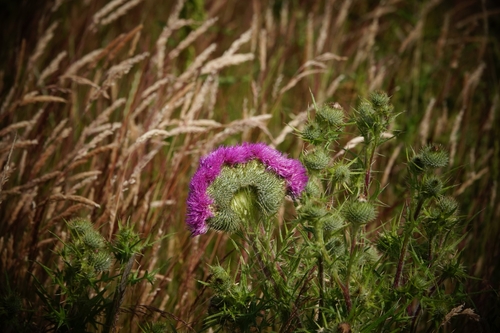
Bull Thistle; Carduus lanceolatus; plumeless thistle; plumeless-thistle
Conservation status
| Kentucky rank | SNA |
|---|---|
| Global rank | GNR |
| KY status | Not verified |
| Federal status | Not verified |
Native alternatives
Find natives for your gardenSources
- tnky_atlas
- usda
- ky_invasive
- Shropshire & Tallamy 2025, Lepidoptera of North America north of Mexico, ZooKeys 1261 (ODbL)
- Noori, Seltmann & Orr 2026, A curated and integrated dataset for exploring global bee-plant interactions (GloBI), Zenodo, CC BY 4.0
- Smith, Bachelder, Russell, Morales, Mosher & Seltmann 2024, Bee-Specialization-Modeling v0.6.1 (specialist host table compiled from J. Fowler's pollen specialist bee lists), Zenodo, CC BY 4.0
- Hurlbert, Olsen, Sawyer & Winner 2021, Avian Diet Database, Scientific Data 8: 260 (CC0)
- Narango, Tallamy & Shropshire 2020, Few keystone plant genera support the majority of Lepidoptera species, Nature Communications