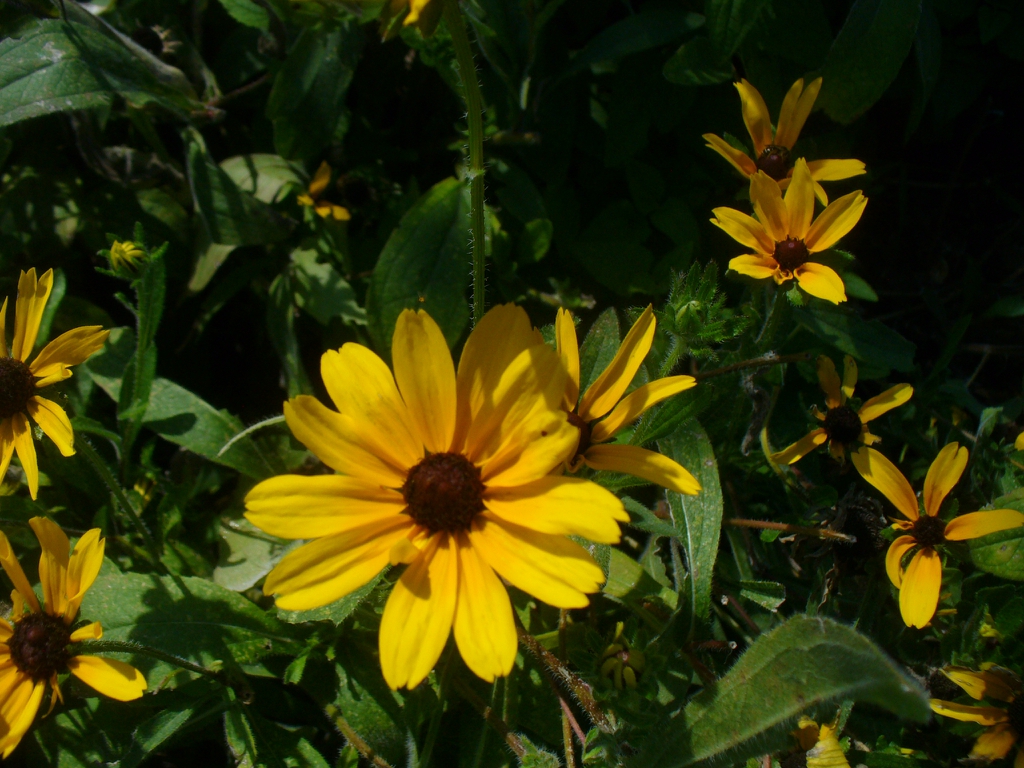
Care
- Avoid soggy soil.
Ecological relationships
Who uses this plant?
 19CaterpillarsGenus host records with ranges including GA
Genus host records with ranges including GA · Rudbeckia
- Chlosyne nycteisSilvery Checkerspot
- Acharia stimuleaSaddleback Caterpillar Moth
- Adaina ambrosiaeAmbrosia Plume Moth, Ragweed Plume Moth
- Archips griseaGray Archips
- Chlorochlamys chloroleucariaBlackberry Looper Moth
- Epiblema carolinanaGray-Blotched Epiblema
- Epiblema tripartitanaThree-Parted Epiblema
- Eupithecia miserulataCommon Eupithacia, Common Pug
- Homoeosoma electellaSunflower Moth
- Lithophane unimodaDowdy Pinion
Show all 19
- Orthotaenia undulanaDusky Leafroller
- Papaipema cataphractaBurdock Border, Potato-Stalk Borer
- Papaipema nebrisStalk Borer
- Papaipema nelitaConeflower Borer
- Phtheochroa birdanaBird's Cochylid
- Synchlora frondariaSouthern Emerald
- Vanessa carduiPainted Lady, Cosmopolite
- Isophrictis similiella
- Paralobesia rhoifructana
 56BeesSoutheastern regional records
Southeastern regional records · Rudbeckia
Individual names are not available yet.
Noori, Seltmann & Orr 2026, A curated and integrated dataset for exploring global bee-plant interactions (GloBI), Zenodo, CC BY 4.0 25Specialist beesPollen specialists
Pollen specialists · Rudbeckia
- Andrena aliciae
- Andrena asteris
- Andrena rudbeckiae
- Diadasia enavata
- Dieunomia bolliana
- Dieunomia heteropoda
- Megachile inimica
- Megachile parallela
- Megachile pugnata
- Megachile xylocopoides
Show all 25
- Melissodes bidentis
- Melissodes boltoniae
- Melissodes coreopsis
- Melissodes denticulatus
- Melissodes dentiventris
- Melissodes desponsus
- Melissodes druriellus
- Melissodes illatus
- Melissodes subillatus
- Melissodes trinodis
- Melissodes wheeleri
- Paranthidium jugatorium
- Perdita octomaculata
- Protandrena albitarsis
- Protandrena andrenoides
 —BirdsRecorded genus food-resource interactions; not a state feeding claim
No records yet · Ants · Beetles · Flies · Adult butterflies / moths · Other wasps · Other insects
Growing and identification
Plant details
- Family
- Asteraceae
- Hardiness
- Zones 3a–9b
- Flower color
- Black, yellow or orange
Safety has not been reviewed for this plant; check toxicity and thorns before planting.
Growing sources and scope
- Bloom · “Summer and fall” · NC Extension Plant Toolbox
- Flower color · “Black, yellow or orange” · NC Extension Plant Toolbox
- Hardiness · “Zones 3a–9b” · NC Extension Plant Toolbox
- Height · “2–3 feet” · NC Extension Plant Toolbox
- Leaves · “Evergreen” · NC Extension Plant Toolbox
- Life cycle · “Perennial” · NC Extension Plant Toolbox
- Light · “Full sun (6 or more hours of direct sunlight a day)” · NC Extension Plant Toolbox
- Soil · “Good drainage; Moist; Occasionally dry” · NC Extension Plant Toolbox
- Spread · “1–2 feet” · NC Extension Plant Toolbox
Conservation status
| Georgia rank | Not available |
|---|---|
| Global rank | G5 |
| GA status | Not verified |
| Federal status | Not verified |
In your garden
Will it fit your spot?
Check this plant against your county, sun and soil moisture. Conditions are checked in your browser.
Choose a county to begin.
Sources
- usda
- nc_flora
- Georgia occurrence source
- Shropshire & Tallamy 2025, Lepidoptera of North America north of Mexico, ZooKeys 1261 (ODbL)
- Noori, Seltmann & Orr 2026, A curated and integrated dataset for exploring global bee-plant interactions (GloBI), Zenodo, CC BY 4.0
- Smith, Bachelder, Russell, Morales, Mosher & Seltmann 2024, Bee-Specialization-Modeling v0.6.1 (specialist host table compiled from J. Fowler's pollen specialist bee lists), Zenodo, CC BY 4.0
- Hurlbert, Olsen, Sawyer & Winner 2021, Avian Diet Database, Scientific Data 8: 260 (CC0)
- Narango, Tallamy & Shropshire 2020, Few keystone plant genera support the majority of Lepidoptera species, Nature Communications