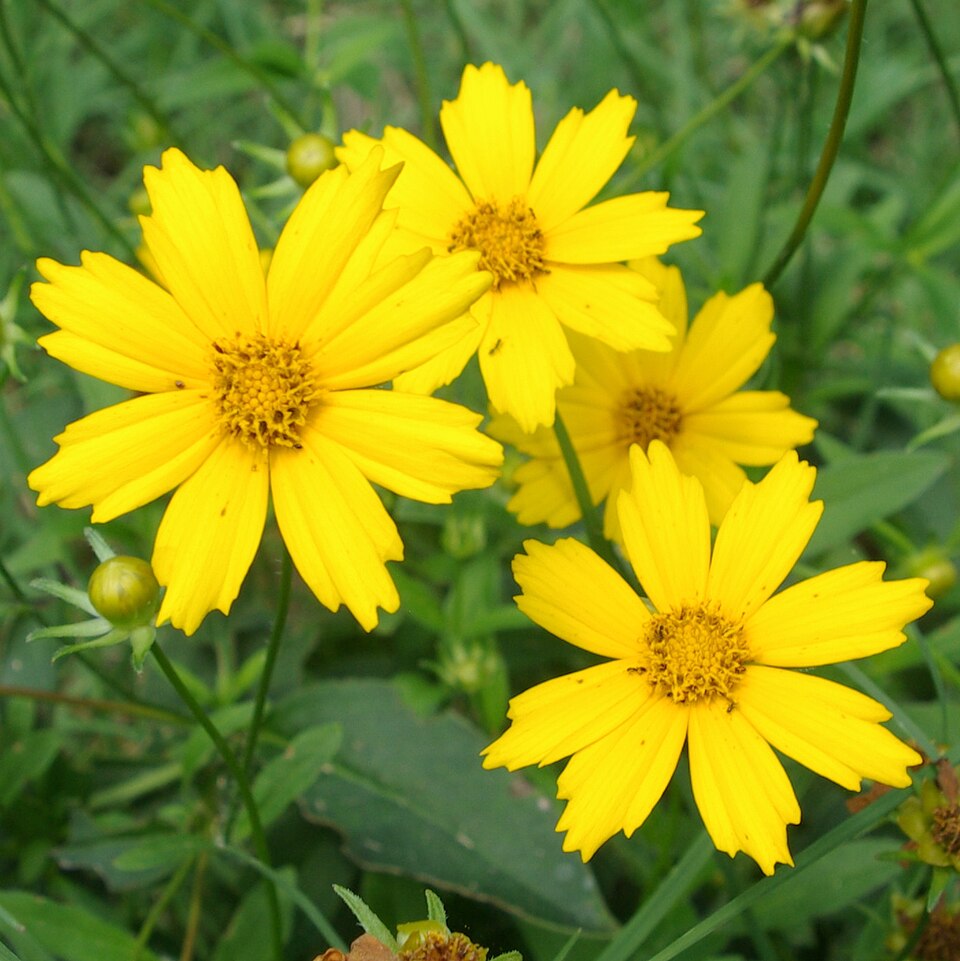

Yellow, notched flower rays brighten this spreading, narrow-leaved perennial.
Care
- Avoid persistently wet, poorly drained soil.
- Optional bloom tip: Removing spent flowers can encourage more blooms.
Who uses this plant?
 6CaterpillarsGenus host records with ranges including GA
Genus host records with ranges including GA · Coreopsis
- Homoeosoma electellaSunflower Moth
- Nathalis ioleDainty Sulphur, Dwarf Yellow
- Pleuroprucha insulsariaCommon Tan Wave
- Suleima helianthanaSunflower Bud Moth
- Synchlora frondariaSouthern Emerald
- Tornos scolopacinariaDimorphic Gray
 46BeesSoutheastern regional records
Southeastern regional records · Coreopsis
Individual names are not available yet.
Noori, Seltmann & Orr 2026, A curated and integrated dataset for exploring global bee-plant interactions (GloBI), Zenodo, CC BY 4.0 15Specialist beesPollen specialists
Pollen specialists · Coreopsis
- Andrena beameri
- Andrena duplicata
- Andrena gardineri
- Colletes birkmanni
- Dianthidium curvatum
- Dianthidium simile
- Megachile parallela
- Megachile pugnata
- Megachile xylocopoides
- Melissodes coreopsis
Show all 15
- Melissodes subillatus
- Melissodes wheeleri
- Paranthidium jugatorium
- Perdita foveata
- Protandrena albitarsis
 —BirdsRecorded genus food-resource interactions; not a state feeding claim
 1AntsRecorded seed interactions
- Solenopsis invicta
Solenopsis invicta: Seed predation.
No records yet · Beetles · Flies · Adult butterflies / moths · Other wasps · Other insects
Plant details
- Family
- Asteraceae
- Hardiness
- Zones 4a–9b
- Soil pH
- Acidic to neutral
- Flower color
- Yellow or orange
- Growth rate
- Moderate
- Growth habit
- Single crown
- Foliage color
- Green
- Fruit begins
- Fall
- Fruit ends
- Fall
Safety has not been reviewed for this plant; check toxicity and thorns before planting.
Deadhead to limit self-seeding and encourage flowers. Rich soil can produce floppy growth; divide crowded clumps. NC State Extension
Growing sources and scope
- Bloom · “May to August” · Prairie Moon 2026 Cultural Guide · Nursery cultural guide; height in flower; moisture categories retained as printed
- Flower color · “Yellow or orange” · NC Extension Plant Toolbox
- Foliage color · “Green” · USDA PLANTS · Nationwide species characteristics; local growing conditions may vary
- Fruit begins · “Fall” · USDA PLANTS · Nationwide species characteristics; local growing conditions may vary
- Fruit ends · “Fall” · USDA PLANTS · Nationwide species characteristics; local growing conditions may vary
- Growth habit · “Single crown” · USDA PLANTS · Nationwide species characteristics; local growing conditions may vary
- Growth rate · “Moderate” · USDA PLANTS · Nationwide species characteristics; local growing conditions may vary
- Hardiness · “Zones 4a–9b” · NC Extension Plant Toolbox
- Height · “1–3 feet” · NC Extension Plant Toolbox
- Leaves · “Deciduous” · NC Extension Plant Toolbox
- Life cycle · “Perennial” · NC Extension Plant Toolbox
- Light · “Full sun (6 or more hours of direct sunlight a day); Partial shade (direct sunlight only part of the day, 2-6 hours)” · NC Extension Plant Toolbox
- Soil · “Moist; Occasionally dry” · NC Extension Plant Toolbox
- Soil pH · “Acidic to neutral” · NC Extension Plant Toolbox
- Spread · “1–2 feet” · NC Extension Plant Toolbox
Recognizing it
Opposite narrow leaves sometimes have side lobes. Flower heads usually carry eight notched yellow rays. Identification source
Also known as
Lance Leaf Tickseed
Conservation status
| Georgia rank | Not available |
|---|---|
| Global rank | G5 |
| GA status | Not verified |
| Federal status | Not verified |
Will it fit your spot?
Check this plant against your county, sun and soil moisture. Conditions are checked in your browser.
Sources
- tnky_atlas
- usda
- nc_flora
- Georgia occurrence source
- Shropshire & Tallamy 2025, Lepidoptera of North America north of Mexico, ZooKeys 1261 (ODbL)
- Noori, Seltmann & Orr 2026, A curated and integrated dataset for exploring global bee-plant interactions (GloBI), Zenodo, CC BY 4.0
- Smith, Bachelder, Russell, Morales, Mosher & Seltmann 2024, Bee-Specialization-Modeling v0.6.1 (specialist host table compiled from J. Fowler's pollen specialist bee lists), Zenodo, CC BY 4.0
- Hurlbert, Olsen, Sawyer & Winner 2021, Avian Diet Database, Scientific Data 8: 260 (CC0)
- Narango, Tallamy & Shropshire 2020, Few keystone plant genera support the majority of Lepidoptera species, Nature Communications
- NC State Extension