

Black-eyed Pea
Vigna unguiculata
Found in cultivated in commercial and home gardens, rarely persistent or occurring as a waif in disturbed areas. FloraQuest, phone app (app page) What its natural habitat tells you
Not native to Florida. How scores work Is it native here?
Profile 82%
- Height
- 5–10 feet
- Spread
- 1–3 feet
- Light
- Full sun
- Soil moisture
- Somewhat dry to moist
Plant this instead
Choose your county to list local plants first.
No recorded swaps for this county. Try the garden finder.
At a glance
- Life cycle
- Annual
- Leaves
- Deciduous
- Bloom
- June to August
- Fruiting season
- July to September
Recorded in 10 Florida counties.
Who uses this plant?
 38CaterpillarsGenus host records with ranges including FL
Genus host records with ranges including FL · Vigna
- Achyra rantalisGarden Webworm Moth
- Agrotis vetustaOld Man Dart
- Amyelois transitellaNavel Orangeworm
- Amyna strictaEight-Spot Moth
- Anomis flavaTropical Anomis Moth
- Anticarsia gemmatalisVelvetbean Caterpillar Moth
- Argyrogramma verrucaGolden Looper
- Argyrotaenia ivanaIvana Leafroller Moth
- Cecropterus dorantesDorantes Longtail, Lilac-Banded Longtail
- Chrysodeixis includensSoybean Looper Moth
Show all 38
- Elasmopalpus lignosellaLesser Cornstalk Borer
- Estigmene acreaSalt Marsh Moth, Acrea Moth
- Eupithecia miserulataCommon Eupithacia, Common Pug
- Euptoieta claudiaVariegated Fritillary, (?)Gulf Fritillary
- Feltia repletaReplete Dart
- Feltia subterraneaSubterranean Dart, Granulate Cutworm
- Fundella pellucensCaribbean Podborer
- Helicoverpa zeaCorn Earworm Moth
- Hemiargus ceraunusCeraunus Blue, Antillean Blue
- Hypena scabraGreen Cloverworm Bomolocha, Black Snout
- Leptostales pannariaPannaria Wave
- Leptotes cassiusCassius Blue, Tropical Striped Blue
- Omiodes indicataBean-Leaf Webworm Moth
- Platynota flavedanaBlack-Shaded Platynota
- Spodoptera eridaniaSouthern Armyworm Moth
- Spodoptera frugiperdaFall Armyworm Moth
- Spoladea recurvalisHawaiian Beet Webworm
- Strymon melinusGray Hairstreak
- Telegonus cellusGolden Banded-Skipper , Golden-Banded Skipper
- Trichoplusia niNi Moth, Cabbage Looper Moth
- Ufa rubedinellaRed Washed Ufa
- Urbanus proteusLong-Tailed Skipper, Bean Leaf Roller
- Anarsioses aberrans
- Ancylostomia stercorea
- Dichomeris acuminatus
- Epinotia perplexana
- Omiodes simialis
- Phidotricha erigens
 —BeesSoutheastern regional records
 —Specialist beesPollen specialists
 1BirdsRecorded genus food-resource interactions; not a state feeding claim
Recorded genus food-resource interactions; not a state feeding claim · Vigna
- Colinus virginianusNorthern Bobwhite
Direct food only: birds recorded eating this genus across North America. Caterpillars on host plants also feed nesting birds. NC Native Plant Society: butterfly gardening
Plant details
- Family
- Fabaceae
- Soil pH
- Acidic to neutral
- Flower color
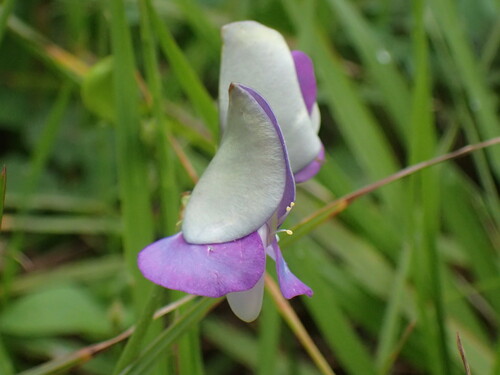
- Purple
- Growth rate
- Rapid
- Growth habit
- Single crown
- Foliage color
- Green
- Fruit begins
- July
- Fruit ends
- September
Safety has not been reviewed for this plant; check toxicity and thorns before planting.
Growing sources and scope
- Bloom · “June to August” · FloraQuest: Carolinas, Georgia (Southeastern Flora Team), phone app (app page) (ranked first; USDA PLANTS differs) · Carolinas and Georgia
- Flower color · “Purple” · NC Extension Plant Toolbox
- Foliage color · “Green” · USDA PLANTS · Nationwide species characteristics; local growing conditions may vary
- Fruit begins · “July” · FloraQuest: Carolinas, Georgia (Southeastern Flora Team), phone app (app page) (ranked first; USDA PLANTS differs) · Carolinas and Georgia
- Fruit ends · “September” · FloraQuest: Carolinas, Georgia (Southeastern Flora Team), phone app (app page) (ranked first; USDA PLANTS differs) · Carolinas and Georgia
- Growth habit · “Single crown” · USDA PLANTS · Nationwide species characteristics; local growing conditions may vary
- Growth rate · “Rapid” · USDA PLANTS · Nationwide species characteristics; local growing conditions may vary
- Height · “5–10 feet” · NC Extension Plant Toolbox (ranked first; USDA PLANTS differs)
- Leaf retention · “Deciduous” · USDA PLANTS · Nationwide species characteristics; local growing conditions may vary
- Life cycle · “Annual” · NC Extension Plant Toolbox
- Light · “Full sun (6 or more hours of direct sunlight a day)” · NC Extension Plant Toolbox
- primary_flower_color · “purple” · USDA PLANTS
- Soil · “Moist; Occasionally dry” · NC Extension Plant Toolbox
- Soil pH · “Acidic to neutral” · NC Extension Plant Toolbox
- Spread · “1–3 feet” · NC Extension Plant Toolbox
Also known as
Black Eye Pea; Black eyed Pea; Blackeyed Pea; Common Cow Pea; Common Cowpea; Cow Pea; Cowpea; Field Pea; Wild Cow Pea; Wild Cowpea; Yard Long Bean; Yard Longbean
Conservation status
| Florida rank | SNA |
|---|---|
| Global rank | GNR |
| FL status | Not verified |
| Federal status | Not verified |
Sources
- Atlas of Florida Plants
- USDA PLANTS
- FloraQuest: Carolinas, Georgia (Weakley), phone app (app page)
- FloraQuest: Florida (Weakley), phone app (app page)
- NatureServe Explorer
- Shropshire & Tallamy 2025, Lepidoptera of North America north of Mexico, ZooKeys 1261 (ODbL)
- Noori, Seltmann & Orr 2026, A curated and integrated dataset for exploring global bee-plant interactions (GloBI), Zenodo, CC BY 4.0
- Smith, Bachelder, Russell, Morales, Mosher & Seltmann 2024, Bee-Specialization-Modeling v0.6.1 (specialist host table compiled from J. Fowler's pollen specialist bee lists), Zenodo, CC BY 4.0
- Hurlbert, Olsen, Sawyer & Winner 2021, Avian Diet Database, Scientific Data 8: 260 (CC0)
- Narango, Tallamy & Shropshire 2020, Few keystone plant genera support the majority of Lepidoptera species, Nature Communications