

Cultivated Tobacco
Nicotiana tabacum
Found in persistent after cultivation; commonly cultivated, rarely naturalized. Weakley, Flora of the Southeastern United States (2025), Florida edition What its natural habitat tells you
—
Not native
Not native to Florida. How scores work Is it native here?
Profile 71%
- Height
- 3–10 feet
- Spread
- 1–2 feet
- Light
- Full sun, Partial shade
- Soil moisture
- Somewhat dry to moist
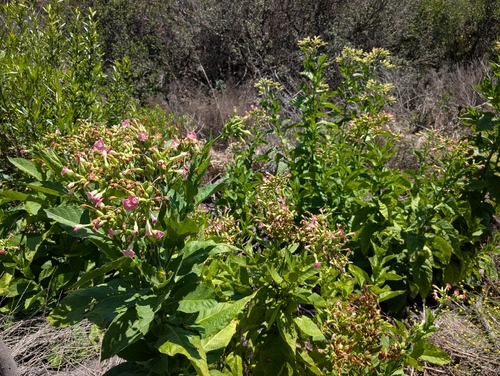
At a glance
- Life cycle
- Annual or perennial
- Leaves
- Deciduous or semi-evergreen
- Fruiting season
- September to October
Not yet recorded · Bloom
Recorded in 1 Florida county.
Ecological relationships
Who uses this plant?
 52CaterpillarsGenus host records with ranges including FL
Genus host records with ranges including FL · Nicotiana
- Agrotis gladiariaSwordsman Dart, Clay-Backed Cut-Worm
- Agrotis ipsilonIpsilon Dart, Black Cutworm, Greasy Cutworm
- Agrotis malefidaRascal Dart, Pale-Sided Cut-Worm, Shagreened Cut-Worm
- Agrotis venerabilisVenerable Dart, Dusky Cut-Worm
- Agrotis vetustaOld Man Dart
- Anagrapha falciferaCelery Looper Moth
- Anicla infectaGreen Cutworm Moth
- Anomis erosaYellow Scallop Moth, Mallow Caterpillar
- Anomis flavaTropical Anomis Moth
- Apantesis phylliraPhyllira Tiger Moth
Show all 52
- Argyrogramma verrucaGolden Looper
- Autoplusia egenaBean-Leaf Skeletonizer Moth
- Chloridea subflexaSubflexus Straw, Groundcherry Sun Moth
- Chloridea virescensTobacco Budworm Moth
- Choephora fungorumBent-Line Dart
- Chrysodeixis includensSoybean Looper Moth
- Cryptothelea gloveriiOrange Bagworm
- Ctenoplusia oxygrammaSharp-Stigma Looper Moth
- Estigmene acreaSalt Marsh Moth, Acrea Moth
- Feltia herilisMaster's Dart
- Feltia jaculiferaDingy Cutworm
- Feltia repletaReplete Dart
- Feltia subterraneaSubterranean Dart, Granulate Cutworm
- Glyphodes sibillalisMulberry Leaftier
- Hahncappsia mancalisCommon Hahncappsia
- Helicoverpa zeaCorn Earworm Moth
- Lacinipolia meditataThe Thinker
- Lacinipolia renigeraBristly Ground Cat, Bristly Cutworm Moth, Kidney Spotted "Mamestra"
- Lineodes integraEggplant Leafroller
- Manduca quinquemaculatusFive-Spotted Hawkmoth, Tomato Hornworm
- Manduca sextaCarolina Sphinx, Tomatoe Sphinx, Tobacco Hornworm
- Megalographa bilobaBilobed Looper Moth
- Neodactria caliginosellusCorn Webworm, Corn Root Webworm, Sooty Crambus
- Orthodes majusculaRustic Quaker, Rustic Groundcat
- Paratrea plebejaPlebeian Sphinx, Trumpet Vine Sphinx
- Pediasia trisectaSod Webworm Moth, Larger Sod Webworm
- Protolampra brunneicollisBrown-Collared Dart
- Rachiplusia ouGray Looper
- Rhectocraspeda periusalisEggplant Webworm
- Sparganothis sulfureanaSparganothis Fruitworm Moth, Sulfur Leafroller, False Yellow-Head
- Spilosoma virginicaVirginian Tiger Moth, Yellow Woolybear Moth, Yellow Bear
- Spodoptera albulaWhite-Spotted Armyworm, Gray-Streaked Armyworm
- Spodoptera dolichosSweetpotato Armyworm, Dolichos Armyworm, Large Cotton Armyworm
- Spodoptera eridaniaSouthern Armyworm Moth
- Spodoptera frugiperdaFall Armyworm Moth
- Spodoptera ornithogalliYellow-Striped Armyworm Moth, Cotton Cutworm
- Sunira bicoloragoBicolored Sallow
- Trichoplusia niNi Moth, Cabbage Looper Moth
- Trichordestra legitimaStriped Garden Caterpillar Moth
- Vanessa carduiPainted Lady, Cosmopolite
- Xestia dolosaGreater Black-Letter Dart, Greater Spotted Cutworm
- Tulsa finitella
 —BeesSoutheastern regional records
 —Specialist beesPollen specialists
 2BirdsRecorded genus food-resource interactions; not a state feeding claim
Recorded genus food-resource interactions; not a state feeding claim · Nicotiana
- Alectoris chukarChukar
- Zenaida asiaticaWhite-winged Dove
Direct food only: birds recorded eating this genus across North America. Caterpillars on host plants also feed nesting birds. NC Native Plant Society: butterfly gardening
Growing and identification
Plant details
- Family
- Solanaceae
- Hardiness
- Zones 7a–11b
- Soil pH
- Acidic to alkaline
- Flower color
- Cream, green, pink or white
- Fruit begins
- September
- Fruit ends
- October
Safety has not been reviewed for this plant; check toxicity and thorns before planting.
Growing sources and scope
- Flower color · “Cream, green, pink or white” · NC Extension Plant Toolbox
- Fruit begins · “September” · Weakley, Flora of the Southeastern United States (2025), Carolinas & Georgia edition · Carolinas and Georgia
- Fruit ends · “October” · Weakley, Flora of the Southeastern United States (2025), Carolinas & Georgia edition · Carolinas and Georgia
- Hardiness · “Zones 7a–11b” · NC Extension Plant Toolbox
- Height · “3–10 feet” · NC Extension Plant Toolbox
- Leaves · “Deciduous or semi-evergreen” · NC Extension Plant Toolbox
- Life cycle · “Annual or perennial” · NC Extension Plant Toolbox
- Light · “Full sun (6 or more hours of direct sunlight a day); Partial shade (direct sunlight only part of the day, 2-6 hours)” · NC Extension Plant Toolbox
- Soil · “Moist; Occasionally dry” · NC Extension Plant Toolbox
- Soil pH · “Acidic to alkaline” · NC Extension Plant Toolbox
- Spread · “1–2 feet” · NC Extension Plant Toolbox
Also known as
Tobacco
Conservation status
| Florida rank | SNA |
|---|---|
| Global rank | GNR |
| FL status | Not verified |
| Federal status | Not verified |
Native alternatives
Find natives for your gardenSources
- Atlas of Florida Plants
- USDA PLANTS
- Weakley, Flora of the Southeastern United States (2025)
- NatureServe Explorer
- Shropshire & Tallamy 2025, Lepidoptera of North America north of Mexico, ZooKeys 1261 (ODbL)
- Noori, Seltmann & Orr 2026, A curated and integrated dataset for exploring global bee-plant interactions (GloBI), Zenodo, CC BY 4.0
- Smith, Bachelder, Russell, Morales, Mosher & Seltmann 2024, Bee-Specialization-Modeling v0.6.1 (specialist host table compiled from J. Fowler's pollen specialist bee lists), Zenodo, CC BY 4.0
- Hurlbert, Olsen, Sawyer & Winner 2021, Avian Diet Database, Scientific Data 8: 260 (CC0)
- Narango, Tallamy & Shropshire 2020, Few keystone plant genera support the majority of Lepidoptera species, Nature Communications