

Red Chokeberry
Aronia arbutifolia
Also listed as Photinia pyrifolia
Found in bogs, pocosins, wet savannas, swamps, other wet habitats, also in this soils over rock with seasonal or sporadic seepage. Weakley, Flora of the Southeastern United States (2025), Florida edition What its natural habitat tells you
Native to Florida. How scores work Is it native here?
Profile 100%
- Height
- 6–12 feet
- Spread
- 3–5 feet
- Light
- Full sun, Partial shade
- Soil moisture
- Moist to standing water
Space about 4 ft apart from its recorded spread, about 6 per 100 sq ft. Enter your bed size for a count
Will it fit your yard?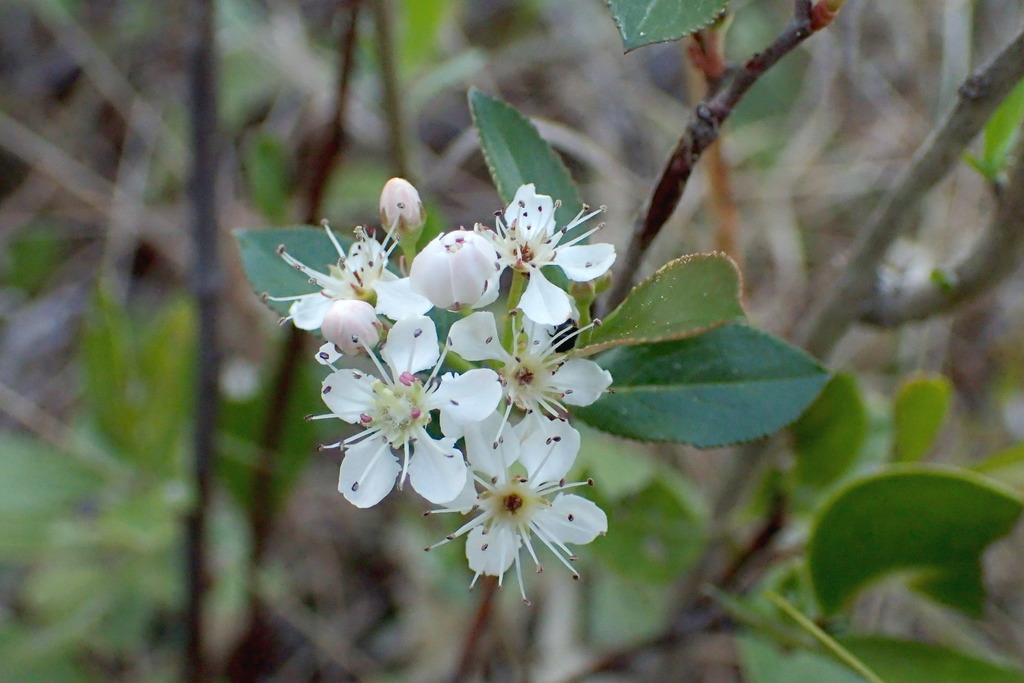
At a glance
- Life cycle
- Woody perennial
- Leaves
- Deciduous
- Bloom
- February to May
- Fruiting season
- September to November
Recorded in 52 Florida counties.
Natural habitats
Places it grows wild. Not a planting requirement. Each habitat page lists the plants and wildlife also found there.
Dense evergreen shrub wetlands and bay forests on wet, acid peat of the Coastal Plain.
Open, fire-kept longleaf pine stands over grasses and wildflowers on wet to moist sandy soil.
Places where groundwater keeps the soil or rock wet, such as seepage slopes and spring runs.
Also found with this plant
Wildlife whose habitat models include habitats this plant grows in, in Florida. Shared habitat, not food. 79 animals.
- White-eyed VireoVireo griseus
- White-throated SparrowZonotrichia albicollis
- Wild TurkeyMeleagris gallopavo
- Yellow-bellied SapsuckerSphyrapicus varius
- Yellow-breasted ChatIcteria virens
- Yellow-rumped WarblerDendroica coronata
- Yellow-throated WarblerDendroica dominica







Who uses this plant?
 39CaterpillarsGenus host records with ranges including FL
Genus host records with ranges including FL · Sorbus
- Acronicta americanaAmerican Dagger
- Acronicta clarescensClear Dagger
- Acronicta funeralisFunerary Dagger, Paddle Caterpillar
- Acronicta impletaYellow-Haired Dagger
- Alsophila pometariaFall Cankerworm Moth
- Amphipyra pyramidoidesMiranda Underwing, Copper Underwing, Copper Amphipyra
- Antheraea polyphemusPolyphemus Moth
- Catocala gryneaWoody Underwing
- Cenopis pettitanaMaple-Basswood Leafroller Moth
- Choristoneura conflictanaLarge Aspen Tortrix
Show all 39
- Coelodasys unicornisUnicorn Caterpillar Moth
- Datana ministraYellow-Necked Caterpillar Moth
- Ennomos subsignariaElm Spanworm Moth
- Erannis tiliariaLinden Looper Moth, Western Winter Moth, Lime Looper
- Eupithecia miserulataCommon Eupithacia, Common Pug
- Euzophera semifuneralisAmerican Plum Borer
- Halysidota tessellarisBanded Tussock Moth, Pale Tiger Moth
- Hedya chionosemaTwin-Spotted Budworm, White-Spotted Hedya
- Hyalophora cecropiaCecropia Silkmoth, Cecropia Moth
- Hyphantria cuneaFall Webworm
- Limenitis arthemisBanded Purple, Red-Spotted Admiral
- Lomographa vestaliataWhite Spring Moth
- Malacosoma americanaEastern Tent Caterpillar
- Malacosoma disstriaForest Tent Caterpillar
- Metaxaglaea semitariaFootpath Sallow
- Metaxaglaea viaticaRoadside Sallow
- Nematocampa resistariaFilament Bearer, Horned Spanworm Moth
- Nemoria mimosariaWhite-Fringed Emerald
- Nymphalis antiopaMourning Cloak
- Orgyia leucostigmaWhite-Marked Tussock Moth
- Pandemis limitataThree-Lined Leafroller Moth
- Papilio glaucusEastern Tiger Swallowtail
- Phigalia titeaThe Half-Wing Geometer, Spiney Looper, Eastern Oak Looper
- Podosesia syringaeLilac Borer Moth, Ash Borer
- Satyrium liparopsStriped Hairstreak
- Synanthedon pictipesLesser Peachtree Borer Moth
- Synanthedon scitulaDogwood Borer, Pecan Borer
- Venusia comptariaBrown-Shaded Carpet
- Xanthotype sospetaCrocus Geometer
 14BeesSoutheastern regional records
Southeastern regional records · Aronia
Individual names are not available yet.
Noori, Seltmann & Orr 2026, A curated and integrated dataset for exploring global bee-plant interactions (GloBI), Zenodo, CC BY 4.0 1Specialist beesPollen specialists
 6BirdsRecorded genus food-resource interactions; not a state feeding claim
Recorded genus food-resource interactions; not a state feeding claim · Sorbus
- Catharus fuscescensVeery
- Catharus ustulatusSwainson's Thrush
- Coccothraustes vespertinusEvening Grosbeak
- Falcipennis canadensisSpruce Grouse
- Pinicola enucleatorPine Grosbeak
- Turdus migratoriusAmerican Robin
Direct food only: birds recorded eating this genus across North America. Caterpillars on host plants also feed nesting birds. NC Native Plant Society: butterfly gardening
No records yet · Ants · Beetles · Flies · Adult butterflies / moths · Other wasps · Other insects
Plant details
- Family
- Rosaceae
- Hardiness
- Zones 3a–9b
- Soil pH
- Acidic to alkaline
- Flower color
- Pink or white
- Growth rate
- Moderate
- Growth habit
- Spreads to form colonies
- Foliage color
- Green
- Fruit begins
- September
- Fruit ends
- November
Safety has not been reviewed for this plant; check toxicity and thorns before planting.
Growing sources and scope
- Bloom · “Late February to May” · Weakley, Flora of the Southeastern United States (2025), Carolinas & Georgia edition (ranked first; USDA PLANTS differs) · Carolinas and Georgia
- Flower color · “Pink or white” · NC Extension Plant Toolbox (ranked first; USDA PLANTS, Lady Bird Johnson Wildflower Center differ)
- Foliage color · “Green” · USDA PLANTS · Nationwide species characteristics; local growing conditions may vary
- Fruit begins · “September” · Weakley, Flora of the Southeastern United States (2025), Carolinas & Georgia edition (ranked first; USDA PLANTS differs) · Carolinas and Georgia
- Fruit ends · “November” · Weakley, Flora of the Southeastern United States (2025), Carolinas & Georgia edition (ranked first; USDA PLANTS differs) · Carolinas and Georgia
- Growth habit · “Spreads to form colonies” · USDA PLANTS · Nationwide species characteristics; local growing conditions may vary
- Growth rate · “Moderate” · USDA PLANTS · Nationwide species characteristics; local growing conditions may vary
- Hardiness · “Zones 3a–9b” · NC Extension Plant Toolbox
- Height · “6–12 feet” · NC Extension Plant Toolbox (ranked first; USDA PLANTS, Lady Bird Johnson Wildflower Center differ)
- Leaves · “Deciduous” · NC Extension Plant Toolbox
- Life cycle · “Woody perennial” · NC Extension Plant Toolbox (ranked first; Lady Bird Johnson Wildflower Center differs)
- Light · “Full sun (6 or more hours of direct sunlight a day); Partial shade (direct sunlight only part of the day, 2-6 hours)” · NC Extension Plant Toolbox (ranked first; Virginia Cooperative Extension, Virginia DCR Piedmont, Virginia DCR Coastal Plain, Lady Bird Johnson Wildflower Center differ)
- Soil · “Frequent standing water; Moist; Occasionally wet” · NC Extension Plant Toolbox (ranked first; Virginia Cooperative Extension, Virginia DCR Piedmont, Virginia DCR Coastal Plain, Lady Bird Johnson Wildflower Center differ)
- Soil pH · “Acidic to alkaline” · NC Extension Plant Toolbox (ranked first; Lady Bird Johnson Wildflower Center differs)
- Spread · “3–5 feet” · NC Extension Plant Toolbox
Also known as
Photinia pyrifolia; Sorbus arbutifolia var. arbutifolia; mountain ash; mountain-ash
Conservation status
| Florida rank | S4S5 |
|---|---|
| Global rank | G5 |
| FL status | Not verified |
| Federal status | Not verified |
Will it fit your yard?
Check this plant against your county, sun and soil moisture. Conditions are checked in your browser.
Growing cautions
- Suckers and forms colonies. Tends to sucker and form colonies; remove root suckers to limit spread. NC State Extension Plant Toolbox
For planning only; these do not change the score or Fit.
Sources
- Atlas of Florida Plants
- USDA PLANTS
- Vascular Plants of North Carolina (NC Natural Heritage Program)
- Weakley, Flora of the Southeastern United States (2025), Florida edition
- NatureServe Explorer
- Shropshire & Tallamy 2025, Lepidoptera of North America north of Mexico, ZooKeys 1261 (ODbL)
- Noori, Seltmann & Orr 2026, A curated and integrated dataset for exploring global bee-plant interactions (GloBI), Zenodo, CC BY 4.0
- Smith, Bachelder, Russell, Morales, Mosher & Seltmann 2024, Bee-Specialization-Modeling v0.6.1 (specialist host table compiled from J. Fowler's pollen specialist bee lists), Zenodo, CC BY 4.0
- Hurlbert, Olsen, Sawyer & Winner 2021, Avian Diet Database, Scientific Data 8: 260 (CC0)
- Narango, Tallamy & Shropshire 2020, Few keystone plant genera support the majority of Lepidoptera species, Nature Communications