

Waxyleaf Meadow-rue
Thalictrum amphibolum
In the Carolinas and Georgia, found in moist to dry forests, woodlands, barrens, and prairies, over hornblende, greenstone, dolostone, and serpentinized olivine. Weakley, Flora of the Southeastern United States (2025), Carolinas & Georgia edition What its natural habitat tells you
Native to Arkansas. How scores work Is it native here?
Profile 100%
- Height
- Up to about 5 feet
- Light
- Full sun, Partial shade
- Soil moisture
- Somewhat dry to moist
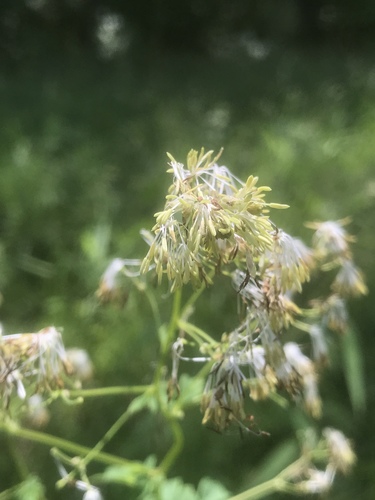
At a glance
- Life cycle
- Perennial
- Bloom
- May to August
Not yet recorded · Spread · Leaves
Recorded in 1 Arkansas county.
Natural habitats
Places it grows wild. Not a planting requirement. Each habitat page lists the plants and wildlife also found there.
Forests on moist but not wet ground, such as rich slopes and ravines.
Forests and open woodlands on dry ridges and slopes, often oak or pine.
Forest or woodland where the source does not say how moist or dry.
Glades, barrens and outcrops on mafic or serpentine rock
Open, thin-soil openings, outcrops and cliffs on dark, magnesium- or iron-rich rock such as serpentine, diabase or gabbro.
Open, grass-dominated places kept open by fire, grazing or thin soil, from tallgrass prairie to Piedmont prairies.
Who uses this plant?
 8CaterpillarsGenus host records with ranges including AR
Genus host records with ranges including AR · Thalictrum
- Calyptra canadensisCanadian Owlet, Meadow Rue Owlet
- Eosphoropteryx thyatyroidesPink-Patched Looper Moth
- Eupithecia miserulataCommon Eupithacia, Common Pug
- Herpetogramma pertextalisBold-Feathered Grass Moth
- Papaipema nebrisStalk Borer
- Papilio cresphontesEastern Giant Swallowtail
- Xestia c-nigrumSpotted Cut-Worm, Setaceous Hebrew Character, Lesser Black-letter Dart
- Xestia dolosaGreater Black-Letter Dart, Greater Spotted Cutworm
 1BeesSoutheastern regional records
Southeastern regional records · Thalictrum
Individual names are not available yet.
Noori, Seltmann & Orr 2026, A curated and integrated dataset for exploring global bee-plant interactions (GloBI), Zenodo, CC BY 4.0 0Specialist beesPollen specialists
 1BirdsRecorded genus food-resource interactions; not a state feeding claim
Recorded genus food-resource interactions; not a state feeding claim · Thalictrum
- Bonasa umbellusRuffed Grouse
Direct food only: birds recorded eating this genus across North America. Caterpillars on host plants also feed nesting birds. NC Native Plant Society: butterfly gardening
No records yet · Ants · Beetles · Flies · Adult butterflies / moths · Other wasps · Other insects
Plant details
- Family
- Ranunculaceae
- Hardiness
- Zones 4a–7b
- Soil pH
- Neutral
- Flower color
- Yellow, green or purple
Safety has not been reviewed for this plant; check toxicity and thorns before planting.
Growing sources and scope
- Bloom · “May to August” · Weakley, Flora of the Southeastern United States (2025), Carolinas & Georgia edition · Carolinas and Georgia
- Flower color · “Yellow, green or purple” · NC Extension Plant Toolbox (ranked first; Lady Bird Johnson Wildflower Center differs)
- Hardiness · “Zones 4a–7b” · NC Extension Plant Toolbox
- Height · “Up to about 5 feet” · Lady Bird Johnson Wildflower Center
- Life cycle · “Perennial” · NC Extension Plant Toolbox
- Light · “Full sun (6 or more hours of direct sunlight a day); Partial shade (direct sunlight only part of the day, 2-6 hours)” · NC Extension Plant Toolbox (ranked first; Lady Bird Johnson Wildflower Center differs)
- Soil · “Moist; Occasionally dry” · NC Extension Plant Toolbox (ranked first; Lady Bird Johnson Wildflower Center differs)
- Soil pH · “Neutral” · NC Extension Plant Toolbox
Also known as
Skunk Meadow Rue; Thalictrum revolutum; Waxyleaf Meadow rue
Conservation status
| Arkansas rank | SNR |
|---|---|
| Global rank | G5 |
| AR status | Not verified |
| Federal status | Not verified |
Will it fit your yard?
Check this plant against your county, sun and soil moisture. Conditions are checked in your browser.
Sources
- Atlas of the Vascular Plants of Arkansas (2013)
- Vascular Plants of North Carolina (NC Natural Heritage Program)
- Weakley, Flora of the Southeastern United States (2025)
- Arkansas occurrence source
- Shropshire & Tallamy 2025, Lepidoptera of North America north of Mexico, ZooKeys 1261 (ODbL)
- Noori, Seltmann & Orr 2026, A curated and integrated dataset for exploring global bee-plant interactions (GloBI), Zenodo, CC BY 4.0
- Smith, Bachelder, Russell, Morales, Mosher & Seltmann 2024, Bee-Specialization-Modeling v0.6.1 (specialist host table compiled from J. Fowler's pollen specialist bee lists), Zenodo, CC BY 4.0
- Hurlbert, Olsen, Sawyer & Winner 2021, Avian Diet Database, Scientific Data 8: 260 (CC0)
- Narango, Tallamy & Shropshire 2020, Few keystone plant genera support the majority of Lepidoptera species, Nature Communications