

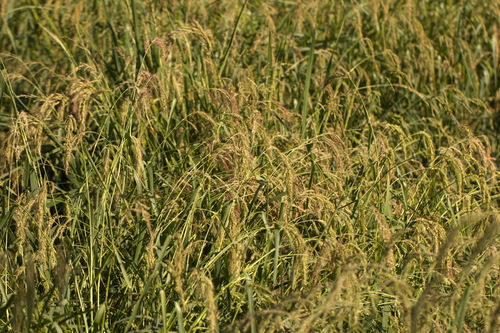
Asian Rice
Oryza sativa
In the Carolinas and Georgia, found in marshes, impoundments, of only sporadic occurrence outside of cultivation. Weakley, Flora of the Southeastern United States (2025), Carolinas & Georgia edition What its natural habitat tells you
Not native to Arkansas. How scores work Is it native here?
Profile 65%
- Light
- Full sun
- Soil moisture
- Moist to standing water
Do not plant. Listed invasive in Arkansas.
At a glance
- Bloom
- June to November
Not yet recorded · Height · Spread · Life cycle · Leaves
This plant is missing most of its facts, so Quercus is looking them up in old botany books.
Recorded in 29 Arkansas counties.
Natural habitats
Places it grows wild. Not a planting requirement. Each habitat page lists the plants and wildlife also found there.
Open, herb-covered wetlands with fresh, non-tidal water.
Still water and its edges: ponds, lakes, millponds and reservoirs.
Who uses this plant?
 14CaterpillarsGenus host records with ranges including AR
Genus host records with ranges including AR · Oryza
- Ancyloxypha numitorLeast Skipper
- Anicla infectaGreen Cutworm Moth
- Dargida diffusaWheat Head Armywotm Moth
- Elasmopalpus lignosellaLesser Cornstalk Borer
- Helicoverpa zeaCorn Earworm Moth
- Lerodea eufalaEufala Skipper, Gray Skipper, Rice Leafroller
- Mocis latipesSmall Mocis, Striped Grass Looper
- Panoquina ocolaOcola Skipper, Long-Winged Skiiper
- Polites corasPeck's Skipper, Yellow-Patch Skipper
- Polites othoSouthern Broken-Dash, Broken-Dash Skipper
Show all 14
- Spodoptera albulaWhite-Spotted Armyworm, Gray-Streaked Armyworm
- Spodoptera frugiperdaFall Armyworm Moth
- Urbanus proteusLong-Tailed Skipper, Bean Leaf Roller
- Chilo plejadellus
 —BeesSoutheastern regional records
 —Specialist beesPollen specialists
 14BirdsRecorded genus food-resource interactions; not a state feeding claim
Recorded genus food-resource interactions; not a state feeding claim · Oryza
- Agelaius phoeniceusRed-winged Blackbird
- Agelaius tricolorTricolored Blackbird
- Anas acutaNorthern Pintail
- Anser albifronsGreater White-fronted Goose
- Anser caerulescensSnow Goose
- Antigone canadensisSandhill Crane
- Cardinalis cardinalisNorthern Cardinal
- Dendrocygna bicolorFulvous Whistling-Duck
- Dolichonyx oryzivorusBobolink
- Molothrus aterBrown-headed Cowbird
Show all 14
- Porzana carolinaSora
- Quiscalus quisculaCommon Grackle
- Rallus elegansKing Rail
- Turdus migratoriusAmerican Robin
Direct food only: birds recorded eating this genus across North America. Caterpillars on host plants also feed nesting birds. NC Native Plant Society: butterfly gardening
Plant details
- Family
- Poaceae
Safety has not been reviewed for this plant; check toxicity and thorns before planting.
Growing sources and scope
- Bloom · “June to November” · Weakley, Flora of the Southeastern United States (2025), Carolinas & Georgia edition · Carolinas and Georgia
- Light · “Full sun (documented habitat)” · Weakley, Flora of the Southeastern United States (2025), Carolinas & Georgia edition · Carolinas and Georgia
- Soil · “Moist; Water; Wet (documented habitat)” · Weakley, Flora of the Southeastern United States (2025), Carolinas & Georgia edition · Carolinas and Georgia
Conservation status
| Arkansas rank | SNA |
|---|---|
| Global rank | GNR |
| AR status | Not verified |
| Federal status | Not verified |
Native alternatives
Find natives for your gardenSources
- Atlas of the Vascular Plants of Arkansas (2013)
- USDA PLANTS
- Weakley, Flora of the Southeastern United States (2025), Carolinas & Georgia edition
- NatureServe Explorer
- Arkansas occurrence source
- Shropshire & Tallamy 2025, Lepidoptera of North America north of Mexico, ZooKeys 1261 (ODbL)
- Noori, Seltmann & Orr 2026, A curated and integrated dataset for exploring global bee-plant interactions (GloBI), Zenodo, CC BY 4.0
- Smith, Bachelder, Russell, Morales, Mosher & Seltmann 2024, Bee-Specialization-Modeling v0.6.1 (specialist host table compiled from J. Fowler's pollen specialist bee lists), Zenodo, CC BY 4.0
- Hurlbert, Olsen, Sawyer & Winner 2021, Avian Diet Database, Scientific Data 8: 260 (CC0)
- Narango, Tallamy & Shropshire 2020, Few keystone plant genera support the majority of Lepidoptera species, Nature Communications