

Swamp Leatherflower
Clematis crispa
In the Carolinas and Georgia, found in marshes, tidal and non-tidal swamps, floodplain forests, disturbed wet or moist areas. Weakley, Flora of the Southeastern United States (2025), Carolinas & Georgia edition What its natural habitat tells you
Native to Arkansas. How scores work Is it native here?
Profile 100%
- Height
- 6–10 feet
- Spread
- 3–6 feet
- Light
- Full sun, Partial shade
- Soil moisture
- Usually moist
Space about 4.5 ft apart from its recorded spread, about 5 per 100 sq ft. Enter your bed size for a count
Will it fit your yard?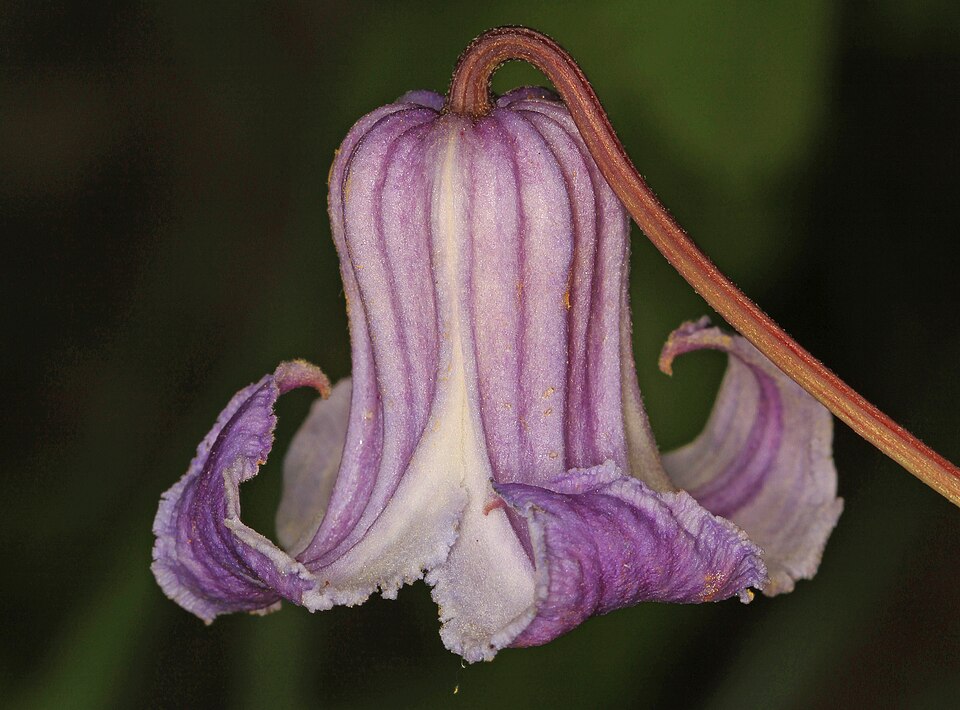

At a glance
- Life cycle
- Perennial
- Leaves
- Deciduous
- Bloom
- Spring and summer
Recorded in 26 Arkansas counties.
Natural habitats
Places it grows wild. Not a planting requirement. Each habitat page lists the plants and wildlife also found there.
Open, herb-covered wetlands with fresh, non-tidal water.
Forested wetlands with standing water much of the year, such as cypress and gum swamps.
Floodplain and bottomland forests
Forests on low ground beside rivers and streams that flood from time to time.
Who uses this plant?
 10CaterpillarsGenus host records with ranges including AR
Genus host records with ranges including AR · Clematis
- Alcathoe caudataClematis Borer, Clematis Clearwing Moth
- Eutrapela clematariaCurved-Tooth Geometer, Purplish Brown Looper
- Horisme intestinataBrown Bark Carpet
- Hyphantria cuneaFall Webworm
- Orgyia leucostigmaWhite-Marked Tussock Moth
- Platynota idaeusalisTufted Apple-Bud Moth
- Pleuroprucha insulsariaCommon Tan Wave
- Pseudothyris sepulchralisMournful Thyris
- Thyridopteryx ephemeraeformisEvergreen Bagworm Moth
- Thyris maculataSpotted Thyris
 9BeesSoutheastern regional records
Southeastern regional records · Clematis
Individual names are not available yet.
Noori, Seltmann & Orr 2026, A curated and integrated dataset for exploring global bee-plant interactions (GloBI), Zenodo, CC BY 4.0 0Specialist beesPollen specialists
 —BirdsRecorded genus food-resource interactions; not a state feeding claim
No records yet · Ants · Beetles · Flies · Adult butterflies / moths · Other wasps · Other insects
Plant details
- Family
- Ranunculaceae
- Hardiness
- Zones 6a–9b
- Soil pH
- Acidic
- Flower color
- Blue, pink, purple or white
Safety has not been reviewed for this plant; check toxicity and thorns before planting.
Growing sources and scope
- Bloom · “Spring and summer” · NC Extension Plant Toolbox
- Flower color · “Blue, pink, purple or white” · NC Extension Plant Toolbox
- Hardiness · “Zones 6a–9b” · NC Extension Plant Toolbox
- Height · “6–10 feet” · NC Extension Plant Toolbox
- Leaves · “Deciduous” · NC Extension Plant Toolbox
- Life cycle · “Perennial” · NC Extension Plant Toolbox
- Light · “Full sun (6 or more hours of direct sunlight a day); Partial shade (direct sunlight only part of the day, 2-6 hours)” · NC Extension Plant Toolbox (ranked first; Tennessee Smart Yards differs)
- Soil · “Good drainage; Moist; Occasionally wet” · NC Extension Plant Toolbox (ranked first; Tennessee Smart Yards differs)
- Soil pH · “Acidic” · NC Extension Plant Toolbox
- Spread · “3–6 feet” · NC Extension Plant Toolbox
Also known as
Marsh Clematis; Southern Leather Flower; Swamp Leather Flower
Conservation status
| Arkansas rank | SNR |
|---|---|
| Global rank | G5 |
| AR status | Not verified |
| Federal status | Not verified |
Will it fit your yard?
Check this plant against your county, sun and soil moisture. Conditions are checked in your browser.
Sources
- Atlas of the Vascular Plants of Arkansas (2013)
- USDA PLANTS
- Vascular Plants of North Carolina (NC Natural Heritage Program)
- Weakley, Flora of the Southeastern United States (2025)
- Arkansas occurrence source
- Shropshire & Tallamy 2025, Lepidoptera of North America north of Mexico, ZooKeys 1261 (ODbL)
- Noori, Seltmann & Orr 2026, A curated and integrated dataset for exploring global bee-plant interactions (GloBI), Zenodo, CC BY 4.0
- Smith, Bachelder, Russell, Morales, Mosher & Seltmann 2024, Bee-Specialization-Modeling v0.6.1 (specialist host table compiled from J. Fowler's pollen specialist bee lists), Zenodo, CC BY 4.0
- Hurlbert, Olsen, Sawyer & Winner 2021, Avian Diet Database, Scientific Data 8: 260 (CC0)
- Narango, Tallamy & Shropshire 2020, Few keystone plant genera support the majority of Lepidoptera species, Nature Communications