

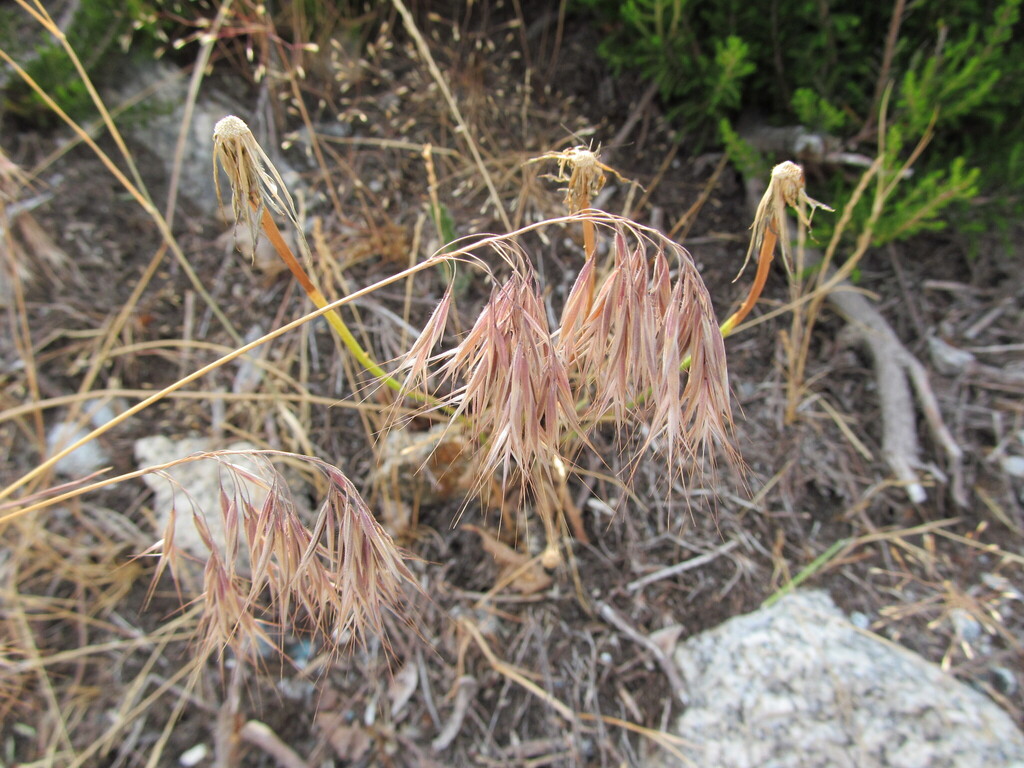
Cheat-grass
Bromus tectorum
In the Carolinas and Georgia, found in disturbed areas. Weakley, Flora of the Southeastern United States (2025), Carolinas & Georgia edition What its natural habitat tells you
Not native to Arkansas. How scores work Is it native here?
Profile 65%
- Height
- In contrast, where moisture, fertility or light intensity are not limiting, cheatgrass plants may produce 12-15 culms, 20 to 30 inches tall, bearing hundreds of spikelets [307,438].
- Light
- Partial shade, Full sun
- Soil moisture
- Dry to wet
Do not plant. Listed invasive in Arkansas.
At a glance
- Bloom
- April to June
Not yet recorded · Spread · Life cycle · Leaves
Recorded in 36 Arkansas counties.
Natural habitats
Places it grows wild. Not a planting requirement. Each habitat page lists the plants and wildlife also found there.
Roadsides, fields and disturbed ground
Ground opened by people: roadsides, old fields, pastures, fencerows and lots.
Who uses this plant?
 15CaterpillarsGenus host records with ranges including AR
Genus host records with ranges including AR · Bromus
- Amblyscirtes vialisCommon Roadside-Skipper, Black Little Skipper
- Anatrytone loganDelaware Skipper, Logan Skipper, Black-Vein Skipper
- Ancyloxypha numitorLeast Skipper
- Apamea sordensBordered Apamea, Rustic Shoulder-Knot
- Cercyonis pegalaCommon Wood Nymph
- Cisseps fulvicollisYellow-Collared Scape Moth
- Dargida diffusaWheat Head Armywotm Moth
- Hesperia leonardusLeonard's Skipper, Blazing Star Skipper, Pawnee Prairie Skipper, Pawnee Montane Skipper
- Leucania multilineaMany-Lined Wainscot
- Leucania phragmitidicolaNeedle Wainscot, Phragmites Wainscot
Show all 15
- Papaipema nebrisStalk Borer
- Polites corasPeck's Skipper, Yellow-Patch Skipper
- Spodoptera frugiperdaFall Armyworm Moth
- Elachista illectella
- Gonioterma mistrella
 —BeesSoutheastern regional records
 —Specialist beesPollen specialists
 11BirdsRecorded genus food-resource interactions; not a state feeding claim
Recorded genus food-resource interactions; not a state feeding claim · Bromus
- Alectoris chukarChukar
- Anser albifronsGreater White-fronted Goose
- Callipepla californicaCalifornia Quail
- Corvus brachyrhynchosAmerican Crow
- Dendragapus obscurusDusky Grouse
- Meleagris gallopavoWild Turkey
- Oreortyx pictusMountain Quail
- Perdix perdixGray Partridge
- Spizella pusillaField Sparrow
- Sturnus vulgarisEuropean Starling
Show all 11
- Zonotrichia atricapillaGolden-crowned Sparrow
Direct food only: birds recorded eating this genus across North America. Caterpillars on host plants also feed nesting birds. NC Native Plant Society: butterfly gardening
Plant details
- Family
- Poaceae
Safety has not been reviewed for this plant; check toxicity and thorns before planting.
Growing sources and scope
- Bloom · “April to June” · Weakley, Flora of the Southeastern United States (2025), Carolinas & Georgia edition · Carolinas and Georgia
- Height · “In contrast, where moisture, fertility or light intensity are not limiting, cheatgrass plants may produce 12-15 culms, 20 to 30 inches (50-75 cm) tall, bearing hundreds of spikelets [307,438].” · Fire Effects Information System: Bromus tectorum · Source botanical description; original units and scope retained
- Light · “Partial shade; Full sun (documented habitat)” · Weakley, Flora of the Southeastern United States (2025), Carolinas & Georgia edition · Carolinas and Georgia
- Soil · “Dry; Moist; Wet (documented habitat)” · Weakley, Flora of the Southeastern United States (2025), Carolinas & Georgia edition · Carolinas and Georgia
Also known as
Cheat grass; Chess; Downy Brome; Downy Cheat; Downy Chess
Conservation status
| Arkansas rank | SNA |
|---|---|
| Global rank | GNR |
| AR status | Not verified |
| Federal status | Not verified |
Native alternatives
Find natives for your gardenSources
- Atlas of the Vascular Plants of Arkansas (2013)
- USDA PLANTS
- Weakley, Flora of the Southeastern United States (2025), Carolinas & Georgia edition
- NatureServe Explorer
- Arkansas occurrence source
- Shropshire & Tallamy 2025, Lepidoptera of North America north of Mexico, ZooKeys 1261 (ODbL)
- Noori, Seltmann & Orr 2026, A curated and integrated dataset for exploring global bee-plant interactions (GloBI), Zenodo, CC BY 4.0
- Smith, Bachelder, Russell, Morales, Mosher & Seltmann 2024, Bee-Specialization-Modeling v0.6.1 (specialist host table compiled from J. Fowler's pollen specialist bee lists), Zenodo, CC BY 4.0
- Hurlbert, Olsen, Sawyer & Winner 2021, Avian Diet Database, Scientific Data 8: 260 (CC0)
- Narango, Tallamy & Shropshire 2020, Few keystone plant genera support the majority of Lepidoptera species, Nature Communications