

Perennial Ragweed
Ambrosia psilostachya
In the Carolinas and Georgia, found in calcareous prairies (westwards); in loamy sandy soil of flats and slight depressions in periodically burned longleaf pine uplands; also in disturbed areas. Weakley, Flora of the Southeastern United States (2025), Carolinas & Georgia edition What its natural habitat tells you
Native to Arkansas. How scores work Is it native here?
Profile 94%
- Height
- usually 1 to 2 feet tall
- Light
- Partial shade, Full sun
- Soil moisture
- Dry to moist
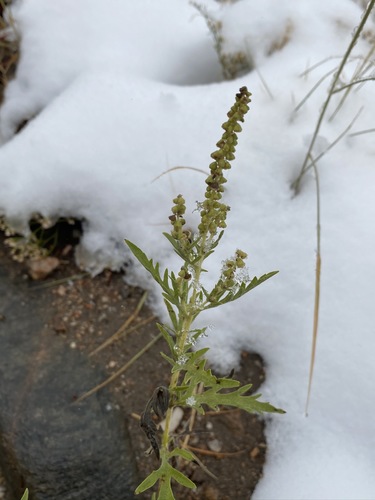
At a glance
- Life cycle
- Perennial
- Bloom
- July to November
Not yet recorded · Spread · Leaves
Recorded in 9 Arkansas counties.
Natural habitats
Places it grows wild. Not a planting requirement. Each habitat page lists the plants and wildlife also found there.
Open, grass-dominated places kept open by fire, grazing or thin soil, from tallgrass prairie to Piedmont prairies.
Roadsides, fields and disturbed ground
Ground opened by people: roadsides, old fields, pastures, fencerows and lots.
Who uses this plant?
 56CaterpillarsGenus host records with ranges including AR
Genus host records with ranges including AR · Ambrosia
- Achyra rantalisGarden Webworm Moth
- Adaina ambrosiaeAmbrosia Plume Moth, Ragweed Plume Moth
- Argyrotaenia velutinanaRed-Banded Leafroller Moth, Jack Pine Tube Moth
- Azenia obtusaObtuse Yellow
- Caenurgina erechteaClover Looper Moth, Common Grass Moth, Forage Looper
- Carmenta texanaTexana Clearwing Moth
- Chionodes mediofuscellaBlack-Smudged Chionodes
- Chlorochlamys chloroleucariaBlackberry Looper Moth
- Chlosyne gorgoneGorgone Checkerspot
- Choristoneura rosaceanaOblique-Banded Leafroller Moth, Rosaceous Leaf Roller
Show all 56
- Condica sutorThe Cobbler, Cobbler Groundling
- Dichomeris juncidellaOrange-Dotted Dichomeris
- Dichomeris serrativittellaToothed Dichomeris
- Ephestiodes infimellaReddish Ephestiodes
- Epiblema otiosanaBidens Borer Moth
- Epiblema strenuanaRagweed Borer
- Eupithecia miserulataCommon Eupithacia, Common Pug
- Exelastis pumilioDwarf Plume Moth
- Feltia subgothicaSubgothic Dart
- Helcystogramma chambersellaChambers' Twirler
- Hellinsia inquinatusBlack-Marked Plume Moth
- Herpetogramma bipunctalisSouthern Beet Webworm, Two-Spotted Herpetogramma
- Hypena scabraGreen Cloverworm Bomolocha, Black Snout
- Lascoria ambigualisAmbiguous Moth, Ambiguous Litter Moth
- Leptostales pannariaPannaria Wave
- Mythimna unipunctaArmyworm Moth, White Speck
- Ogdoconta cinereolaCommon Pinkband Groundling
- Ostrinia obumbratalisSmartweed Borer
- Papaipema cataphractaBurdock Border, Potato-Stalk Borer
- Papaipema nebrisStalk Borer
- Pelochrista cataclystianaSolidaga Eucosma, Solidaga Pelochrista
- Pholisora catullusCommon Sootywing
- Plagiomimicus pityochromusBlack-Barred Brown, Ragweed Seedcropper
- Platynota stultanaOmnivorous Leafroller
- Pleuroprucha insulsariaCommon Tan Wave
- Polygonia interrogationisQuestion Mark
- Ponometia candefactaOlive-Shaded Bird-Dropping Moth
- Ponometia erastrioidesSmall Bird-Dropping Moth
- Rachiplusia ouGray Looper
- Schinia gracilentaIva Flower Moth, Slender Flower Moth
- Schinia rivulosaRagweed Flower Moth
- Schinia thoreauiThoreau's Flower Moth
- Scopula inductataSoft-Lined Wave
- Sparganothis sulfureanaSparganothis Fruitworm Moth, Sulfur Leafroller, False Yellow-Head
- Spilosoma virginicaVirginian Tiger Moth, Yellow Woolybear Moth, Yellow Bear
- Spragueia leoCommon Spragueia
- Synchlora aerataWavy-Lined Emerald, Camouflaged Looper
- Synchlora frondariaSouthern Emerald
- Thyridopteryx ephemeraeformisEvergreen Bagworm Moth
- Tricholita signataSignate Quaker, Signate Groundcat
- Dichomeris washingtoniella
- Gnorimoschema saphirinella
- Hahncappsia marculenta
- Landryia matutella
- Paralobesia sambuci
- Paralobesia vernoniana
 2BeesSoutheastern regional records
Southeastern regional records · Ambrosia
Individual names are not available yet.
Noori, Seltmann & Orr 2026, A curated and integrated dataset for exploring global bee-plant interactions (GloBI), Zenodo, CC BY 4.0 0Specialist beesPollen specialists
 31BirdsRecorded genus food-resource interactions; not a state feeding claim
Recorded genus food-resource interactions; not a state feeding claim · Ambrosia
- Acanthis flammeaCommon Redpoll
- Agelaius phoeniceusRed-winged Blackbird
- Ammodramus savannarumGrasshopper Sparrow
- Anthus rubescensAmerican Pipit
- Anthus spragueiiSprague's Pipit
- Calcarius lapponicusLapland Longspur
- Calcarius pictusSmith's Longspur
- Cardinalis cardinalisNorthern Cardinal
- Colinus virginianusNorthern Bobwhite
- Columbina passerinaCommon Ground Dove
Show all 31
- Corvus brachyrhynchosAmerican Crow
- Dolichonyx oryzivorusBobolink
- Eremophila alpestrisHorned Lark
- Haemorhous mexicanusHouse Finch
- Junco hyemalisDark-eyed Junco
- Loxia curvirostraRed Crossbill
- Loxia leucopteraWhite-winged Crossbill
- Melospiza lincolniiLincoln's Sparrow
- Melospiza melodiaSong Sparrow
- Molothrus aterBrown-headed Cowbird
- Ortalis vetulaPlain Chachalaca
- Pinicola enucleatorPine Grosbeak
- Plectrophenax nivalisSnow Bunting
- Quiscalus quisculaCommon Grackle
- Rhynchophanes mccowniiMcCown's Longspur
- Sialia sialisEastern Bluebird
- Sturnus vulgarisEuropean Starling
- Turdus migratoriusAmerican Robin
- Tympanuchus phasianellusSharp-tailed Grouse
- Zenaida macrouraMourning Dove
- Zonotrichia querulaHarris's Sparrow
Direct food only: birds recorded eating this genus across North America. Caterpillars on host plants also feed nesting birds. NC Native Plant Society: butterfly gardening
No records yet · Ants · Beetles · Flies · Adult butterflies / moths · Other wasps · Other insects
Plant details
- Family
- Asteraceae
- Flower color
- White or green
Safety has not been reviewed for this plant; check toxicity and thorns before planting.
Growing sources and scope
- Bloom · “July to November” · Weakley, Flora of the Southeastern United States (2025), Carolinas & Georgia edition · Carolinas and Georgia
- Flower color · “White or green” · Lady Bird Johnson Wildflower Center
- Height · “usually 1 to 2 feet (30-60 cm) tall” · Fire Effects Information System: Ambrosia psilostachya (ranked first; Lady Bird Johnson Wildflower Center, Minnesota Wildflowers differ) · Source botanical description; original units and scope retained
- Life cycle · “Perennial” · Minnesota Wildflowers
- Light · “Partial shade; Full sun (documented habitat)” · Weakley, Flora of the Southeastern United States (2025), Carolinas & Georgia edition · Carolinas and Georgia
- Soil · “Dry; Moist (documented habitat)” · Weakley, Flora of the Southeastern United States (2025), Carolinas & Georgia edition · Carolinas and Georgia
Also known as
Ambrosia psilostachya and Ambrosia rugelii
Conservation status
| Arkansas rank | SNR |
|---|---|
| Global rank | G5 |
| AR status | Not verified |
| Federal status | Not verified |
Will it fit your yard?
Check this plant against your county, sun and soil moisture. Conditions are checked in your browser.
Sources
- Atlas of the Vascular Plants of Arkansas (2013)
- USDA PLANTS
- Vascular Plants of North Carolina (NC Natural Heritage Program)
- Weakley, Flora of the Southeastern United States (2025)
- Arkansas occurrence source
- Shropshire & Tallamy 2025, Lepidoptera of North America north of Mexico, ZooKeys 1261 (ODbL)
- Noori, Seltmann & Orr 2026, A curated and integrated dataset for exploring global bee-plant interactions (GloBI), Zenodo, CC BY 4.0
- Smith, Bachelder, Russell, Morales, Mosher & Seltmann 2024, Bee-Specialization-Modeling v0.6.1 (specialist host table compiled from J. Fowler's pollen specialist bee lists), Zenodo, CC BY 4.0
- Hurlbert, Olsen, Sawyer & Winner 2021, Avian Diet Database, Scientific Data 8: 260 (CC0)
- Narango, Tallamy & Shropshire 2020, Few keystone plant genera support the majority of Lepidoptera species, Nature Communications