

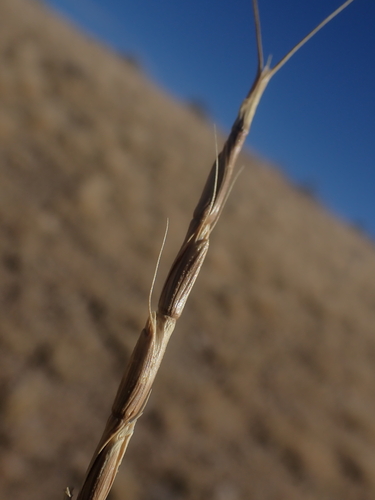
Goat Grass
Gamochaeta antillana
In the Carolinas and Georgia, found in fields, pastures, roadsides, other disturbed areas. Weakley, Flora of the Southeastern United States (2025), Carolinas & Georgia edition What its natural habitat tells you
Native status: sources disagree. How scores work Is it native here?
Profile 65%
- Light
- Full sun
- Soil moisture
- Dry to moist
At a glance
- Bloom
- April to August
Not yet recorded · Height · Spread · Life cycle · Leaves
This plant is missing most of its facts, so Quercus is looking them up in old botany books.
Recorded in 42 Arkansas counties.
Natural habitats
Places it grows wild. Not a planting requirement. Each habitat page lists the plants and wildlife also found there.
Roadsides, fields and disturbed ground
Ground opened by people: roadsides, old fields, pastures, fencerows and lots.
Who uses this plant?
 1CaterpillarsGenus host records with ranges including AR
Genus host records with ranges including AR · Aegilops
- Elasmopalpus lignosellaLesser Cornstalk Borer
 —BeesSoutheastern regional records
 —Specialist beesPollen specialists
 —BirdsRecorded genus food-resource interactions; not a state feeding claim
Plant details
- Family
- Poaceae
Safety has not been reviewed for this plant; check toxicity and thorns before planting.
Growing sources and scope
- Bloom · “April to August” · Weakley, Flora of the Southeastern United States (2025), Carolinas & Georgia edition · Carolinas and Georgia
- Light · “Full sun (documented habitat)” · Weakley, Flora of the Southeastern United States (2025), Carolinas & Georgia edition · Carolinas and Georgia
- Soil · “Dry; Moist (documented habitat)” · Weakley, Flora of the Southeastern United States (2025), Carolinas & Georgia edition · Carolinas and Georgia
Also known as
Acer campestre; Agastache rugosa; Cajanus scarabaeoides; Claytonia rubra subsp. rubra; Corydalis orthopoda; Crataegus scabrida var. asperifolia; Dichanthelium helleri; Dichanthelium inflatum; Dichanthelium mutabile; Epilobium parviflorum; Equisetum laevigatum; Euphorbia hypericifolia; Euphorbia myrsinites; Euphrasia stricta var. stricta; Gamochaeta antillana; Hedera hibernica; Isolepis setacea; Lythrum portula; Monarda reedii; Not in RAB; Persicaria filiformis; Persicaria posumbu; Petasites japonicus; Phlox derelicta; Pleioblastus fortunei; Poa iconia var. iconia; Prunus glandulosa; Pycnanthemum monotrichum; Sabulina diffusa; Spiranthes bightensis; Styrax japonicus; Symphyotrichum schistosum; Tephrosia purpurea; Tilia cordata; Vachellia constricta; Valerianella woodsiana; Veronica sublobata; Viola imposter; Viola stoneana
Conservation status
| Arkansas rank | SNA |
|---|---|
| Global rank | G5 |
| AR status | Not verified |
| Federal status | Not verified |
Will it fit your yard?
Check this plant against your county, sun and soil moisture. Conditions are checked in your browser.
Sources
- Atlas of the Vascular Plants of Arkansas (2013)
- Atlas of the Vascular Plants of Arkansas (2013)
- Atlas of the Vascular Plants of Arkansas (2013)
- USDA PLANTS
- Vascular Plants of North Carolina (NC Natural Heritage Program)
- Weakley, Flora of the Southeastern United States (2025), Carolinas & Georgia edition
- NatureServe Explorer
- Arkansas occurrence source
- Shropshire & Tallamy 2025, Lepidoptera of North America north of Mexico, ZooKeys 1261 (ODbL)
- Noori, Seltmann & Orr 2026, A curated and integrated dataset for exploring global bee-plant interactions (GloBI), Zenodo, CC BY 4.0
- Smith, Bachelder, Russell, Morales, Mosher & Seltmann 2024, Bee-Specialization-Modeling v0.6.1 (specialist host table compiled from J. Fowler's pollen specialist bee lists), Zenodo, CC BY 4.0
- Hurlbert, Olsen, Sawyer & Winner 2021, Avian Diet Database, Scientific Data 8: 260 (CC0)
- Narango, Tallamy & Shropshire 2020, Few keystone plant genera support the majority of Lepidoptera species, Nature Communications