

Bread Wheat
Triticum aestivum
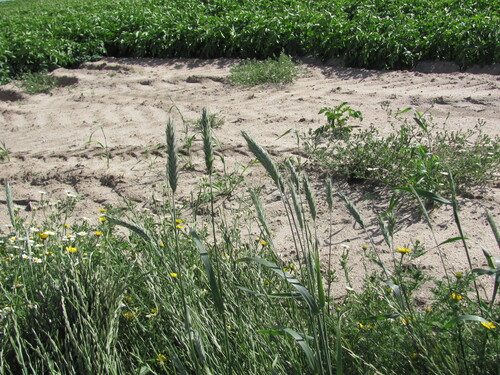
Found in fields; frequently cultivated, rarely persistent or volunteering following cultivation. FloraQuest, phone app (app page) What its natural habitat tells you
Not native to Alabama. How scores work Is it native here?
Profile 82%
- Height
- 2–4 feet
- Spread
- 6 inches–1 foot
- Light
- Full sun
- Soil moisture
- Somewhat dry to moist
Plant this instead
Choose your county to list local plants first.
No recorded swaps for this county. Try the garden finder.
At a glance
- Life cycle
- Annual
- Bloom
- April to June
- Fruiting season
- Spring to summer
Not yet recorded · Leaves
Recorded in 37 Alabama counties.
Natural habitats
Places it grows wild. Not a planting requirement. Each habitat page lists the plants and wildlife also found there.
Roadsides, fields and disturbed ground
Ground opened by people: roadsides, old fields, pastures, fencerows and lots.
Who uses this plant?
 25CaterpillarsGenus host records with ranges including AL
Genus host records with ranges including AL · Triticum
- Achatodes zeaeElder Shoot Border Moth, Spindele Worm, Cornstalk Borer
- Acronicta insularisHenry's Marsh Moth, Cattail Caterpillar
- Acronicta oblinitaSmeared Dagger
- Agnorisma badinodisPale-Banded Dart
- Anicla infectaGreen Cutworm Moth
- Dargida diffusaWheat Head Armywotm Moth
- Elasmopalpus lignosellaLesser Cornstalk Borer
- Euxoa detersaRubbed Dart, Sandhill Cutworm
- Feltia jaculiferaDingy Cutworm
- Feltia subgothicaSubgothic Dart
Show all 25
- Feltia subterraneaSubterranean Dart, Granulate Cutworm
- Fissicrambus mutabilisStriped Webworm, Striped Sodworm, Changeable Grass-Veneer
- Helicoverpa zeaCorn Earworm Moth
- Lacinipolia meditataThe Thinker
- Leucania pseudargyriaFalse Wainscot
- Mocis latipesSmall Mocis, Striped Grass Looper
- Mythimna unipunctaArmyworm Moth, White Speck
- Neodactria caliginosellusCorn Webworm, Corn Root Webworm, Sooty Crambus
- Nephelodes miniansBronzed Cutworm
- Ogdoconta cinereolaCommon Pinkband Groundling
- Papaipema nebrisStalk Borer
- Rachiplusia ouGray Looper
- Spodoptera frugiperdaFall Armyworm Moth
- Spodoptera ornithogalliYellow-Striped Armyworm Moth, Cotton Cutworm
- Xestia dolosaGreater Black-Letter Dart, Greater Spotted Cutworm
 —BeesSoutheastern regional records
 —Specialist beesPollen specialists
 56BirdsRecorded genus food-resource interactions; not a state feeding claim
Recorded genus food-resource interactions; not a state feeding claim · Triticum
- Agelaius phoeniceusRed-winged Blackbird
- Agelaius tricolorTricolored Blackbird
- Alectoris chukarChukar
- Anas platyrhynchosMallard
- Anser albifronsGreater White-fronted Goose
- Anthus rubescensAmerican Pipit
- Antigone canadensisSandhill Crane
- Aphelocoma californicaCalifornia Scrub-Jay
- Branta canadensisCanada Goose
- Calcarius lapponicusLapland Longspur
Show all 56
- Calcarius ornatusChestnut-collared Longspur
- Calcarius pictusSmith's Longspur
- Callipepla californicaCalifornia Quail
- Cardinalis cardinalisNorthern Cardinal
- Centrocercus urophasianusGreater Sage-Grouse
- Colinus virginianusNorthern Bobwhite
- Columba liviaRock Pigeon
- Columbina passerinaCommon Ground Dove
- Corvus brachyrhynchosAmerican Crow
- Corvus caurinusNorthwestern Crow
- Corvus coraxCommon Raven
- Cyanocitta stelleriSteller's Jay
- Dryobates pubescensDowny Woodpecker
- Ectopistes migratoriusPassenger Pigeon
- Eremophila alpestrisHorned Lark
- Euphagus cyanocephalusBrewer's Blackbird
- Ixoreus naeviusVaried Thrush
- Mareca americanaAmerican Wigeon
- Melanerpes erythrocephalusRed-headed Woodpecker
- Melospiza melodiaSong Sparrow
- Melozone crissalisCalifornia Towhee
- Molothrus aterBrown-headed Cowbird
- Oreortyx pictusMountain Quail
- Passer domesticusHouse Sparrow
- Patagioenas fasciataBand-tailed Pigeon
- Perdix perdixGray Partridge
- Phasianus colchicusRing-necked Pheasant
- Pheucticus ludovicianusRose-breasted Grosbeak
- Pheucticus melanocephalusBlack-headed Grosbeak
- Pipilo maculatusSpotted Towhee
- Plectrophenax nivalisSnow Bunting
- Quiscalus quisculaCommon Grackle
- Rhynchophanes mccowniiMcCown's Longspur
- Sialia sialisEastern Bluebird
- Sitta carolinensisWhite-breasted Nuthatch
- Spinus psaltriaLesser Goldfinch
- Sturnella neglectaWestern Meadowlark
- Sturnus vulgarisEuropean Starling
- Turdus migratoriusAmerican Robin
- Tympanuchus pallidicinctusLesser Prairie-Chicken
- Tympanuchus phasianellusSharp-tailed Grouse
- Xanthocephalus xanthocephalusYellow-headed Blackbird
- Zenaida asiaticaWhite-winged Dove
- Zenaida macrouraMourning Dove
- Zonotrichia atricapillaGolden-crowned Sparrow
- Zonotrichia leucophrysWhite-crowned Sparrow
Direct food only: birds recorded eating this genus across North America. Caterpillars on host plants also feed nesting birds. NC Native Plant Society: butterfly gardening
Plant details
- Family
- Poaceae
- Soil pH
- Neutral
- Flower color
- Green
- Growth rate
- Rapid
- Growth habit
- Grows in clumps
- Foliage color
- Green
- Fruit begins
- Spring
- Fruit ends
- Summer
Safety has not been reviewed for this plant; check toxicity and thorns before planting.
Growing sources and scope
- Bloom · “April to June” · FloraQuest: Carolinas, Georgia (Southeastern Flora Team), phone app (app page) (ranked first; USDA PLANTS differs) · Carolinas and Georgia
- Flower color · “Green” · NC Extension Plant Toolbox (ranked first; USDA PLANTS differs)
- Foliage color · “Green” · USDA PLANTS · Nationwide species characteristics; local growing conditions may vary
- Fruit begins · “Spring” · USDA PLANTS · Nationwide species characteristics; local growing conditions may vary
- Fruit ends · “Summer” · USDA PLANTS · Nationwide species characteristics; local growing conditions may vary
- Growth habit · “Grows in clumps” · USDA PLANTS · Nationwide species characteristics; local growing conditions may vary
- Growth rate · “Rapid” · USDA PLANTS · Nationwide species characteristics; local growing conditions may vary
- Height · “2–4 feet” · NC Extension Plant Toolbox (ranked first; USDA PLANTS differs)
- Life cycle · “Annual” · NC Extension Plant Toolbox
- Light · “Full sun (6 or more hours of direct sunlight a day)” · NC Extension Plant Toolbox
- Soil · “Moist; Occasionally dry” · NC Extension Plant Toolbox
- Soil pH · “Neutral” · NC Extension Plant Toolbox
- Spread · “6 inches–1 foot” · NC Extension Plant Toolbox
Also known as
Wheat
Conservation status
| Alabama rank | SNA |
|---|---|
| Global rank | GNR |
| AL status | Not verified |
| Federal status | Not verified |
Sources
- Alabama Plant Atlas
- USDA PLANTS
- FloraQuest: Carolinas, Georgia (Weakley), phone app (app page)
- FloraQuest: South Central (Weakley), phone app (app page)
- NatureServe Explorer
- Shropshire & Tallamy 2025, Lepidoptera of North America north of Mexico, ZooKeys 1261 (ODbL)
- Noori, Seltmann & Orr 2026, A curated and integrated dataset for exploring global bee-plant interactions (GloBI), Zenodo, CC BY 4.0
- Smith, Bachelder, Russell, Morales, Mosher & Seltmann 2024, Bee-Specialization-Modeling v0.6.1 (specialist host table compiled from J. Fowler's pollen specialist bee lists), Zenodo, CC BY 4.0
- Hurlbert, Olsen, Sawyer & Winner 2021, Avian Diet Database, Scientific Data 8: 260 (CC0)
- Narango, Tallamy & Shropshire 2020, Few keystone plant genera support the majority of Lepidoptera species, Nature Communications