

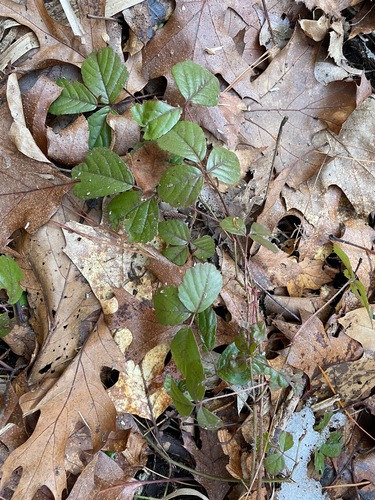
Swamp Dewberry
Rubus hispidus
Found in bogs, moist woodlands and forests, disturbed moist areas. FloraQuest, phone app (app page) What its natural habitat tells you
Native to Alabama. How scores work Is it native here?
Profile 100%
- Height
- About 2 feet
- Light
- Dappled sunlight, Partial shade
- Soil moisture
- Usually moist
At a glance
- Life cycle
- Perennial
- Leaves
- Evergreen
- Bloom
- May to June
- Fruiting season
- June to July
Not yet recorded · Spread
Recorded in 3 Alabama counties.
Natural habitats
Places it grows wild. Not a planting requirement. Each habitat page lists the plants and wildlife also found there.

Who uses this plant?
 110CaterpillarsGenus host records with ranges including AL
Genus host records with ranges including AL · Rubus
- Acharia stimuleaSaddleback Caterpillar Moth
- Achatia distinctaDistinct Quaker
- Acronicta americanaAmerican Dagger
- Acronicta funeralisFunerary Dagger, Paddle Caterpillar
- Acronicta longaLong-Winged Dagger, Darkish Dagger
- Acronicta oblinitaSmeared Dagger
- Agrotis gladiariaSwordsman Dart, Clay-Backed Cut-Worm
- Agrotis vetustaOld Man Dart
- Amorbia humerosanaWhite-Lined Leafroller Moth
- Amphipyra pyramidoidesMiranda Underwing, Copper Underwing, Copper Amphipyra
Show all 110
- Anavitrinella pampinariaCommon Gray, Cranberry Spanworm
- Ancylis floridanaStrawberry Leafroller
- Ancylis muricanaRed-Headed Ancylis
- Anisota senatoriaOrange-Tipped Oakworm Moth, Orangestriped Oakworm
- Antepione thisoariaVariable Antepione
- Apatelodes torrefactaSpotted Apatelodes
- Archips argyrospilaFruit-Tree Leafroller Moth
- Archips purpuranaOmnivorous Leafroller Moth
- Argyrotaenia marianaGray-Banded Leafroller Moth
- Argyrotaenia quercifolianaYellow-Winged Oak Leafroller Moth, Lined Oak Leafroller
- Argyrotaenia velutinanaRed-Banded Leafroller Moth, Jack Pine Tube Moth
- Automeris ioIo Moth
- Biston betulariaSalt-and-Pepper Geometer, Cleft-Headed Looper
- Cecrita guttivittaMaple Prominent, Saddled Prominent
- Cenopis directanaChokecherry Leafroller Moth
- Cenopis reticulatanaReticulated Fruitworm Moth
- Cepphis decolorariaDark Scallop Moth
- Cerastis tenebriferaReddish Speckled Dart
- Chloridea virescensTobacco Budworm Moth
- Chlorochlamys chloroleucariaBlackberry Looper Moth
- Choristoneura fractivittanaBroken-Banded Leafroller, Lined Corn-Borer Moth
- Choristoneura obsoletanaObsolete Leafroller
- Choristoneura rosaceanaOblique-Banded Leafroller Moth, Rosaceous Leaf Roller
- Coelodasys unicornisUnicorn Caterpillar Moth
- Coptotriche aeneaBlackberry Leafminer Moth
- Datana ministraYellow-Necked Caterpillar Moth
- Ectropis crepusculariaThe Small Engrailed, Saddleback Looper
- Erastria colorariaBroad-Lined Erastria
- Erastria cruentariaThin-Lined Erastria
- Euclea delphiniiSpiny Oak-Slug Moth
- Euphyia intermediataSharp-Angled Carpet Moth, The Intermediate
- Eupithecia miserulataCommon Eupithacia, Common Pug
- Eupithecia peckorumPeck's Pug
- Eupsilia cirripaleaFranclemont's Sallow
- Feltia jaculiferaDingy Cutworm
- Feltia subgothicaSubgothic Dart
- Geina busckiBuck's Plume Moth
- Habrosyne scriptaLettered Habrosyne
- Halysidota tessellarisBanded Tussock Moth, Pale Tiger Moth
- Haploa colonaColona Moth
- Haploa leconteiLeconte's Haploa
- Hedya separatanaPink-Washed Leafroller Moth
- Herpetogramma aeglealisSerpentine Webworm
- Herpetogramma bipunctalisSouthern Beet Webworm, Two-Spotted Herpetogramma
- Herpetogramma pertextalisBold-Feathered Grass Moth
- Herpetogramma thestealisZigzag Herpetogramma, Subtle-Feathered Grass Moth
- Hyalophora cecropiaCecropia Silkmoth, Cecropia Moth
- Hyles lineataWhite-Lined Sphinx
- Hypena scabraGreen Cloverworm Bomolocha, Black Snout
- Hyphantria cuneaFall Webworm
- Iridopsis defectariaBrown-Shaded Gray, Willow Looper
- Iridopsis humariaSmall Purplish Gray
- Iridopsis larvariaBent-Line Gray
- Kocakina fidelisIntractable Quaker, Green Fruitworm, Fourlined Green Fruitworm
- Lascoria ambigualisAmbiguous Moth, Ambiguous Litter Moth
- Lithophane antennataAshen Pinion
- Malacosoma disstriaForest Tent Caterpillar
- Megalopyge crispataBlack-Waved Flannel Moth, Crinkled Flannel Moth
- Melanolophia canadariaCanadian Melanolphia, Variable Redmarked Looper
- Mythimna unipunctaArmyworm Moth, White Speck
- Nematocampa resistariaFilament Bearer, Horned Spanworm Moth
- Nymphalis antiopaMourning Cloak
- Oedemasia concinnaRed-Humped Caterpillar, Red-Humped Appleworm
- Olethreutes furfuranumWoolly-Backed Moth
- Olethreutes permundanaRaspberry Leafroller
- Orgyia leucostigmaWhite-Marked Tussock Moth
- Orthodes majusculaRustic Quaker, Rustic Groundcat
- Orthosia rubescensRuby Quaker
- Palthis angulalisDark-Spotted Palthis
- Paonias excaecataBlinded Sphinx, Blind Eyed Sphinx
- Papaipema cataphractaBurdock Border, Potato-Stalk Borer
- Papaipema nebrisStalk Borer
- Pennisetia marginatumRaspberry Crown Borer Moth
- Phigalia strigatariaSmall Phigalia, Small Oak Looper
- Phigalia titeaThe Half-Wing Geometer, Spiney Looper, Eastern Oak Looper
- Phlogophora irisOlive Angle Shades
- Phyllodesma americanaLappet Moth, American Lappet Moth, Southern Lappet Moth
- Plagodis pulverariaAmerican Barred Umber, Barred Umber
- Platynota flavedanaBlack-Shaded Platynota
- Platynota idaeusalisTufted Apple-Bud Moth
- Platynota stultanaOmnivorous Leafroller
- Pseudothyatira cymatophoroidesTufted Thyatirid
- Pyrrharctia isabellaIsabella Tiger Moth, Banded Woolybear
- Pyrrhia ciliscaAmerican Bordered Sallow, Noble Sun Moth
- Satyrium liparopsStriped Hairstreak
- Schizura ipomaeaeMorning-Glory Prominent, Checkered-Fringe Prominent
- Scopula limboundataLarge Lace-Border
- Spilosoma virginicaVirginian Tiger Moth, Yellow Woolybear Moth, Yellow Bear
- Spodoptera dolichosSweetpotato Armyworm, Dolichos Armyworm, Large Cotton Armyworm
- Spodoptera eridaniaSouthern Armyworm Moth
- Spodoptera ornithogalliYellow-Striped Armyworm Moth, Cotton Cutworm
- Strymon melinusGray Hairstreak
- Synchlora aerataWavy-Lined Emerald, Camouflaged Looper
- Synchlora frondariaSouthern Emerald
- Syndemis afflictanaFall Dead-Leaf Roller, Gray Leafroller, Black-and-Grey Banded Leafroller
- Thyridopteryx ephemeraeformisEvergreen Bagworm Moth
- Xanthorhoe lacustrataToothed Brown Carpet
- Zale lunataLunate Zale
- Zale minereaColorful Zale
- Menesta tortriciformella
 79BeesSoutheastern regional records
Southeastern regional records · Rubus
Individual names are not available yet.
Noori, Seltmann & Orr 2026, A curated and integrated dataset for exploring global bee-plant interactions (GloBI), Zenodo, CC BY 4.0 1Specialist beesPollen specialists
 48BirdsRecorded genus food-resource interactions; not a state feeding claim
Recorded genus food-resource interactions; not a state feeding claim · Rubus
- Bombycilla cedrorumCedar Waxwing
- Cardinalis cardinalisNorthern Cardinal
- Turdus migratoriusAmerican Robin
- Acanthis flammeaCommon Redpoll
- Aix sponsaWood Duck
- Aphelocoma californicaCalifornia Scrub-Jay
- Bonasa umbellusRuffed Grouse
- Callipepla californicaCalifornia Quail
- Catharus fuscescensVeery
- Catharus guttatusHermit Thrush
Show all 48
- Catharus minimus/bicknelliGray-cheeked/Bicknell's Thrush
- Catharus ustulatusSwainson's Thrush
- Coccothraustes vespertinusEvening Grosbeak
- Colinus virginianusNorthern Bobwhite
- Contopus virensEastern Wood-Pewee
- Corvus caurinusNorthwestern Crow
- Cyanocitta stelleriSteller's Jay
- Dryocopus pileatusPileated Woodpecker
- Empidonax alnorum/trailliiAlder/Willow Flycatcher (Traill's Flycatcher)
- Empidonax difficilisPacific-slope Flycatcher
- Euphagus cyanocephalusBrewer's Blackbird
- Falcipennis canadensisSpruce Grouse
- Hylocichla mustelinaWood Thrush
- Icterus bullockiiBullock's Oriole
- Ixoreus naeviusVaried Thrush
- Lagopus lagopusWillow Ptarmigan
- Melanerpes erythrocephalusRed-headed Woodpecker
- Meleagris gallopavoWild Turkey
- Melospiza melodiaSong Sparrow
- Melozone crissalisCalifornia Towhee
- Passerina cyaneaIndigo Bunting
- Patagioenas fasciataBand-tailed Pigeon
- Perdix perdixGray Partridge
- Pheucticus ludovicianusRose-breasted Grosbeak
- Pheucticus melanocephalusBlack-headed Grosbeak
- Pinicola enucleatorPine Grosbeak
- Pipilo maculatusSpotted Towhee
- Piranga ludovicianaWestern Tanager
- Plectrophenax nivalisSnow Bunting
- Sayornis nigricansBlack Phoebe
- Sialia mexicanaWestern Bluebird
- Sialia sialisEastern Bluebird
- Sturnus vulgarisEuropean Starling
- Toxostoma redivivumCalifornia Thrasher
- Tyrannus tyrannusEastern Kingbird
- Vireo griseusWhite-eyed Vireo
- Vireo olivaceusRed-eyed Vireo
- Zonotrichia leucophrysWhite-crowned Sparrow
Direct food only: birds recorded eating this genus across North America. Caterpillars on host plants also feed nesting birds. NC Native Plant Society: butterfly gardening
No records yet · Ants · Beetles · Flies · Adult butterflies / moths · Other wasps · Other insects
Plant details
- Family
- Rosaceae
- Hardiness
- Zones 3a–7b
- Soil pH
- Acidic
- Flower color
- White
- Growth rate
- Moderate
- Growth habit
- Single stem
- Foliage color
- Gray-green
- Fruit begins
- June
- Fruit ends
- July
Safety has not been reviewed for this plant; check toxicity and thorns before planting.
Growing sources and scope
- Bloom · “May to June” · FloraQuest: Carolinas, Georgia (Southeastern Flora Team), phone app (app page) (ranked first; USDA PLANTS differs) · Carolinas and Georgia
- Flower color · “White” · NC Extension Plant Toolbox
- Foliage color · “Gray-green” · USDA PLANTS · Nationwide species characteristics; local growing conditions may vary
- Fruit begins · “June” · FloraQuest: Carolinas, Georgia (Southeastern Flora Team), phone app (app page) (ranked first; USDA PLANTS differs) · Carolinas and Georgia
- Fruit ends · “July” · FloraQuest: Carolinas, Georgia (Southeastern Flora Team), phone app (app page) (ranked first; USDA PLANTS differs) · Carolinas and Georgia
- Growth habit · “Single stem” · USDA PLANTS · Nationwide species characteristics; local growing conditions may vary
- Growth rate · “Moderate” · USDA PLANTS · Nationwide species characteristics; local growing conditions may vary
- Hardiness · “Zones 3a–7b” · NC Extension Plant Toolbox
- Height · “About 2 feet” · USDA PLANTS (ranked first; Lady Bird Johnson Wildflower Center differs) · Nationwide species characteristics; local growing conditions may vary
- Leaves · “Evergreen” · Lady Bird Johnson Wildflower Center
- Leaf retention · “Deciduous” · USDA PLANTS · Nationwide species characteristics; local growing conditions may vary
- Life cycle · “Perennial” · NC Extension Plant Toolbox
- Light · “Dappled sunlight (shade through upper canopy all day); Partial shade (direct sunlight only part of the day, 2-6 hours)” · NC Extension Plant Toolbox (ranked first; Lady Bird Johnson Wildflower Center differs)
- primary_flower_color · “white” · USDA PLANTS
- Soil · “Occasionally wet” · NC Extension Plant Toolbox (ranked first; Lady Bird Johnson Wildflower Center differs)
- Soil pH · “Acidic” · NC Extension Plant Toolbox
Also known as
Bristly Dewberry
Conservation status
| Alabama rank | Not available |
|---|---|
| Global rank | G5 |
| AL status | Not verified |
| Federal status | Not verified |
Will it fit your yard?
Check this plant against your county, sun and soil moisture. Conditions are checked in your browser.
Sources
- Alabama Plant Atlas
- USDA PLANTS
- Vascular Plants of North Carolina (NC Natural Heritage Program)
- FloraQuest: Carolinas, Georgia (Weakley), phone app (app page)
- Shropshire & Tallamy 2025, Lepidoptera of North America north of Mexico, ZooKeys 1261 (ODbL)
- Noori, Seltmann & Orr 2026, A curated and integrated dataset for exploring global bee-plant interactions (GloBI), Zenodo, CC BY 4.0
- Smith, Bachelder, Russell, Morales, Mosher & Seltmann 2024, Bee-Specialization-Modeling v0.6.1 (specialist host table compiled from J. Fowler's pollen specialist bee lists), Zenodo, CC BY 4.0
- Hurlbert, Olsen, Sawyer & Winner 2021, Avian Diet Database, Scientific Data 8: 260 (CC0)
- Narango, Tallamy & Shropshire 2020, Few keystone plant genera support the majority of Lepidoptera species, Nature Communications