

Bigleaf Magnolia
Magnolia macrophylla
Found in moist forests; Coastal Plain hammocks. FloraQuest, phone app (app page) What its natural habitat tells you
Native to Alabama. How scores work Is it native here?
Profile 100%
- Height
- 30–40 feet
- Spread
- 30–40 feet
- Light
- Full sun, Partial shade
- Soil moisture
- Usually moist
Space about 30 ft apart from its recorded spread. Enter your bed size for a count
Will it fit your yard?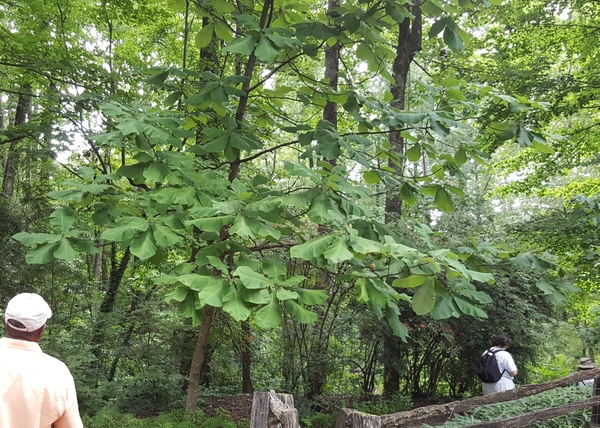
At a glance
- Life cycle
- Woody perennial
- Leaves
- Deciduous
- Bloom
- May to June
- Fruiting season
- July to August
Recorded in 41 Alabama counties.
Natural habitats
Places it grows wild. Not a planting requirement. Each habitat page lists the plants and wildlife also found there.
Forests on moist but not wet ground, such as rich slopes and ravines.
Dense, evergreen groves of live oak, magnolia and other hardwoods in the southern Coastal Plain, from dry oak domes to wet hydric hammocks and south Florida's tropical hammocks; salt-shaped maritime hammocks are maritime forests.
Also found with this plant
Wildlife whose habitat models include habitats this plant grows in, in Alabama. Shared habitat, not food. 106 animals.
- Acadian FlycatcherEmpidonax virescens
- American CrowCorvus brachyrhynchos
- American GoldfinchCarduelis tristis
- American KestrelFalco sparverius
- American RedstartSetophaga ruticilla
- American RobinTurdus migratorius
- American WoodcockScolopax minor
- Bald EagleHaliaeetus leucocephalus
- Baltimore OrioleIcterus galbula
- Barred OwlStrix varia
- Belted KingfisherMegaceryle alcyon
- Black VultureCoragyps atratus
- Black-and-White WarblerMniotilta varia
- Blue GrosbeakPasserina caerulea
- Blue JayCyanocitta cristata
- Blue-gray GnatcatcherPolioptila caerulea
- Broad-winged HawkButeo platypterus
- Brown CreeperCerthia americana
- Brown ThrasherToxostoma rufum
- Carolina ChickadeePoecile carolinensis
- Carolina WrenThryothorus ludovicianus
- Cedar WaxwingBombycilla cedrorum
- Chimney SwiftChaetura pelagica
- Chipping SparrowSpizella passerina
























Who uses this plant?
 25CaterpillarsGenus host records with ranges including AL
Genus host records with ranges including AL · Magnolia
- Callosamia prometheaPromethea Moth
- Papilio glaucusEastern Tiger Swallowtail
- Automeris ioIo Moth
- Callosamia anguliferaTulip-Tree Silkmoth
- Callosamia securiferaSweetbay Silkmoth, Carolina Silk Moth
- Cameraria hamadryadellaSolitary Oak Leafminer Moth
- Epimecis hortariaTulip-Tree Beauty
- Episimus tyriusMaple Tip Borer
- Euzophera ostricolorellaTulip-Tree Borer, Root Collar borer
- Hypercompe scriboniaGiant Leopard Moth, Great Leopard Moth
Show all 25
- Hyphantria cuneaFall Webworm
- Laetilia coccidivoraScale-Feeding Snout
- Melanolophia canadariaCanadian Melanolphia, Variable Redmarked Looper
- Morrisonia latexFluid Arches, Fluid Mamestra
- Orgyia leucostigmaWhite-Marked Tussock Moth
- Papilio palamedesPalamedes Swallowtail
- Papilio polyxenesBlack Swallowtail, Celery Caterpillar, Fennel Worm, Desert Black Swallowtail, Parsnip Swallowtail
- Papilio troilusSpicebush Swallowtail
- Paralobesia cyclopianaSweetbay Seedpod Moth
- Paralobesia liriodendranaTulip-Tree Leaftier
- Phyllocnistis liriodendronellaMagnolia Serpentine Leafminer
- Prolimacodes badiaSkiff Moth, Skiff Caterpillar
- Archips magnoliana
- Paralobesia magnoliana
- Paralobesia parsaura
 7BeesSoutheastern regional records
Southeastern regional records · Magnolia
Individual names are not available yet.
Noori, Seltmann & Orr 2026, A curated and integrated dataset for exploring global bee-plant interactions (GloBI), Zenodo, CC BY 4.0 0Specialist beesPollen specialists
 2BirdsRecorded genus food-resource interactions; not a state feeding claim
Recorded genus food-resource interactions; not a state feeding claim · Magnolia
- Campephilus principalisIvory-billed Woodpecker
- Vireo olivaceusRed-eyed Vireo
Direct food only: birds recorded eating this genus across North America. Caterpillars on host plants also feed nesting birds. NC Native Plant Society: butterfly gardening
No records yet · Ants · Beetles · Flies · Adult butterflies / moths · Other wasps · Other insects
Plant details
- Family
- Magnoliaceae
- Hardiness
- Zones 5a–8b
- Soil pH
- Acidic to neutral
- Flower color
- Cream, purple or white
- Fruit begins
- July
- Fruit ends
- August
Safety has not been reviewed for this plant; check toxicity and thorns before planting.
Growing sources and scope
- Bloom · “May to June” · FloraQuest: Carolinas, Georgia (Southeastern Flora Team), phone app (app page) · Carolinas and Georgia
- Flower color · “Cream, purple or white” · NC Extension Plant Toolbox
- Fruit begins · “July” · FloraQuest: Carolinas, Georgia (Southeastern Flora Team), phone app (app page) (ranked first; NC Extension Plant Toolbox differs) · Carolinas and Georgia
- Fruit ends · “August” · FloraQuest: Carolinas, Georgia (Southeastern Flora Team), phone app (app page) (ranked first; NC Extension Plant Toolbox differs) · Carolinas and Georgia
- Hardiness · “Zones 5a–8b” · NC Extension Plant Toolbox
- Height · “30–40 feet” · NC Extension Plant Toolbox
- Leaves · “Deciduous” · NC Extension Plant Toolbox
- Life cycle · “Woody perennial” · NC Extension Plant Toolbox
- Light · “Full sun (6 or more hours of direct sunlight a day); Partial shade (direct sunlight only part of the day, 2-6 hours)” · NC Extension Plant Toolbox (ranked first; Tennessee Smart Yards differs)
- Soil · “Moist” · NC Extension Plant Toolbox (ranked first; Tennessee Smart Yards differs)
- Soil pH · “Acidic to neutral” · NC Extension Plant Toolbox
- Spread · “30–40 feet” · NC Extension Plant Toolbox
Conservation status
| Alabama rank | SNR |
|---|---|
| Global rank | G4 |
| AL status | Not verified |
| Federal status | Not verified |
Will it fit your yard?
Check this plant against your county, sun and soil moisture. Conditions are checked in your browser.
Sources
- Alabama Plant Atlas
- USDA PLANTS
- Vascular Plants of North Carolina (NC Natural Heritage Program)
- NatureServe Explorer
- Shropshire & Tallamy 2025, Lepidoptera of North America north of Mexico, ZooKeys 1261 (ODbL)
- Noori, Seltmann & Orr 2026, A curated and integrated dataset for exploring global bee-plant interactions (GloBI), Zenodo, CC BY 4.0
- Smith, Bachelder, Russell, Morales, Mosher & Seltmann 2024, Bee-Specialization-Modeling v0.6.1 (specialist host table compiled from J. Fowler's pollen specialist bee lists), Zenodo, CC BY 4.0
- Hurlbert, Olsen, Sawyer & Winner 2021, Avian Diet Database, Scientific Data 8: 260 (CC0)
- Narango, Tallamy & Shropshire 2020, Few keystone plant genera support the majority of Lepidoptera species, Nature Communications