

Toothed Spurge
Euphorbia dentata
Found in bottomland forests, disturbed areas, hedgerows, thickets, railroad cinders. Weakley, Flora of the Southeastern United States (2025), South Central edition What its natural habitat tells you
Not native to Alabama. How scores work Is it native here?
Profile 76%
- Height
- Up to about 2 feet
- Light
- Partial shade, Full sun
- Soil moisture
- Dry to moist
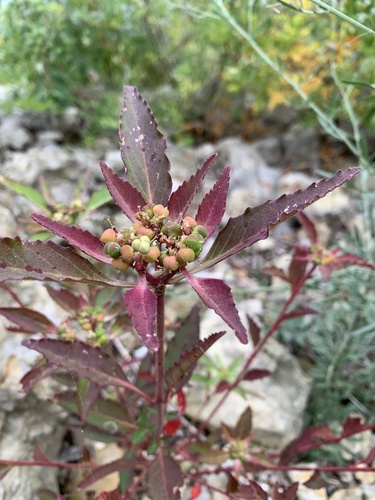
At a glance
- Life cycle
- Annual
- Bloom
- July to October
Not yet recorded · Spread · Leaves
Recorded in 34 Alabama counties.
Natural habitats
Places it grows wild. Not a planting requirement. Each habitat page lists the plants and wildlife also found there.
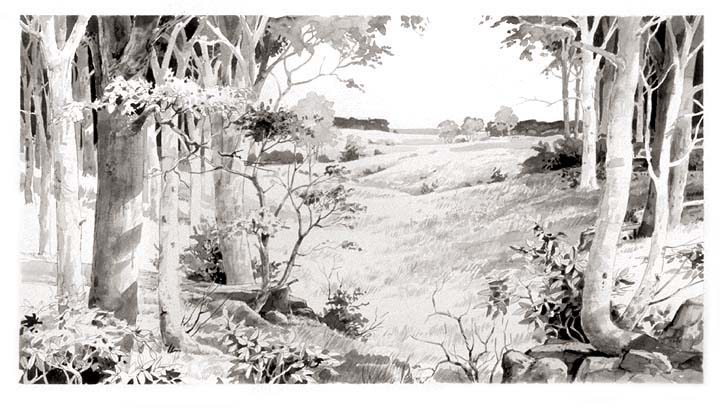
Floodplain and bottomland forests
Forests on low ground beside rivers and streams that flood from time to time.
Roadsides, fields and disturbed ground
Ground opened by people: roadsides, old fields, pastures, fencerows and lots.
Who uses this plant?
 12CaterpillarsGenus host records with ranges including AL
Genus host records with ranges including AL · Euphorbia
- Automeris ioIo Moth
- Episimus argutanaSumac Leaftier
- Erinnyis alopeAlope Sphinx
- Erinnyis obscuraObscure Sphinx
- Eudryas unioPearly Wood-Nymph
- Eutrapela clematariaCurved-Tooth Geometer, Purplish Brown Looper
- Hypercompe scriboniaGiant Leopard Moth, Great Leopard Moth
- Lobocleta plemyrariaStraight-Lined Wave
- Melanochroia chephiseWhite-Tipped Black Moth, Snowbush Spanworm
- Pygarctia abdominalisYellow-Edged Pygarctia
Show all 12
- Sparganothis sulfureanaSparganothis Fruitworm Moth, Sulfur Leafroller, False Yellow-Head
- Ethelgoda texanana
 —BeesSoutheastern regional records
 —Specialist beesPollen specialists
 14BirdsRecorded genus food-resource interactions; not a state feeding claim
Recorded genus food-resource interactions; not a state feeding claim · Euphorbia
- Anthus rubescensAmerican Pipit
- Anthus spragueiiSprague's Pipit
- Calcarius pictusSmith's Longspur
- Callipepla gambeliiGambel's Quail
- Cardinalis cardinalisNorthern Cardinal
- Columbina passerinaCommon Ground Dove
- Corvus brachyrhynchosAmerican Crow
- Cyrtonyx montezumaeMontezuma Quail
- Meleagris gallopavoWild Turkey
- Pooecetes gramineusVesper Sparrow
Show all 14
- Spizella breweriBrewer's Sparrow
- Spizella pusillaField Sparrow
- Tympanuchus pallidicinctusLesser Prairie-Chicken
- Zenaida macrouraMourning Dove
Direct food only: birds recorded eating this genus across North America. Caterpillars on host plants also feed nesting birds. NC Native Plant Society: butterfly gardening
Plant details
- Family
- Euphorbiaceae
- Flower color
- White or green
Safety has not been reviewed for this plant; check toxicity and thorns before planting.
Growing sources and scope
- Bloom · “July to October” · Weakley, Flora of the Southeastern United States (2025), Carolinas & Georgia edition · Carolinas and Georgia
- Flower color · “White or green” · Lady Bird Johnson Wildflower Center
- Height · “Up to about 2 feet” · Lady Bird Johnson Wildflower Center
- Life cycle · “Annual” · Lady Bird Johnson Wildflower Center
- Light · “Partial shade; Full sun (documented habitat)” · Weakley, Flora of the Southeastern United States (2025), Carolinas & Georgia edition · Carolinas and Georgia
- Soil · “Dry; Moist (documented habitat)” · Weakley, Flora of the Southeastern United States (2025), Carolinas & Georgia edition · Carolinas and Georgia
Also known as
Painted Leaf; Wild Poinsettia
Conservation status
| Alabama rank | SNR |
|---|---|
| Global rank | G5 |
| AL status | Not verified |
| Federal status | Not verified |
Native alternatives
Find natives for your gardenSources
- Alabama Plant Atlas
- USDA PLANTS
- Weakley, Flora of the Southeastern United States (2025)
- Shropshire & Tallamy 2025, Lepidoptera of North America north of Mexico, ZooKeys 1261 (ODbL)
- Noori, Seltmann & Orr 2026, A curated and integrated dataset for exploring global bee-plant interactions (GloBI), Zenodo, CC BY 4.0
- Smith, Bachelder, Russell, Morales, Mosher & Seltmann 2024, Bee-Specialization-Modeling v0.6.1 (specialist host table compiled from J. Fowler's pollen specialist bee lists), Zenodo, CC BY 4.0
- Hurlbert, Olsen, Sawyer & Winner 2021, Avian Diet Database, Scientific Data 8: 260 (CC0)
- Narango, Tallamy & Shropshire 2020, Few keystone plant genera support the majority of Lepidoptera species, Nature Communications