

Venus Flytrap
Dionaea muscipula
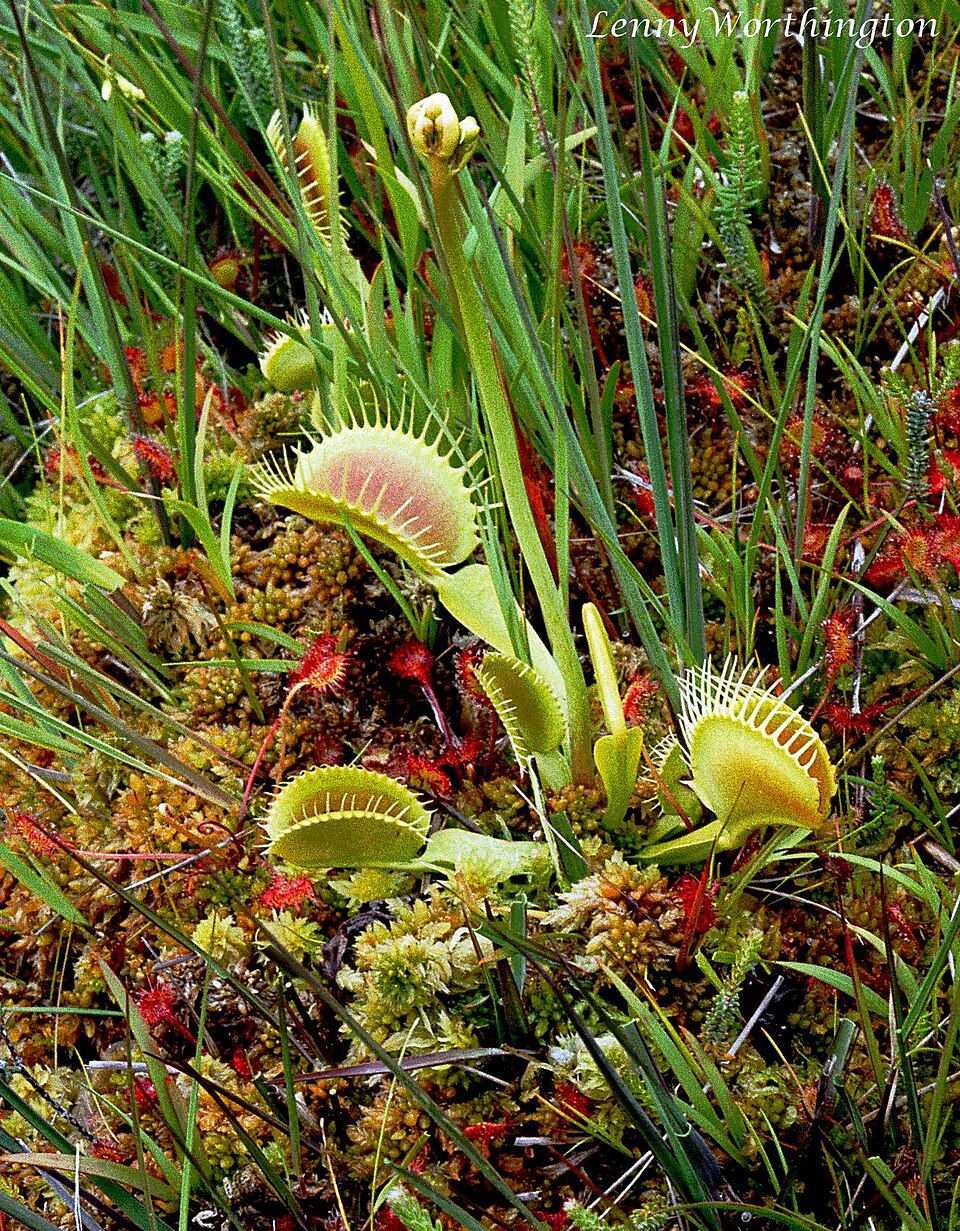
A small carnivorous plant with hinged traps and white flowers held above the foliage. Found in wet pine savannas, sandhill seepages. FloraQuest, phone app (app page) What its natural habitat tells you
Not native to Alabama. How scores work Is it native here?
Profile 82%
- Height
- 6–12 inches including flower stalks
- Spread
- 6–8 inches
- Light
- Full sun, Partial shade
- Soil moisture
- Moist to standing water
Plant this instead
Choose your county to list local plants first.

No recorded swaps for this county. Try the garden finder.
At a glance
- Life cycle
- Herbaceous perennial
- Leaves
- Deciduous
- Bloom
- May to June
- Fruiting season
- June to July
Recorded in 1 Alabama county.
Natural habitats
Places it grows wild. Not a planting requirement. Each habitat page lists the plants and wildlife also found there.
Open, fire-kept longleaf pine stands over grasses and wildflowers on wet to moist sandy soil.
Dry, deep-sand ridges with longleaf pine and turkey oak, kept open by fire.
Places where groundwater keeps the soil or rock wet, such as seepage slopes and spring runs.
Who uses this plant?
 —CaterpillarsGenus host records with ranges including AL
 —BeesSoutheastern regional records
 —Specialist beesPollen specialists
 —BirdsRecorded genus food-resource interactions; not a state feeding claim
No records yet · Ants · Beetles · Flies · Adult butterflies / moths · Other wasps · Other insects
Plant details
- Family
- Droseraceae
- Hardiness
- Zones 7–10; colder sites need winter protection
- Soil pH
- Acidic
- Flower color
- White
- Fruit begins
- June
- Fruit ends
- July
Safety has not been reviewed for this plant; check toxicity and thorns before planting.
Use rainwater or distilled water. Keep moist, do not fertilize, and choose nursery-propagated plants. NC State Extension
Growing sources and scope
- Bloom · “May to June” · FloraQuest: Carolinas, Georgia (Southeastern Flora Team), phone app (app page) · Carolinas and Georgia
- Flower color · “White” · NC Extension Plant Toolbox
- Fruit begins · “June” · FloraQuest: Carolinas, Georgia (Southeastern Flora Team), phone app (app page) · Carolinas and Georgia
- Fruit ends · “July” · FloraQuest: Carolinas, Georgia (Southeastern Flora Team), phone app (app page) · Carolinas and Georgia
- Hardiness · “Zones 6a–10b” · NC Extension Plant Toolbox
- Height · “6 inches–1 foot” · NC Extension Plant Toolbox
- Leaves · “Deciduous” · NC Extension Plant Toolbox
- Life cycle · “Perennial” · NC Extension Plant Toolbox
- Light · “Full sun (6 or more hours of direct sunlight a day); Partial shade (direct sunlight only part of the day, 2-6 hours)” · NC Extension Plant Toolbox
- primary_flower_color · “white” · NC Extension Plant Toolbox
- Soil · “Frequent standing water; Moist; Occasionally wet” · NC Extension Plant Toolbox
- Soil pH · “Acidic” · NC Extension Plant Toolbox
- Spread · “6–8 inches” · NC Extension Plant Toolbox
Recognizing it
A low rosette carries paired trap lobes edged with bristles. Flowers sit on leafless stalks. Identification source
Conservation status
| Alabama rank | Not available |
|---|---|
| Global rank | G2G3 |
| AL status | Not verified |
| Federal status | Not verified |
Sources
- Alabama Plant Atlas
- USDA PLANTS
- Vascular Plants of North Carolina (NC Natural Heritage Program)
- Shropshire & Tallamy 2025, Lepidoptera of North America north of Mexico, ZooKeys 1261 (ODbL)
- Noori, Seltmann & Orr 2026, A curated and integrated dataset for exploring global bee-plant interactions (GloBI), Zenodo, CC BY 4.0
- Smith, Bachelder, Russell, Morales, Mosher & Seltmann 2024, Bee-Specialization-Modeling v0.6.1 (specialist host table compiled from J. Fowler's pollen specialist bee lists), Zenodo, CC BY 4.0
- Hurlbert, Olsen, Sawyer & Winner 2021, Avian Diet Database, Scientific Data 8: 260 (CC0)
- Narango, Tallamy & Shropshire 2020, Few keystone plant genera support the majority of Lepidoptera species, Nature Communications
- NC State Extension