

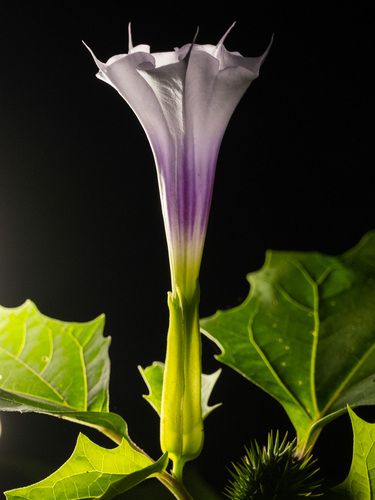
Jimsonweed
Datura stramonium
Found in roadsides, fields and disturbed ground. Weakley, Flora of the Southeastern United States (2025), South Central edition What its natural habitat tells you
Not native to Alabama. Not suggested for planting. How scores work Is it native here?
Profile 82%
- Height
- 1–4 feet
- Spread
- 1–4 feet
- Light
- Full sun, Partial shade
- Soil moisture
- Usually moist
Highly poisonous. Serious poisoning risk if eaten. Excluded from default planting suggestions; keep away from children and pets. Plant caution source
Hidden from default planting suggestions. Wildlife value and native status remain unchanged.
At a glance
- Life cycle
- Annual
- Bloom
- July to September
- Fruiting season
- August to October
Not yet recorded · Leaves
Recorded in 47 Alabama counties.
Natural habitats
Places it grows wild. Not a planting requirement. Each habitat page lists the plants and wildlife also found there.
Roadsides, fields and disturbed ground
Ground opened by people: roadsides, old fields, pastures, fencerows and lots.
Who uses this plant?
 9CaterpillarsGenus host records with ranges including AL
Genus host records with ranges including AL · Datura
- Agrius cingulataPink-Spotted Hawkmoth, Sweet Potatoe Caterpillar
- Chloridea virescensTobacco Budworm Moth
- Emmelina monodactylaMorning-Glory Plume Moth
- Helicoverpa zeaCorn Earworm Moth
- Manduca quinquemaculatusFive-Spotted Hawkmoth, Tomato Hornworm
- Manduca sextaCarolina Sphinx, Tomatoe Sphinx, Tobacco Hornworm
- Platynota rostranaOmnivorous Platynota
- Spodoptera dolichosSweetpotato Armyworm, Dolichos Armyworm, Large Cotton Armyworm
- Spodoptera ornithogalliYellow-Striped Armyworm Moth, Cotton Cutworm
 —BeesSoutheastern regional records
 —Specialist beesPollen specialists
 1BirdsRecorded genus food-resource interactions; not a state feeding claim
Recorded genus food-resource interactions; not a state feeding claim · Datura
- Agelaius phoeniceusRed-winged Blackbird
Direct food only: birds recorded eating this genus across North America. Caterpillars on host plants also feed nesting birds. NC Native Plant Society: butterfly gardening
Plant details
- Family
- Solanaceae
- Hardiness
- Zones 7a–9b
- Soil pH
- Acidic to alkaline
- Flower color
- Purple or white
- Fruit begins
- August
- Fruit ends
- October
Growing sources and scope
- Bloom · “July to September” · Weakley, Flora of the Southeastern United States (2025), Carolinas & Georgia edition · Carolinas and Georgia
- Flower color · “Purple or white” · NC Extension Plant Toolbox
- Fruit begins · “August” · Weakley, Flora of the Southeastern United States (2025), Carolinas & Georgia edition · Carolinas and Georgia
- Fruit ends · “October” · Weakley, Flora of the Southeastern United States (2025), Carolinas & Georgia edition · Carolinas and Georgia
- Hardiness · “Zones 7a–9b” · NC Extension Plant Toolbox
- Height · “1–4 feet” · NC Extension Plant Toolbox
- Life cycle · “Annual” · NC Extension Plant Toolbox
- Light · “Full sun (6 or more hours of direct sunlight a day); Partial shade (direct sunlight only part of the day, 2-6 hours)” · NC Extension Plant Toolbox
- Soil · “Moist” · NC Extension Plant Toolbox
- Soil pH · “Acidic to alkaline” · NC Extension Plant Toolbox
- Spread · “1–4 feet” · NC Extension Plant Toolbox
Conservation status
| Alabama rank | SNA |
|---|---|
| Global rank | GU |
| AL status | Not verified |
| Federal status | Not verified |
Native alternatives
Find natives for your gardenSources
- Alabama Plant Atlas
- USDA PLANTS
- Weakley, Flora of the Southeastern United States (2025)
- NatureServe Explorer
- Shropshire & Tallamy 2025, Lepidoptera of North America north of Mexico, ZooKeys 1261 (ODbL)
- Noori, Seltmann & Orr 2026, A curated and integrated dataset for exploring global bee-plant interactions (GloBI), Zenodo, CC BY 4.0
- Smith, Bachelder, Russell, Morales, Mosher & Seltmann 2024, Bee-Specialization-Modeling v0.6.1 (specialist host table compiled from J. Fowler's pollen specialist bee lists), Zenodo, CC BY 4.0
- Hurlbert, Olsen, Sawyer & Winner 2021, Avian Diet Database, Scientific Data 8: 260 (CC0)
- Narango, Tallamy & Shropshire 2020, Few keystone plant genera support the majority of Lepidoptera species, Nature Communications